
目次13項目開く
- 1.Quick Facts
- 2.What The Character Is About
- 3.What The Crucible Is About
- 4.Comparison 1: Ordinary Spaces That Become Total Systems
- 5.Comparison 2: Accusation and the Power of Naming
- 6.Comparison 3: Myth Versus History
- 7.Comparison 4: The Group and the Individual
- 8.Comparison 5: Realism, Surrealism, and Audience Responsibility
- 9.Production Notes for International Theater-Makers
- 10.Which Play Should You Read First?
- 11.Frequently Asked Questions
- 12.Final Takeaway
- 13.Research Sources
Hideki Noda’s The Character and Arthur Miller’s The Crucible are plays about communities that turn belief into violence: one begins in a neighborhood calligraphy school and Greek myth, while the other begins in colonial Salem and the fear of witchcraft.
The two plays are not adaptations of one another, and they do not offer the same kind of realism. The Crucible (1953) uses the Salem witch trials as a historical and political lens on McCarthyism. The Character (Za Kyラクター, ザ・キャラクター), first produced by NODA・MAP in 2010, uses a small calligraphy school, mythic transformation, and theatrical excess to examine how ordinary people can surrender judgment to a charismatic system.
For readers discovering Japanese drama in English, this pairing is useful because it avoids a shallow “East versus West” comparison. Both plays ask how a group creates a reality that its members are afraid to challenge. They differ in how they make that process visible: Miller builds a pressure-cooker courtroom and village; Noda lets language, bodies, myth, and theatrical form mutate in front of the audience.
Quick Facts
| Item | The Character (ザ・キャラクター) | The Crucible |
|---|---|---|
| Playwright | Hideki Noda (野田秀樹) | Arthur Miller |
| First production | NODA・MAP, 2010 | Broadway, 1953 |
| Dramatic world | A neighborhood calligraphy school that opens into Greek myth | Salem, Massachusetts, during the 1692 witch trials |
| Central mechanism | Transformation, indoctrination, symbolic language, ritual | Accusation, confession, testimony, legal and religious authority |
| Main question | How does a seemingly ordinary community become a mythic machine? | What happens when fear becomes public proof? |
| Form | Surreal, physically dynamic, language-driven contemporary theater | Historical tragedy with political allegory |
| Best comparison axis | Belief becoming performance | Performance becoming evidence |
| English-speaking entry point | Read alongside Noda’s The Bee or Red Demon | Read alongside Miller’s Death of a Salesman |
What The Character Is About
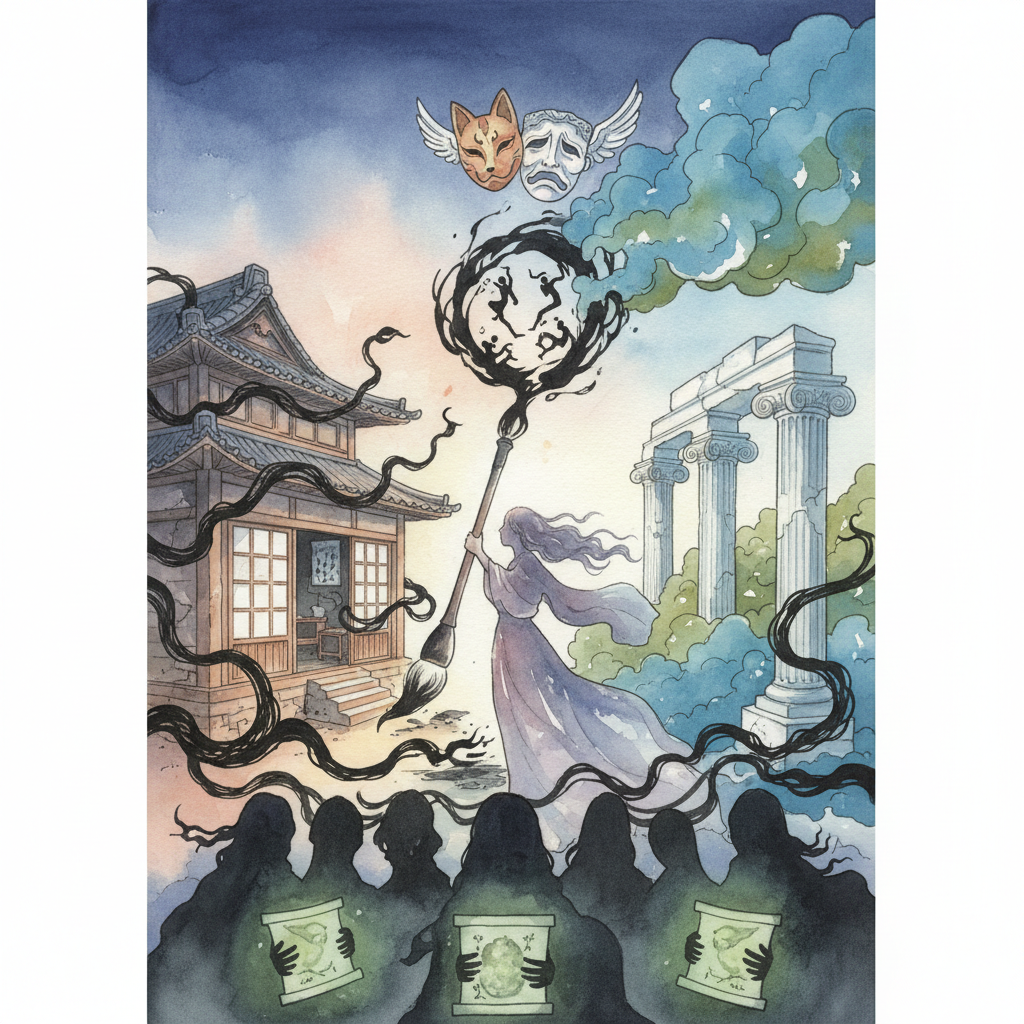
NODA・MAP’s official description begins with an intentionally ordinary image: a small calligraphy school in a town. From that everyday location, the play opens into the world of Greek mythology. The official production note describes transformation, or metamorphosis, as the play’s organizing idea: people and beliefs change shape until a familiar story appears in a new form.[1]
The Japanese title, Za Kyarakutā, can be translated as “The Character,” but the word also carries the sense of a role, a persona, or a recognizable type. That ambiguity matters. The play is interested not only in who people are, but in how they become characters inside a story that someone else seems to control.
The catalog description in the Japanese Play Library places the action in a calligraphy classroom whose strange practices gradually reveal a darker reality. A person who enters the school with a private purpose is drawn into a Greek-mythic world, while the apparent teachers and staff reveal the logic of the organization around them. The play’s movement is therefore double: a realistic social space becomes a mythic stage, and myth becomes a way of naming contemporary violence.
Noda is known for combining rapid verbal play, physical performance, cultural references, and abrupt shifts in theatrical scale. The official NODA MAP English profile lists The Character alongside works such as Kill, Pandora no kane, Akaoni (Red Demon), The Bee, and The Diver.[2] That context helps international readers understand why The Character should not be staged as a conventional psychological thriller. Its characters may have recognizable motives, but the production is also a machine for changing the audience’s perception of what kind of story it is watching.
A classroom can become a temple. A lesson can become a command. A name can become a role. A role can become an identity. When those changes happen quickly enough, resistance becomes difficult because the person resisting is no longer sure which world they are in.
What The Crucible Is About
Arthur Miller’s The Crucible dramatizes the Salem witch trials of 1692, but its historical setting is also a deliberate response to the political climate of the 1950s. PBS’s American Masters explains that Miller researched Salem after seeing the effects of McCarthyism and the House Un-American Activities Committee; the play uses the witch trials as an allegory for the oppressive tactics of the anti-Communist investigations.[3]
The play begins with accusations that appear to be personal and local. Young women are suspected of forbidden behavior. Adults fear scandal. Religious authority interprets uncertainty as sin. Once accusations begin to produce social power, the original facts become less important than the consequences of denying the official story.
Miller’s central innovation is to make moral compromise public. Characters do not merely fear punishment; they fear being seen as disloyal, impure, or politically dangerous. A confession can save one person while condemning another. Silence can look like guilt. A name can become evidence even when the person named has no opportunity to answer.
This is why The Crucible remains a practical play for theater-makers rather than only a historical text. Its structure shows how institutions manufacture certainty. The court does not simply discover truth. It creates a system in which the court’s demand for agreement becomes proof that the court is right.
Comparison 1: Ordinary Spaces That Become Total Systems
Both plays begin in spaces that appear manageable.
In The Character, the setting is a small calligraphy school. It is local, familiar, and apparently educational. People enter because they want instruction, community, or access to something they cannot find elsewhere. The danger comes from the gap between the room’s ordinary appearance and the system operating inside it.
In The Crucible, the setting is a village and its court. The audience recognizes the basic social units: home, church, farm, courtroom, reputation. Yet each familiar space is connected to an expanding authority. A private suspicion can become a public charge; a charge can become an arrest; an arrest can become a demand for more names.
The difference is theatrical. Miller expands outward from the individual household into the court and the community. Noda folds the outside world inward. The classroom already contains a mythic universe, and the audience watches that universe disclose itself.
For a director, the comparison suggests two staging strategies:
- Stage The Crucible through accumulation. Let each new accusation add weight to the room.
- Stage The Character through conversion. Let objects, gestures, words, and spatial rules change meaning in front of the audience.
The two plays can look very different while producing a similar audience experience: the realization that an apparently normal environment has become difficult to leave.
Comparison 2: Accusation and the Power of Naming
Both plays understand that naming is never neutral.
In The Crucible, naming someone as a witch is an accusation with legal and physical consequences. The named person is moved from neighbor to suspect, from suspect to prisoner, and potentially from prisoner to condemned body. The accusation reorganizes the community around a new category of person.
In The Character, naming is connected to the idea of the character itself. A person can be absorbed into a role, a myth, or an institutional script. The question is not only “Who did this?” but “What kind of person are you now being told to become?”
This creates a useful distinction. Miller’s characters are trapped by names imposed through testimony. Noda’s characters are trapped by names that become identities through performance and repetition.
The result is not simply that one play is realistic and the other surreal. Miller shows a social group converting speech into legal evidence. Noda shows a social group converting speech into a world. In both cases, language stops describing reality and begins producing it.
That is particularly important when translating or performing Noda in English. A translator should not treat every unusual phrase as decorative wordplay. Some language may function as an action, a transformation, or a change in status. The line is not merely something a character says; it may be the mechanism that moves the character into a new theatrical reality.
Comparison 3: Myth Versus History
The most obvious contrast is that The Crucible is anchored in a documented historical event, while The Character draws on Greek mythology and theatrical transformation.
But the difference should not be mistaken for a difference between truth and fantasy. Miller uses history to reveal a modern political pattern. Noda uses myth to reveal a contemporary social pattern. Both playwrights choose a frame that gives local behavior a larger meaning.
Miller’s Salem is specific: the play names a place, a religious culture, a judicial process, and a historical crisis. That specificity gives the allegory pressure. The audience can see how real institutions, not abstract evil, make catastrophe possible.
Noda’s Greek-mythic framework performs a different operation. Myth strips ordinary behavior of its reassuring surface. A teacher, student, lesson, or rule can suddenly be seen as part of an ancient pattern of sacrifice, authority, inheritance, and transformation. The mythic frame does not make the violence less real. It makes its structure easier to recognize.
The comparison is valuable for international audiences because it shows two ways to make a local play travel:
- Historical portability: place a specific event under a spotlight and show how its moral mechanism repeats elsewhere.
- Mythic portability: use a recognizable story pattern to make a contemporary social system legible across cultures.
Miller asks the audience to remember that history can return. Noda asks the audience to notice that myth may already be operating inside the present.
Comparison 4: The Group and the Individual
Neither play is satisfied with a simple hero-versus-villain structure.
In The Crucible, John Proctor is often treated as the central moral figure, but the play’s social force depends on the entire community. Proctor’s choices matter because the court, the accusers, the ministers, the neighbors, and the families create the pressure around him. His resistance is meaningful precisely because the system has made private conscience publicly dangerous.
In The Character, the individual is also unstable. A person may enter the space believing they have a private mission, but the play keeps asking whether a private self can remain separate from the roles available inside the group. Noda’s characters do not simply join an organization; they are changed by the organization’s language and theatrical logic.
This is where the two plays differ from a conventional conspiracy story. In a conspiracy story, the audience usually knows that the hidden group is false and waits for the protagonist to discover the truth. In these plays, the audience watches belief become attractive. The system offers explanation, belonging, and a role to play. Its danger comes partly from the fact that it answers needs that ordinary life leaves unresolved.
For actors, this means that the group should not be played as uniformly foolish. If every follower is obviously stupid or malicious, the production protects the audience from the play’s most difficult question: under what conditions might I also want the certainty this group offers?
Comparison 5: Realism, Surrealism, and Audience Responsibility
Miller’s realism directs attention toward testimony, interruption, legal procedure, and moral decision. Noda’s theatricality directs attention toward rhythm, image, bodily change, and the instability of categories.
Yet both forms make the audience responsible for interpretation.
In The Crucible, the audience may recognize the pattern before every character does. That knowledge produces frustration. Why do they not stop? Why do they not see the obvious lie? The answer is that social systems do not feel obvious from inside them. People see consequences, threats, and reputations before they see the whole structure.
In The Character, the audience may understand that the world is changing before it can explain exactly how. That uncertainty is not a problem to solve too quickly. It is part of the production’s method. If the audience is always given a stable interpretive key, the play’s transformation loses force.
A strong production of The Crucible should resist turning history into a museum display. A strong production of The Character should resist turning surrealism into random visual noise. Both require a clear social logic beneath the theatrical surface.
Production Notes for International Theater-Makers
If you are staging The Crucible
Keep the social geography precise. Who can hear whom? Who has access to the court? Who can interrupt? Who is believed before speaking? The play’s power depends on the audience seeing that authority is distributed unevenly.
Do not make the court frightening only through shouting. Bureaucratic calm can be more dangerous than visible rage. A measured request for a name, a pause before signing a confession, or a polite insistence that the process must continue can reveal institutional violence more clearly than melodrama.
The historical setting should remain visible even when the production speaks to a contemporary audience. The goal is not to replace Salem with a generic modern institution. It is to let the historical structure remain specific enough that the contemporary parallel becomes an act of interpretation rather than an imposed slogan.
If you are staging The Character
Begin with the ordinary. The calligraphy school should feel usable, not merely symbolic. Desks, tools, paper, and the discipline of writing can establish a world with rules before those rules begin to mutate.
Treat transformation as a change in behavior, not only a change in lighting or projection. The audience should feel that a gesture has acquired a new meaning, that a phrase has become a command, or that a familiar body has entered a different role.
Language needs physical partners. If a passage is fast, the rhythm should affect bodies and space. If a phrase returns, its repetition should not be identical; the audience should hear the status change. Noda’s theatricality works when the production gives each formal shift a consequence.
Above all, do not explain the Greek-mythic layer before it has had time to operate. Let the audience experience the movement from social realism to myth. The shock of recognition is more valuable than a paragraph of advance information.
Which Play Should You Read First?
Read The Crucible first if you want a clear historical frame, a tightly escalating public conflict, and a direct study of accusation, reputation, and political fear.
Read The Character first if you want to understand how contemporary Japanese theater can combine social critique with myth, verbal speed, physical transformation, and unstable theatrical form.
If you are building a comparative reading list, add The Character in the Japanese Play Library catalog, then place it beside Nokemono Kitarite (The Beast Descends) and The Fake: Beneath the Cherry Trees in Full Bloom. These works show different phases of Hideki Noda’s interest in myth, collective behavior, and the pressure of theatrical language.
For wider context, read our Hideki Noda playwright profile and guide to Japanese plays for readers who like The Crucible. The first explains Noda’s international career and small-theater background; the second places Miller’s political tragedy in a larger reading path.
Frequently Asked Questions
Is The Character an adaptation of The Crucible?
No. They are independent plays. The comparison is thematic and structural: both dramatize communities that turn belief, accusation, and authority into systems of control.
What is the main difference between the two plays?
The Crucible uses historical realism and courtroom pressure to examine McCarthy-era political fear through the Salem witch trials. The Character uses a calligraphy school, Greek mythology, and theatrical transformation to show how ordinary social structures can become mythic and coercive.
Why compare a Japanese play with an American play?
The pairing makes translation visible. It shows that similar political questions can be staged through different dramatic languages: testimony and legal realism in Miller, metamorphosis and theatrical instability in Noda.
Is The Character suitable for an English-language production?
It can be, but it requires more than literal translation. Directors and actors need to preserve rhythm, repetition, physical transformation, and the shifts in status carried by language. The production should treat the text as an active theatrical system, not only as dialogue on a page.
What should I read after these two plays?
Try Noda’s The Bee or Red Demon, then return to Miller’s Death of a Salesman. The first group expands Noda’s international and mythic range; the second shows how Miller repeatedly turns private conflict into a study of social morality.
Final Takeaway
The Crucible shows a community turning fear into evidence. The Character shows a community turning ordinary life into a mythic role-play. One tightens the screws of history; the other changes the shape of the room.
Read together, they offer a practical lesson for theater-makers: collective violence rarely begins with people announcing that they want to become cruel. It begins when a group makes one interpretation feel safer than uncertainty, when language becomes a test of loyalty, and when playing a role gradually replaces making a judgment.
That is why these plays belong in the same conversation in 2026. They do not tell us that Japan and the United States have the same theatrical tradition. They show us that different theatrical traditions can make the same human danger newly visible.
Research Sources
- NODA・MAP: The Character production information — official synopsis and 2010 production context.
- NODA・MAP English profile — Hideki Noda’s career, international work, and The Character in his repertoire.
- PBS American Masters: Why Arthur Miller Wrote The Crucible — McCarthyism, Salem research, and the play’s political allegory.
- PBS American Masters: Why Arthur Miller Matters — Miller’s social-moral drama and the historical position of The Crucible.
この記事で紹介した戯曲
戯曲図書館 編集部・公開日 2026/10/25
演劇経験者が運営する戯曲検索サービスの編集チームです。脚本選びのノウハウ、演劇の最新情報、公演レポートなどを書いています。
関連記事
- Shintoku-maru vs Oedipus Rex: A 2026 Guide to Fate, Family, and the Body on StageCompare Shuji Terayama's Shintoku-maru (身毒丸) and Sophocles' Oedipus Rex as plays about prophecy, incest, mother-figures, and the suffering body — with staging notes for English-speaking theater-makers.2026/10/04
- Five Days in March vs Angels in America: A 2026 Guide to Political Theater, Sex, and the End of the WorldCompare Toshiki Okada's Five Days in March and Tony Kushner's Angels in America as generational political plays about apocalypse, apathy, and intimacy under history.2026/09/27
- Tomodachi vs No Exit: A 2026 Guide to Friendly Invasion, Hellish Rooms, and the Violence of Other PeopleCompare Tomodachi and No Exit through confinement, coercion, group pressure, and the politics of being trapped with others.2026/08/30
- If You Like The Crucible (2026 Guide): 4 Japanese Plays About Scapegoats, Panic, and Public ObedienceLove The Crucible? Read 4 Japanese plays about fear, scapegoats, conformity, and the cost of refusing the crowd.2026/08/21