Kobo Abe's Tomodachi (Friends, 友達) and Jean-Paul Sartre's No Exit are plays about what happens when other people become a closed system you cannot step outside.
That is the clearest way to connect them for English-speaking theater-makers in 2026.
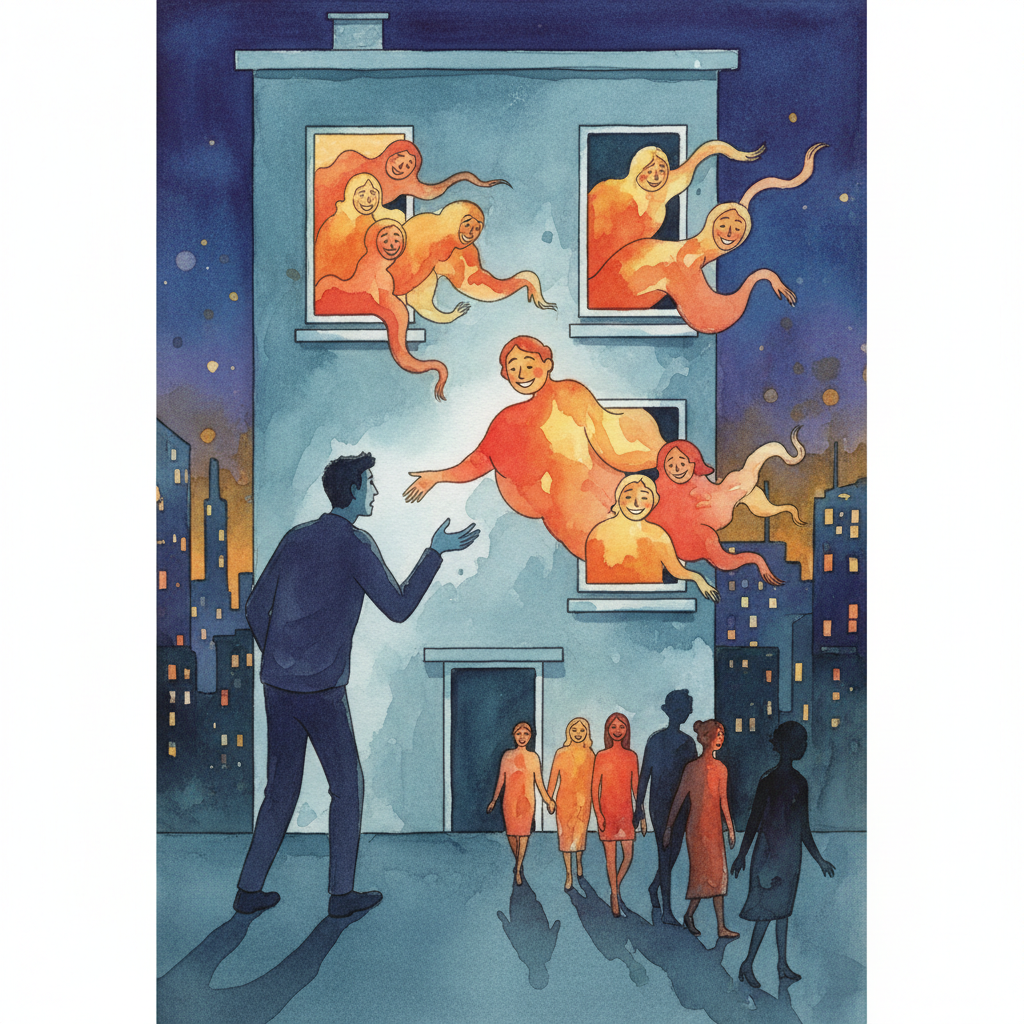
At first glance, the pairing may seem uneven. No Exit is a globally canonical existential chamber play about three dead strangers locked in Hell. Tomodachi is a Japanese absurdist dark comedy in which a smiling family enters one man's apartment and gradually turns friendship into occupation. One sounds philosophical. The other sounds social. One begins after death. The other begins inside ordinary life.
But both plays are ruthless about the same practical theatrical question: what does confinement reveal when the real prison is made of other people rather than walls alone?
For readers who already know Sartre, Abe becomes easier to place. For readers who start from Abe, No Exit looks less like a slogan-delivery classic and more like a highly efficient machine for exposing how identity breaks down under inescapable scrutiny.
Quick Facts
| Item | Tomodachi (Friends, 友達) | No Exit |
|---|---|---|
| Playwright | Kobo Abe (安部公房, Abe Kobo) | Jean-Paul Sartre |
| Premiere / publication frame | Major stage version associated with 1967; revised edition later published by Shinchosha | First performed in Paris in May 1944 |
| Core setting | A bachelor's apartment invaded by a family of nine | A Second Empire drawing room in Hell |
| Typical cast profile | 15 performers in Japanese Play Library metadata | 4 roles in Concord listing |
| Typical runtime | About 130 minutes in Japanese Play Library metadata | About 75 minutes in Concord listing |
| Main dramatic engine | Invasive kindness becoming social coercion | Mutual exposure becoming eternal torment |
| Core fear | Losing autonomy inside a crowd that claims to help | Losing secrecy inside a room with no exit |
| Best production fit | Ensemble companies, universities, actor-centered absurdism | Chamber productions, philosophy-theater crossover, black box classics |
| Why pair them? | Shows how social warmth becomes violence | Shows how psychological exposure becomes punishment |
Internal reading list:
Related English reading:
Why This Pairing Matters in 2026
English-language theater conversations often split "existential" and "social" drama too neatly.
- Existential plays are treated as abstract philosophy.
- Social plays are treated as realistic diagnosis.
This pairing breaks that lazy division.
No Exit is deeply social. Its hell is not a metaphysical fog but a relationship structure. Tomodachi is deeply existential. Its apartment invasion is terrifying not only because property or privacy is violated, but because the protagonist's very right to define himself begins to collapse.
That makes the pair especially useful in 2026, when many companies, teachers, and directors are asking how to stage:
- coercion that hides inside everyday language,
- the loss of privacy under constant social exposure,
- the pressure to become legible to others on their terms,
- and the feeling that there may be no clean border between care and control.
Sartre and Abe arrive there by different routes, but they are both writing about human beings who can no longer secure a private interior life.
1) The Room Is Not the Real Prison
The obvious comparison is spatial. Both plays happen in enclosed spaces. But the deeper comparison is that enclosure is never merely architectural.
In No Exit, the room is infamous because there is no exit, no mirror, no sleep, and no escape from mutual perception. Yet the real punishment is not the furniture or the locked door. The punishment is that Garcin, Inez, and Estelle cannot stop being interpreted by one another.
In Tomodachi, the apartment initially looks like normal private space. It is a room one person owns, understands, and should be able to defend. But Abe rapidly reveals that private space means very little if a group can redefine your refusal as illness, selfishness, or proof of loneliness. The room stops being yours before the walls physically change.
This is the key bridge:
In Sartre
The room traps people who can no longer hide.
In Abe
The room traps a person who can no longer make others accept his version of reality.
That difference matters in rehearsal.
In No Exit, actors must treat space as exposure. Every look, pause, seat choice, and verbal attack sharpens the room's impossible intimacy.
In Tomodachi, actors must treat space as occupation. The terror grows through accumulation: one body too many, one object touched too casually, one practical suggestion too confidently offered, one refusal too lightly dismissed.
2) Other People as Torture, Other People as "Rescue"
Sartre's most famous idea from No Exit is often reduced to a quote, but the play's actual mechanism is more specific. The characters torture one another because each needs recognition on terms the others will not grant. Garcin wants to be seen as brave. Estelle wants to be desired and absolved. Inez wants lucidity and domination. Nobody gets the form of confirmation they want.
In Tomodachi, the family uses a different weapon. They do not arrive as declared enemies. They arrive as social medicine. They identify the solitary man as lonely and therefore in need of intervention. Their presence becomes harder to resist because it is wrapped in the rhetoric of care.
That makes Abe's play feel eerily current. Many forms of contemporary control do not present themselves as punishment. They present themselves as support, optimization, community, protection, or wellbeing.
Comparison Table: How "other people" function
| Question | Tomodachi | No Exit |
|---|---|---|
| How does the trap begin? | With smiling intrusion and claims of friendship | With posthumous confinement in a sealed room |
| What do the others want? | Access, control, expansion, moral authority | Recognition, exposure, power, validation |
| How is violence delivered? | Through help, numbers, and social normalcy | Through relentless psychological scrutiny |
| What makes resistance hard? | Refusal sounds antisocial or unreasonable | There is literally nowhere to go |
| Main emotional flavor | Darkly comic social suffocation | Bitter, lucid interpersonal torment |
This is why the pairing works beyond surface absurdism. Both plays insist that other people become most dangerous when they acquire interpretive control over your situation.
3) The Crowd vs the Triangle
One of the most productive contrasts between the plays is cast geometry.
No Exit is built like a triangle. Three central figures produce constantly shifting pressure lines. Alliances form and collapse. Desire, disgust, dependence, and cruelty circulate with mathematical efficiency. The economy is tight. Every turn matters immediately.
Tomodachi is built like a swarm. The family of nine does not function only as nine separate psychologies. It operates as a social organism. Its force comes from multiplication, repetition, and collective confidence. The surrounding figures who should help, such as the manager, police, fiancee, and lawyer, widen the sense that individual testimony is losing value.
That means the two plays teach different kinds of acting intelligence.
In No Exit
Actors must handle concentrated psychological warfare.
In Tomodachi
Actors must handle choreographed social pressure.
For companies, this distinction is practical.
| Acting axis | Tomodachi | No Exit |
|---|---|---|
| Ensemble logic | Crowd rhythm and occupation | Chamber precision and relational shifts |
| Main challenge | Making the group feel plausibly normal and terrifying | Sustaining mutual exposure without monotony |
| Best training value | Spatial pressure, collective timing, tonal escalation | Subtext, status play, verbal precision |
| Risk in production | Turning the family into obvious caricature too early | Turning the play into static philosophy recital |
| Best venue type | Flexible black box or university stage | Intimate studio or chamber room |
If you teach acting, dramaturgy, or directing, this pairing is gold because it shows two different dramaturgies of entrapment:
- entrapment by many,
- and entrapment by few.
4) Privacy, Shame, and the Collapse of Self-Definition
Both plays are obsessed with a specifically modern fear: that your inner account of yourself may not survive contact with others.
In No Exit, shame is unavoidable because the characters' bad faith gets stripped bare. They keep trying to narrate themselves into innocence, glamour, or moral clarity, and the room keeps ruining the performance. The torment is not only guilt. It is failed self-authorship.
In Tomodachi, the protagonist's crisis is different but related. He knows the family does not belong in his room. He knows their language is manipulative. But the more they speak, and the more institutions side with them, the less socially valid his own interpretation becomes. He is not merely overpowered. He is outnarrated.
This is where Abe and Sartre meet most sharply.
- Sartre asks what happens when others see through your performance.
- Abe asks what happens when others overwrite your reality with a friendlier script.
Both are forms of self-loss.
For 2026 audiences, that bridge is especially legible. Public and semi-public life now constantly pressures people to explain themselves in formats that other people, systems, platforms, or institutions will accept. Both plays diagnose what it feels like when that process becomes total.
5) Comedy Is Not Relief in Either Play
People often remember No Exit as severe and Tomodachi as absurdly funny. That contrast is true, but incomplete.
No Exit has wit, pettiness, theatrical cruelty, and the ugly comedy of people trapped in their own patterns. Its sharpness comes partly from how recognizable the social maneuvers are. Vanity is funny until it becomes unbearable.
Tomodachi is funnier on the surface, but the comedy is acid. The family can look ridiculous, overfamiliar, and even playful. Yet every laugh pushes the protagonist further toward erasure. The audience laughs because the invasion is socially legible. Then the laughter curdles because social legibility is exactly what makes the invasion succeed.
This gives both plays unusual staying power.
In No Exit
Comedy exposes the vanity of self-justification.
In Tomodachi
Comedy exposes the violence of ordinary helpfulness.
A production mistake in both cases is tonal simplification.
- If No Exit is staged as pure solemn philosophy, it becomes heavy and predictable.
- If Tomodachi is staged as mere absurd farce, it loses its moral terror.
Both need actors who understand that laughter and humiliation can occupy the same beat.
6) Philosophy vs Social Diagnosis, or Why the Difference Matters
It would be easy to say the two plays are "really the same" because both are about being trapped with others. That would be too vague to help anyone.
Sartre is building a moral-philosophical chamber. The characters are dead already. Their condition is terminal. The question is not how to escape institutional capture in practical life, but what human consciousness becomes when it cannot stop confronting the gaze of others.
Abe is building a social-political nightmare out of ordinary conditions. The protagonist is alive. The room is recognizably domestic. The institutions around him are supposedly functional. The terror is that the logic of coercion can still win because it sounds normal.
That distinction makes the plays complementary rather than redundant.
| Deeper axis | Tomodachi | No Exit |
|---|---|---|
| Condition of characters | Living, socially embedded | Dead, metaphysically trapped |
| Main world logic | Social systems normalize coercion | Hell is interpersonal consciousness without escape |
| Key keyword | Occupation | Exposure |
| Central fear | Consent becoming meaningless | Secrecy becoming impossible |
| Best use in discussion | Social conformity, privacy, institutions, group violence | Shame, self-deception, recognition, existential ethics |
For a syllabus or season, that is extremely useful. You can pair them without flattening either one.
7) Which Companies Should Stage Which Play?
Readers usually want the practical answer underneath the criticism, so here it is directly.
Choose No Exit first if your company wants:
- a widely recognized Western classic,
- a compact cast,
- a strong actor showcase built on verbal and psychological pressure,
- a post-show discussion around ethics, bad faith, and human dependence.
Choose Tomodachi first if your company wants:
- a larger ensemble piece,
- Japanese absurdism that feels immediately contemporary,
- a dark comedy with clear social bite,
- a rehearsal process centered on group rhythm, spatial takeover, and coercive normality.
Program them together if you want audiences to confront two different forms of the same nightmare:
the moment when "being with others" stops meaning community and starts meaning captivity.
That double bill will not work because the plots are alike. It will work because the dramaturgies argue with each other intelligently.
Where to Read Next on Japanese Play Library
If this comparison grabs you, the strongest next path is:
- Tomodachi / Friends (友達)
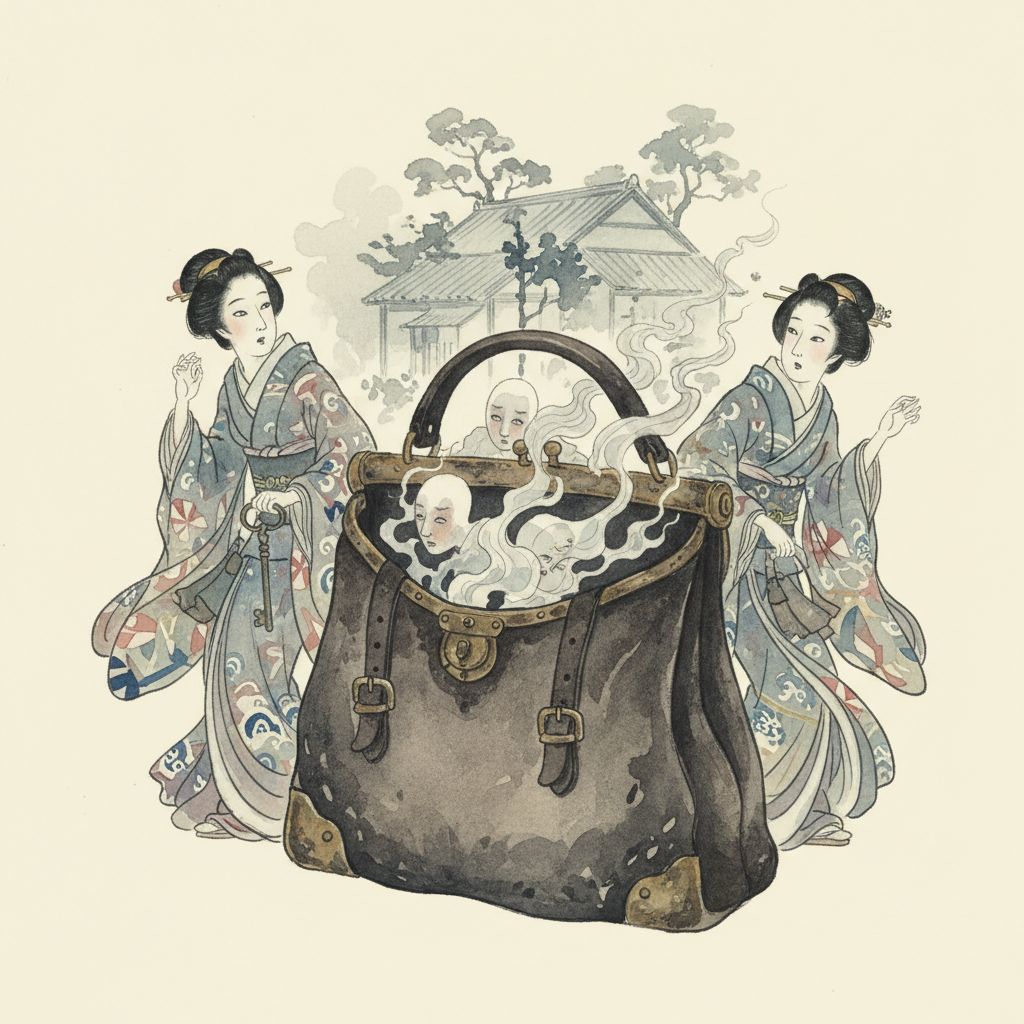
- Kaban / The Suitcase (鞄)
- Playwright Profile: Kobo Abe (安部公房) in 2026
- Best Japanese Plays for Dark Comedy Lovers in 2026
If you want a wider Japanese context for room-scale social pressure, The Elephant / Zō (象) and Tokyo Notes (東京ノート) are also strong follow-ups for very different reasons.
FAQ
Is Tomodachi basically Japan's version of No Exit?
No. The connection is structural and thematic, not genealogical. No Exit is an existential chamber play about mutual exposure after death. Tomodachi is a social absurdist play about invasive friendliness, conformity, and the collapse of private autonomy.
Which play is easier for first-time audiences?
Usually No Exit, because the cast is smaller and the premise is instantly clear. But Tomodachi is also highly accessible once audiences understand that the smiling family is not a quirky inconvenience but the mechanism of domination.
Which play is more practical for schools or universities?
It depends on cast needs. No Exit is easier for small programs. Tomodachi is excellent for larger ensembles that want a serious dark comedy with strong staging and discussion value.
Why pair these plays in 2026?
Because both reveal how confinement can be produced by human relations rather than physical walls alone. They help contemporary audiences think about coercion, visibility, shame, and the politics of being defined by others.
What is the one-sentence takeaway?
Tomodachi and No Exit both show that the most terrifying room is the one where other people control the meaning of your existence.
Sources
- Shinchosha, Tomodachi / The Man Who Turned Into a Stick edition page: https://www.shinchosha.co.jp/book/112119/
- Sis Company, 2021 production page for Tomodachi: https://www.siscompany.com/produce/lineup/tomodachi/
- Nobel Prize, Jean-Paul Sartre facts page: https://www.nobelprize.org/prizes/literature/1964/sartre/facts/
- Concord Theatricals, No Exit licensing and summary page: https://www.concordtheatricals.com/p/1975/no-exit
この記事で紹介した戯曲
Written by
戯曲図書館 編集部
演劇経験者が運営する戯曲検索サービス「戯曲図書館」の編集チームです。 脚本選びのノウハウ、演劇業界の最新情報、公演レポートなどを発信しています。
関連記事
Shintoku-maru vs Oedipus Rex: A 2026 Guide to Fate, Family, and the Body on Stage
Compare Shuji Terayama's Shintoku-maru (身毒丸) and Sophocles' Oedipus Rex as plays about prophecy, incest, mother-figures, and the suffering body — with staging notes for English-speaking theater-makers.
2026-10-04
Five Days in March vs Angels in America: A 2026 Guide to Political Theater, Sex, and the End of the World
Compare Toshiki Okada's Five Days in March and Tony Kushner's Angels in America as generational political plays about apocalypse, apathy, and intimacy under history.
2026-09-27
Play Spotlight 2026: Tomodachi (Friends, 友達) by Kobo Abe (安部公房)
A 2026 English spotlight on Tomodachi, Kobo Abe's invasive dark comedy about loneliness, conformity, and kindness as violence.
2026-08-24
Playwright Profile: Kobo Abe (安部公房) in 2026 — Why Friends and The Suitcase Still Feel Unsettling
A 2026 English guide to Kobo Abe's theatrical career, major plays, style, and why his stage work still matters for global theater artists.
2026-08-20