Shuji Terayama's Shintoku-maru (身毒丸) and Sophocles' Oedipus Rex are both plays about a young man destroyed by a family prophecy he did not write and cannot outrun — and both put the mother's body at the center of that destruction.
That is the cleanest way to connect them for English-speaking directors, dramaturgs, and students in 2026.
At first glance the pairing looks absurd. Oedipus Rex was first performed around 429 BCE in Athens, won a prize at the City Dionysia, and became Aristotle's model tragedy in the Poetics. Shintoku-maru was written in the 1970s by Shuji Terayama (寺山修司, Terayama Shūji) for his Tenjo Sajiki (天井桟敷) troupe, drawing on the medieval Japanese sekkyō-bushi narrative Shintokumaru and later famously adapted by Rio Kishida (岸田理生). One is the founding text of Western tragic form. The other is a 20th-century angura (アングラ, underground) hallucination of folk ritual, horse racing, mother-shops, and acid-pop music.
But they rhyme. They rhyme on the three most dangerous subjects a tragedy can touch: prophecy, incest, and the mother. If you only had time to teach one Greek tragedy and one Japanese play back-to-back, this pairing shows an English-speaking audience, in two evenings, almost the entire arc of what Western theater has done with the Oedipal wound.
Quick Facts: Side by Side
| Oedipus Rex (Oidipous Tyrannos) | Shintoku-maru (身毒丸) | |
|---|---|---|
| Playwright | Sophocles (c. 497–406 BCE) | Shuji Terayama (寺山修司), 1935–1983; stage adaptation by Rio Kishida (岸田理生) |
| First performed | c. 429 BCE, City Dionysia, Athens | 1978 by Tenjo Sajiki; major Rio Kishida / Yukio Ninagawa (蜷川幸雄) production in Tokyo and at the Barbican Theatre, London, 1997 |
| Language of origin | Classical Greek | Japanese |
| Genre | Attic tragedy | Angura theater; mythic / surrealist drama |
| Runtime | ~90–100 minutes (modern productions) | ~120 minutes (Japanese Play Library edition) |
| Cast scale | Small named cast + chorus of Theban elders | 27 performers in the Japanese Play Library edition (10 men / 13 women / 4 others) |
| Source material | Theban myth cycle | Medieval sekkyō-bushi folk ballad Shintokumaru |
| Central relation | Son–mother (Jocasta) | Stepson–stepmother (Nadeshiko / later variants) |
| Prophecy device | Delphic oracle | Mother-shop, dolls, blind priestesses, folk divination |
| Famous image | Oedipus blinding himself with Jocasta's brooches | Shintoku's body covered in sores; the "mother shop"; underworld boats |
One-sentence verdict: Sophocles writes a man who discovers he was fated. Terayama writes a boy who refuses to accept he was ever not fated — and tries to buy, murder, or seduce his way out.
Two Prophecies, Two Shapes of Fate
Oedipus Rex begins after the prophecy has already done most of its work. A plague ravages Thebes. The oracle at Delphi tells King Oedipus that the pollution will not lift until the murderer of the previous king, Laius, is found and punished. The play is a tightening investigation. The audience knows the answer from the first scene — Athenian audiences already knew the Theban myth — and watches Oedipus close the net on himself. According to the standard Wikipedia and LitCharts summaries, Oedipus eventually learns he killed Laius (his biological father) at a crossroads and married Jocasta (his biological mother), fulfilling the prophecy he was trying to escape. Jocasta hangs herself. Oedipus blinds himself with the gold brooches on her dress.
Sophocles' prophecy is linear, singular, and ironic. One oracle. One truth to uncover. Every attempt to avoid it is the mechanism of its fulfillment. Jocasta even argues at one point that oracles are a sham because the one about her son was never fulfilled — only to discover minutes later that it was fulfilled, perfectly (per LitCharts' theme analysis). The irony is airtight.
Shintoku-maru's prophecy structure is ritual, repetitive, and bodily. The medieval source story, Shintokumaru, is a sekkyō-bushi — a narrative recited by itinerant performers to Buddhist and folk-religious audiences — about a young nobleman cursed by his jealous stepmother so that his body breaks out in sores and he is cast out. Terayama and Kishida keep the curse but detonate the frame. The play opens with Shintoku visiting a "mother shop," where his father literally buys a replacement mother for him after his biological mother's death. The new mother brings her own son, and from there the house slides into incestuous attraction, witchcraft, pins stuck into dolls, and a descent into an underworld where many mothers wait in grief for their dead children (per the Cinema of the World 1978 production notes and the 1997 Barbican reviews in The Independent and cix.co.uk).
Where Oedipus discovers his doom, Shintoku is surrounded by it. There is no single oracle; there is a texture of magical thinking — dolls, incantations, bought mothers — that treats fate as something you can shop for, hex into, or wander through.
That difference is the single most useful thing to understand about why these plays feel so different in performance. Sophocles writes a detective story about truth. Terayama writes a dream about desire.
The Mother Problem
Both plays obsess over the mother, but the shape of the obsession is almost opposite.
Jocasta is the biological mother Oedipus does not know he has. The horror in Sophocles is the recognition that intimacy has already happened — children have been born, a marriage has been consummated — before anyone understood what it was. The incest is retroactive knowledge. The violence is the knowledge itself, which drives Jocasta to suicide and Oedipus to self-blinding. The play's famous Greek word, anagnorisis (recognition), is literally about seeing what was always there.
The stepmother in Shintoku-maru is the mother he knows is not his. Terayama inverts the Oedipal structure in a very specific way. Shintoku's biological mother is dead before the play begins. The stepmother (variously named across productions — often Nadeshiko) is a replacement, bought like merchandise. Their attraction is not retroactive discovery but present-tense temptation. They know they are not biologically related. They want each other anyway. And the stepmother, humiliated and threatened, retaliates with sorcery: she pins curses into dolls, and Shintoku's body breaks out in weeping sores.
Where Sophocles writes a tragedy of knowledge, Terayama writes a tragedy of substitution. The core question is not "did I know?" but "can one body replace another?" Can a bought mother replace a lost one? Can a stepson become a lover? Can a doll stand in for a boy's body, and can what you do to the doll travel back to the boy?
For English-speaking theater-makers, that reframing is enormously useful. If you are tired of Freudian readings of Oedipus — the hundred-year industry of therapy-as-tragedy — Shintoku-maru offers a different reading of the same wound: not the psychoanalytic Oedipus complex but a folk-religious logic of ritual substitution and sympathetic magic.
Fate vs Free Will — But Not the Textbook Version
Any high school student can tell you the central theme of Oedipus Rex is "fate versus free will" (as framed by Study.com and LitCharts). Oedipus runs from Corinth to avoid the prophecy. He runs straight into it. His every free choice is the prophecy's vehicle. That tension — a man who thinks he is choosing while the gods already know what he will choose — is the Greek tragic engine.
Shintoku-maru refuses that binary and this is where the comparison gets interesting.
Terayama was deeply skeptical of the Western idea of the autonomous individual making choices against fate. His theater kept dissolving the border between dream and action, between folk ritual and personal psychology, between stage and street. In Shintoku-maru, Shintoku does not run from his fate the way Oedipus does. He wades deeper. He goes to the underworld to find his lost mother. He answers his stepmother's curses with his own transgression. He treats the body — his own and others' — as something you can rewrite with ritual.
The play's implicit philosophy is closer to a folk-Buddhist and animist worldview than to Greek rationalism: fate is not a single oracle; it is a thickness in the air. You are not fighting one god's prediction. You are inside a cosmos saturated with other people's grief, other mothers' lost sons, other dolls with pins in them. The question is not whether you can beat fate. It is which rituals you will perform inside it.
For a director choosing between these two plays, this matters practically. Oedipus Rex wants an actor who can play sharpened intelligence — a man thinking, deducing, closing in on himself. Shintoku-maru wants performers who can play porousness — bodies open to curses, dreams, music, and other bodies.
Staging the Suffering Body
Both plays torture the body of their protagonist, and the comparison of how they do it is one of the most instructive differences in world theater.
Sophocles' violence is almost entirely offstage and reported. The convention of Attic tragedy forbade on-stage killing. Jocasta's suicide and Oedipus' self-blinding happen behind the skene (the stage building), and a messenger returns to describe them in long formal speeches. When Oedipus does reappear with bloody eye sockets, the horror has already been linguistically prepared. The chorus speaks about his body. The body itself is a sign that completes a verbal argument.
Terayama puts the suffering body downstage, in color, moving. Shintoku's sores are visible. The 1997 Ninagawa production at the Barbican (reviewed by The Independent in October 1997) was known for its ravishing lighting, its mix of folk imagery and pop-rock music composed by J.A. Seazer, and for making a very young Tatsuya Fujiwara (藤原竜也) its physical center — his first major stage role at fifteen. The whole language of angura theater, which Terayama helped define alongside Juro Kara (唐十郎) and Minoru Betsuyaku (別役実), was built on the actor's body as a site of transformation — not as a sign of something that happened elsewhere.
If you teach these plays together, the staging contrast is probably the sharpest lesson. Greek tragedy builds horror through language, delay, and the chorus's rhythm. Angura theater builds horror through image, music, and the actor's visible flesh. One is a tragedy you hear. The other is a tragedy you see and smell.
The Chorus Problem
Sophocles has a chorus. Terayama does not — but he has something analogous.
The Theban elders in Oedipus Rex function as the city's moral weather. They sing, they debate, they warn Oedipus, they lament. They are the audience's placeholder, the voice of the polis under plague. For modern Anglophone productions, the chorus is often the hardest element to stage credibly — directors cut it, split it among soloists, or redesign it as a crowd of citizens. Peter Hall, Yukio Ninagawa himself, and Robert Icke have each wrestled publicly with how to make a Greek chorus live for contemporary audiences.
Terayama does not use a formal chorus. But he uses something structurally similar: a crowd of folk types — blind priestesses (reminiscent of itaka or itako, the blind spirit mediums of northeastern Japan where Terayama grew up), sideshow performers, dolls, ghostly mothers in the underworld. In Japanese Play Library's edition, the piece calls for 27 performers precisely because the texture of the play depends on being surrounded by other people's rituals and griefs. The crowd is not the voice of the polis commenting on the hero. It is the environment that makes the hero possible.
If you are designing a double bill, this is where you can be most inventive. A chorus and a sekkyō-bushi crowd are different theatrical animals, but both refuse the modern naturalistic premise that a play is just a few people in a room talking.
FAQ for English-Speaking Theater-Makers
Which play is older?
Oedipus Rex by about 2,400 years. Sophocles' play was first produced around 429 BCE in Athens. Terayama's Shintoku-maru was written in the 1970s, with its most famous international production at London's Barbican in 1997.
Are these plays actually comparable, or is this a stretch?
They are comparable along four axes: prophecy as the engine of plot, the mother as the central erotic and ethical crisis, the physical destruction of the young male protagonist, and the use of a non-naturalistic crowd (chorus in Sophocles; folk types in Terayama). They are not comparable in cultural function — one founded a Western genre, the other critiqued a modernizing Japan — but they are a legitimate dramaturgical pairing.
Does Shintoku-maru explicitly reference Oedipus Rex?
Not directly. Terayama's main sources are the medieval sekkyō-bushi Shintokumaru ballad, the Nō play Yoroboshi which also derives from the same legend, and his own biography (particularly his complicated relationship with his mother Hatsu). But Terayama was deeply read in Western theater and would have known the Greek template. The play reads as a parallel, non-Western answer to the Oedipal problem rather than as a citation.
Which one should I program first for a Western audience?
If your audience is new to both: start with Oedipus Rex in a short, muscular production (90 minutes, minimal chorus, one strong actor). Then program Shintoku-maru in the next slot. The reverse order can work for sophisticated audiences but tends to leave viewers trying to decode Shintoku-maru through Greek expectations, which flattens it.
Can Shintoku-maru be done in English?
Yes, with care. Rio Kishida's adaptation has been translated and used in international productions, most famously the 1997 Ninagawa Barbican run with English surtitles. A fully English-language production is possible but requires a director sensitive to the music, the Japanese folk-religious textures, and the specific resonance of the "mother shop" and sekkyō-bushi background. Workshopping with a dramaturg familiar with angura theater is strongly recommended.
Is there a required dress code or audience expectation for Japanese productions?
For Shingeki or angura revivals in Tokyo, no dress code applies. Dress is casual to smart-casual. See our broader Japanese Theater Etiquette guide for details.
What's the cast and runtime for Shintoku-maru?
In the Japanese Play Library edition, Shintoku-maru calls for 27 performers (10 men, 13 women, and 4 others) and runs approximately 120 minutes. Explore the full data: Shintoku-maru (身毒丸).
Four Comparison Axes at a Glance
| Axis | Oedipus Rex | Shintoku-maru |
|---|---|---|
| Shape of fate | Single oracle; linear investigation; airtight irony | Folk-ritual texture; dolls, curses, mother-shops; porous dream logic |
| Mother relation | Biological mother unknowingly married; retroactive incest discovered | Bought stepmother knowingly desired; present-tense transgression |
| Body on stage | Violence offstage, reported; body as sign | Violence onstage, embodied; body as living site of curse |
| Crowd function | Theban chorus as moral weather of the polis | Folk types, mediums, dead mothers as cosmic environment |
Both plays end with a boy who has learned something that cannot be unlearned. Sophocles' Oedipus is blinded by the brooches of the mother he did not know he had married. Terayama's Shintoku ends scarred, cursed, and estranged from the mother he chose over the one he lost. Both authors seem to agree on one thing: the family prophecy is the most dangerous story a culture tells, because every child is born inside one.
For Further Reading on the Japanese Play Library
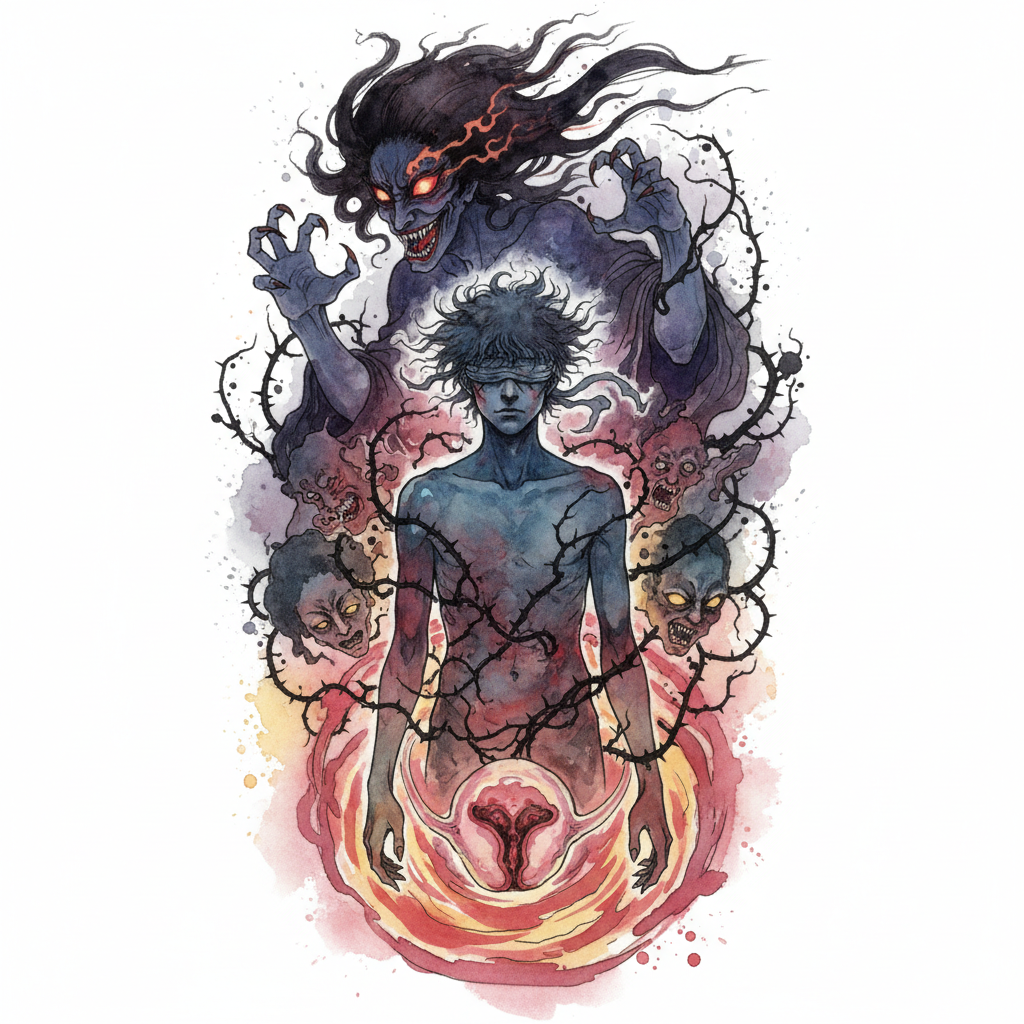
- Shintoku-maru (身毒丸) — full data and cast
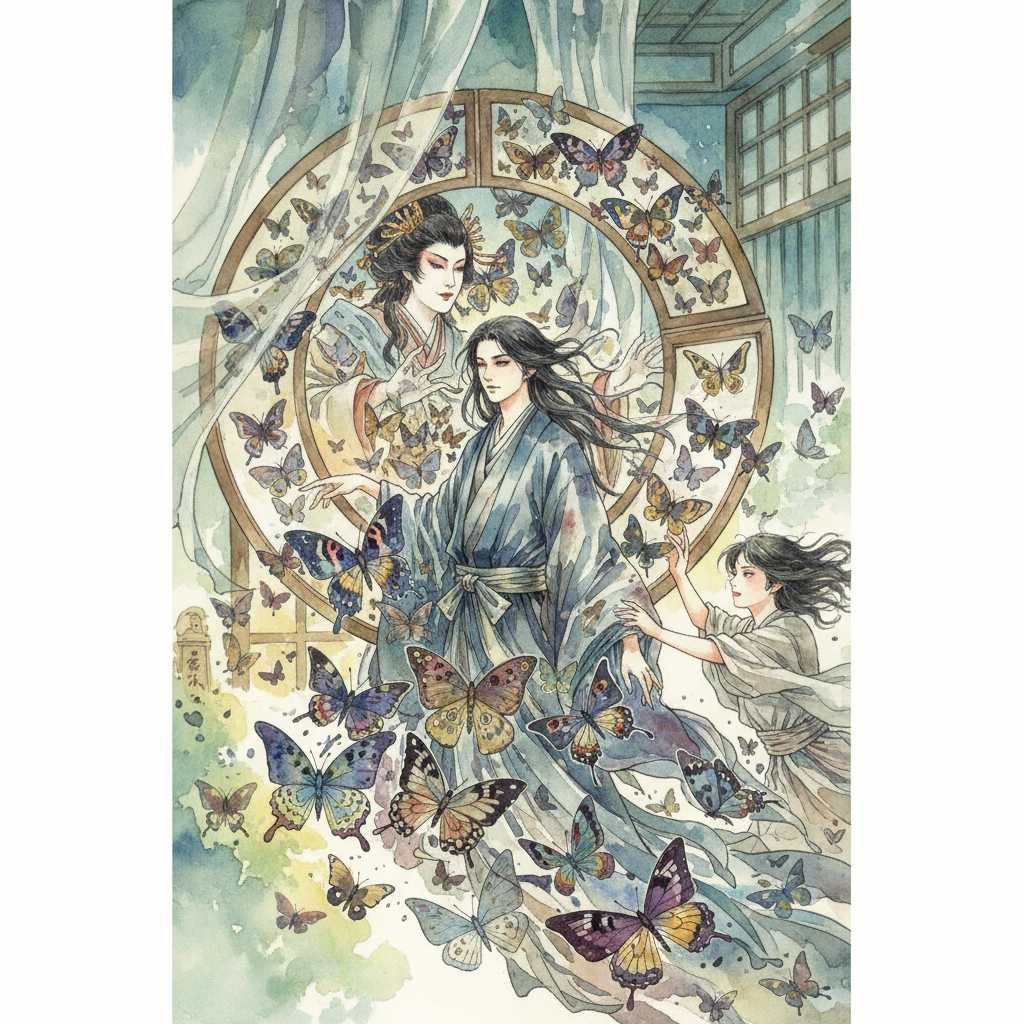
- Kegawa no Marie (毛皮のマリー) — Terayama's other great gender-bending angura text
- Aka Oni / The Red Demon (赤鬼) — a modern Japanese fable useful as a third comparison point for ritual-and-outsider themes
- Playwright Profile: Shuji Terayama (2026) — a full English introduction to Terayama's life, Tenjo Sajiki troupe, and his place in angura theater
- Understanding Angura Theater (2026) — background on the underground theater movement that made Shintoku-maru possible
Sources consulted:
- "Shūji Terayama" and "Oedipus Rex" — Wikipedia (en), accessed 2026
- "Shuji Terayama – Shintoku Maru (1978)" — Cinema of the World
- "Review: Theatre: Shintoku-Maru, Yukio Ninagawa, The Barbican, London" — The Independent, 17 October 1997
- "Review of Shintoku-Maru" — Shutters Reviews (cix.co.uk), 1997
- "Oedipus Rex by Sophocles: Plot Summary" and "Fate vs. Free Will Theme" — LitCharts
- "Oedipus Rex by Sophocles: Summary, Themes & Characters" and "Prophecy in Oedipus Rex" — Study.com
- "Yukio Ninagawa's quest for the perfect Hamlet" — The Independent, 2015 (background on Tatsuya Fujiwara and the 1997 Barbican Shintoku-maru)
この記事で紹介した戯曲
Written by
戯曲図書館 編集部
演劇経験者が運営する戯曲検索サービス「戯曲図書館」の編集チームです。 脚本選びのノウハウ、演劇業界の最新情報、公演レポートなどを発信しています。
関連記事
Five Days in March vs Angels in America: A 2026 Guide to Political Theater, Sex, and the End of the World
Compare Toshiki Okada's Five Days in March and Tony Kushner's Angels in America as generational political plays about apocalypse, apathy, and intimacy under history.
2026-09-27
Tomodachi vs No Exit: A 2026 Guide to Friendly Invasion, Hellish Rooms, and the Violence of Other People
Compare Tomodachi and No Exit through confinement, coercion, group pressure, and the politics of being trapped with others.
2026-08-30
History of the Rise and Fall of Japanese Literature vs Arcadia: A 2026 Guide to Literature, Time, and National Imagination
Compare Oriza Hirata's History of the Rise and Fall of Japanese Literature with Arcadia through time, authorship, and modernity.
2026-08-16
Ayumi vs The Glass Menagerie: A 2026 Guide to Memory, Movement, and the Weight of Ordinary Life
Compare Ayumi and The Glass Menagerie through memory, family pressure, embodiment, and small-scale theatrical power.
2026-08-02