
Toshiki Okada's Five Days in March (三月の5日間, Sangatsu no Itsukakan) and Tony Kushner's Angels in America are both plays about what young people do with their bodies while the world they were promised is collapsing offstage.
That is the sharpest way to connect them for English-speaking theater-makers, dramaturgs, and playwrights in 2026.
At first glance, the pairing looks lopsided. Angels in America is a two-part, six-plus-hour "Gay Fantasia on National Themes" that won the Pulitzer Prize for Drama, the Tony Award for Best Play, and a place in the American canon (per Wikipedia and Britannica summaries). Five Days in March is a roughly ninety-minute Japanese play by a former ballet dropout that won the 49th Kishida Kunio Drama Prize in 2005 (per the Wikipedia entry on Toshiki Okada). One is an epic. The other is an anti-epic.
But both plays are asking the same terrifying question in radically different keys: how do private lives — sex, love, addiction, loneliness — register the arrival of a historical catastrophe that people are, at first, only half-willing to see?
For readers who already know Kushner, Okada suddenly stops sounding like a "difficult" formalist and starts sounding like a political playwright working in a very different tradition. For readers who start with Okada, Angels in America looks less like a period piece about the 1980s and more like a machine that keeps working every time history threatens to end again.
Quick Facts
| Item | Five Days in March (三月の5日間) | Angels in America |
|---|---|---|
| Playwright | Toshiki Okada (岡田利規, Okada Toshiki) | Tony Kushner |
| Company / origin | chelfitsch (チェルフィッチュ), founded 1997 | Eureka Theatre / Mark Taper Forum development, early 1990s |
| Premiere frame | 2004, Yokohama; won 49th Kishida Prize for Drama in 2005 (per Wikipedia) | Millennium Approaches premiered 1991; two-part version consolidated 1992–1993 (per Britannica) |
| Historical trigger | Start of the US-led war in Iraq, March 2003 | The height of the AIDS crisis and the Reagan era, 1985–1986 |
| Setting | A Shibuya love hotel, an anti-war march, Tokyo streets and cafés | New York City apartments, hospital rooms, Central Park, and the "threshold of revelation" |
| Cast profile | 5 men, 2 women in the Japanese Play Library listing | Roughly 8 principal actors, most doubling roles |
| Typical runtime | Around 90 minutes in Japanese Play Library metadata | Two parts of roughly 3 hours 30 minutes each |
| Core aesthetic | "Super-real Japanese" plus a "sluggish, noisy corporeality," per chelfitsch's own description | Epic realism plus theatrical fantasy: angels, ghosts, hallucinations |
| Central image | A five-night stand in a love hotel while bombs drop somewhere else | An angel crashing through a ceiling above a dying man |
| Best production fit | Small ensembles, contemporary studios, movement-literate actors | Large ensembles, resident companies, universities, festival main stages |
Internal reading list:
- Five Days in March / Sangatsu no Itsukakan (三月の5日間)
- Tokyo Notes (東京ノート)
- Aka Oni / The Red Demon (赤鬼)
- Love's Whirlpool / Ai no Uzu (愛の渦)
Related English reading:
- Playwright Profile: Toshiki Okada (2026)
- Best Japanese Plays for English-Speaking Theater-Makers (2026)
What the two plays are actually about
Five Days in March in one paragraph
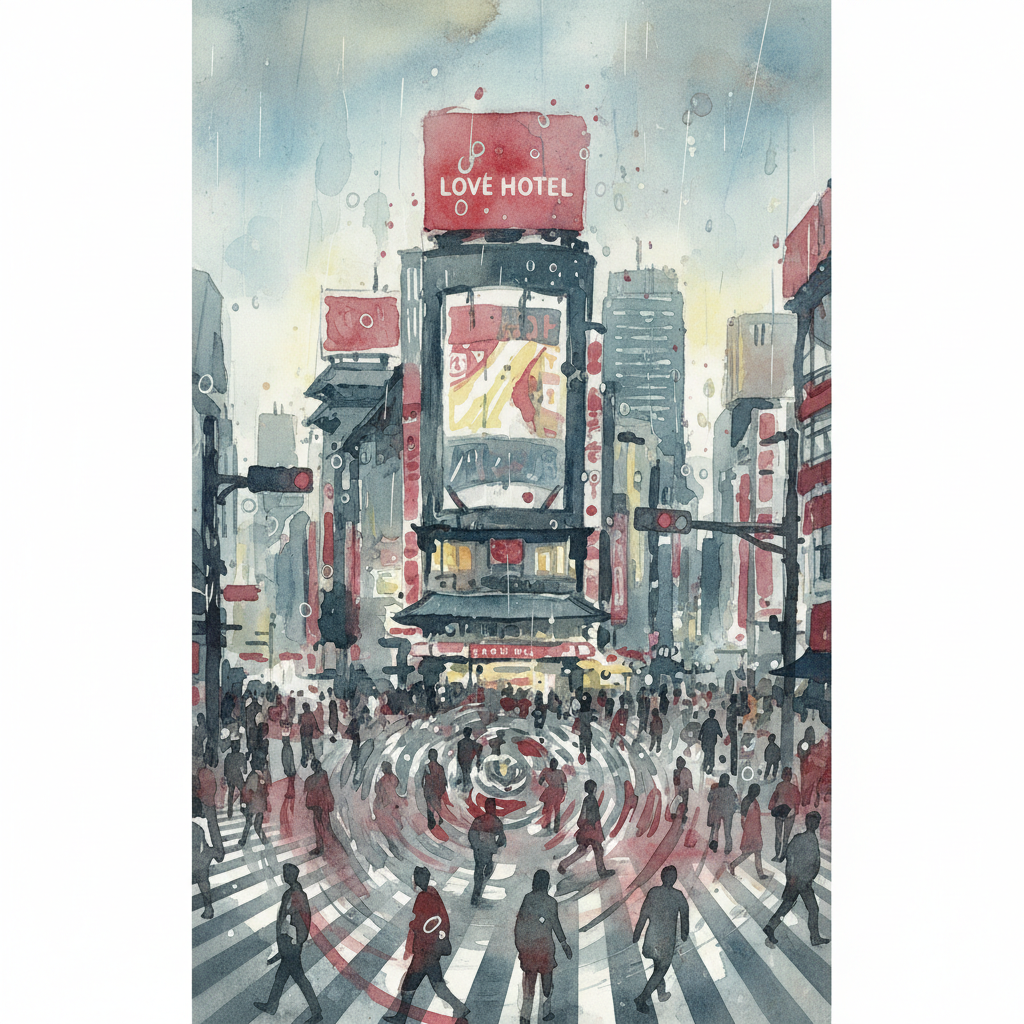
Two strangers, Minobe and Yukki, meet at a live music event in Shibuya and go to a love hotel. They stay in bed for what turns out to be five days. Outside, on March 20, 2003, the United States and Britain begin bombing Iraq, and Japan formally supports the invasion. Around this couple, other young Tokyoites tell overlapping monologues: one goes to an anti-war march at Hibiya Park, someone crashes at a Yoshinoya beef bowl restaurant, a woman circles her own hesitations. Nothing "big" happens on stage. War, protest, and history are all reported. The couple's sustained sex is the only continuous event. The play's original English translator, Aya Ogawa, describes the piece as an "award-winning breakout" that follows several young people in Tokyo through "a one-night stand (which turns into a five-night stand) and anti-war protests, during the start of the American war against Iraq" (per ayaogawa.com). The Belgian venue Kaaitheater, presenting Okada's own re-creation, notes that "on the eve of the US-British offensive in Iraq on 21 March 2003, Japan joins the invading troops. This is Japan's first military engagement since 1945, and it provokes many reactions" (per kaaitheater.be).
Angels in America in one paragraph
New York City, October 1985 to February 1986. Prior Walter, a young gay man, is diagnosed with AIDS. His boyfriend Louis abandons him. A closeted Mormon lawyer, Joe Pitt, is being groomed by the historical figure Roy Cohn — attorney, McCarthy henchman, closeted gay man dying of what he insists is liver cancer — for a Justice Department job in the Reagan administration. Joe's wife Harper hallucinates travel agents in her Valium haze. Prior is visited by an Angel who commands humanity to stop moving. Britannica summarizes the two parts, Millennium Approaches (1990) and Perestroika (1991), as works that "explore political issues and the AIDS epidemic in the 1980s." A University of Michigan production note describes the mid-1980s New York of the play as one in which "the lives of five New Yorkers" intersect during "the emerging AIDS crisis." Kushner's subtitle — A Gay Fantasia on National Themes — is not decoration. The play is trying to metabolize an entire American decade through the bodies of a handful of characters.
Four axes of comparison
1. History enters through the bedroom, not the podium
Both plays refuse the classic "political play" gesture of putting speeches at podiums. History is not announced. It leaks in.
In Five Days in March, the Iraq War is on TV in the love hotel and in headlines on the streets. The play's dramatic engine is the disproportion between the immensity of what is happening (a first Japanese military commitment since 1945, per Kaaitheater) and the smallness of what any single character can bring themselves to do about it. Sex becomes a way to keep breathing while remaining unable to act.
In Angels in America, the AIDS crisis and Reaganism enter through hospital rooms, apartments, and courtrooms. Roy Cohn on the phone is a policy machine. Prior in bed is a body responding to a national policy of neglect. The Audible summary rightly frames the play's setting as "the height of the AIDS crisis in America, as well as the conservative political climate of the Reagan administration."
Both plays trust the audience to feel the political through the personal. Neither play is about a hero deciding to do politics. Both are about people already inside politics before they have language for it.
2. Form as an argument
The formal choices are the biggest gap — and the most productive one for a comparative reading.
Angels in America is written in epic realism. Its scenes are cross-cut across space, its dialogue is quotable, its monologues are extended arias. Angels crash through ceilings. Ghosts appear. Ethel Rosenberg visits Roy Cohn. The play uses metaphysical spectacle as an argument: this crisis is not only medical, not only political, it is cosmological.
Five Days in March is written in what Okada himself, together with chelfitsch's own program materials, calls "super-real Japanese," combined with a "sluggish, noisy corporeality." That phrase is quoted directly on the chelfitsch website and further discussed in an essay at The Theatre Times, which describes Okada's method as "the combination of 'super-real Japanese' and a 'sluggish, noisy corporeality.'" Actors do not "play" the past. They stand awkwardly, gesture with hyper-detailed micro-movements, hesitate, restart sentences. The Performing Arts Network Japan feature on Okada notes that his chelfitsch productions "are characterized by unique body language that has even become the object of attention from the contemporary dance world."
Where Kushner uses angels, Okada uses awkwardness. Both are ways of pushing past naturalism. Kushner pushes upward, into vision. Okada pushes downward, into how young Tokyoites actually stand in a room. Neither wants the polished mid-Atlantic theatrical voice. Both are political precisely in refusing it.
3. Sex, illness, and the body under history
Both plays make the body the site where history is felt.
In Five Days in March, sex is not romantic and it is not transgressive. It is a five-day pause. The Stranger's coverage of Okada's US touring version captures the premise plainly: the play is "about what young couples were doing when the U.S. attacked Iraq in 2003 — one pair stays in a love hotel for five days, leaving only to eat." The couple do not evolve. They negotiate meals. They repeat themselves. Their bodies are alive in the most banal way while, on television, other bodies elsewhere are becoming statistics.
In Angels in America, sex is inseparable from illness. Kaposi's sarcoma appears on Prior's body in scene after scene. Roy Cohn refuses the word "homosexual" while dying of AIDS. Belize, a former drag queen and nurse, is one of the few characters who consistently touches sick bodies with tenderness. The Goodreads summary of Millennium Approaches notes the script's ability to balance "humour whilst engaging with very serious themes around death and identity, whilst being set during the AIDS epidemic during the 1980s."
For an English-speaking theater-maker, this is where the two plays cross-illuminate the most. Angels in America shows what happens when the state has made your body dangerous. Five Days in March shows what happens when the state has made your body safe — and irrelevant to any decision that matters.
4. Language: Kushner's arias vs Okada's stutters
Kushner writes speakable, arguable, memorable dialogue. Prior, Louis, Belize, Harper, and Cohn all have identifiable rhetorical signatures. The play is quoted in classrooms because it is written to be quoted.
Okada writes what looks on the page like colloquial Japanese youth speech pushed to the edge of intelligibility. Sentences reset. Pronouns drift. Filler words carry more weight than "important" nouns. Wikipedia's description of Okada's early style summarizes it as "hyperrealistic," rooted in "contemporary Japanese." The Theatre Times's essay on his work "In What Time Do We Live?" reads that same vernacular as an experiment: Okada "writes in the vernacular of Japanese youth, which he pushed to its limits."
In performance, this asymmetry becomes visible. A great Angels in America production wants actors who can hold a rhetorical line. A great Five Days in March production wants actors who can hold a hesitation.
Comparison table: how the two plays behave in production
| Question | Five Days in March | Angels in America |
|---|---|---|
| Best rehearsal focus | Physical vocabulary, ensemble timing, monologue textures | Character arcs, doubled roles, political context |
| Design demand | Minimal — bare stage, some sound design, everyday clothing | High — multiple locations, flying rigs (optional), period design |
| Audience commitment | ~90 minutes, single sitting | Two parts, either back-to-back or across nights |
| Cultural risk to think about | Representing Tokyo youth voice authentically for non-Japanese casts | Representing gay experience, HIV/AIDS history, and religious identity with care |
| Ideal venue | Studio spaces, black boxes, festivals | Main stages, regional theaters, university productions |
| Best cross-cast | Ensembles who can move together for 90 minutes | Ensembles who can double roles across genders and time periods |
| Best pre-show reading | Reporting on Japan's role in the 2003 Iraq War | Randy Shilts, "And the Band Played On"; Reagan-era AIDS policy |
Why pair these two, specifically?
Because both plays are asking, in radically different theatrical languages, what political theater can be after the era of the direct manifesto.
Kushner's answer is: enlarge the stage. Bring on the angels. Give politics cosmological weight. Trust that a grand American form, remade from queer material, can still bear the argument.
Okada's answer is: shrink the stage. Bring on the awkwardness. Take away the podium. Trust that a couple in a love hotel is already a political scene, because the war they are ignoring is being fought in their name.
For a 2026 English-language production, the pairing is especially useful in three practical contexts:
- Universities running a semester on political theater since 1990 will find the two plays cover very different national experiences of state violence and neglect: American healthcare and homophobia in the 1980s, and Japanese post-Cold War militarization in the early 2000s.
- Small companies who want to program one shorter, cheaper piece as a curtain-raiser or paired reading to a longer classic will find Five Days in March is remarkably portable, while Angels in America rewards long-form investment.
- Directors thinking about acting technique will find Okada's approach to gesture a working corrective to a diet of naturalistic American realism.
Frequently asked questions
Are both plays available in English? Angels in America is widely published (Theatre Communications Group) and licensed for performance. Five Days in March has been translated into English by Aya Ogawa and performed internationally, including in the United States; the Japanese script is available in book form in Japan. Rights and licensing details should be confirmed directly with the respective rights holders.
Which one is easier to program first? Five Days in March is significantly shorter, needs a smaller cast, and requires almost no scenic budget. It is the easier first program of the two, especially for companies new to contemporary Japanese work.
Is Five Days in March really a "political play" if nothing political happens onstage? Yes. That is the play's argument. Political events happening offstage while a couple has sex onstage is itself the theatrical statement. Compare with Kushner, where politics happen onstage constantly, in courtrooms, phones, and hospitals. Two different bets on what makes theater political.
What contemporary Japanese plays sit near Five Days in March? Oriza Hirata's Tokyo Notes (東京ノート), which quietly places young Tokyoites in a museum while a war unfolds in Europe, is the closest cousin. Hideki Noda's The Red Demon (赤鬼) also sits nearby as a fable about a community's reaction to an outsider. Daisuke Miura's Love's Whirlpool (愛の渦) shares the sexually candid, generational focus, without the war context.
What contemporary American plays sit near Angels in America? Larry Kramer's The Normal Heart (1985) is the most obvious companion; Paula Vogel's The Baltimore Waltz is another. But Angels in America is unusually canonical, and few peers match both its formal ambition and its length.
A note on translation and staging outside Japan
Okada's plays are notoriously hard to translate because so much of the script's meaning is carried by rhythm, filler, and speech disfluency. English-language productions have sometimes chosen to preserve a translated hesitancy in the acting; others have re-set the play in a more naturalistic register. Both are defensible. What is not defensible is treating the script as an ordinary well-made-play whose "content" can be extracted from its form. The Performing Arts Network Japan interview with Okada frames his work as a set of "distinctive interpretations of gestures and movement" — the movement is not decoration, it is the meaning.
Kushner's play, by contrast, travels relatively easily. Its rhetorical density is portable across English-speaking cultures, and it has been produced across the US, UK, and Australia, as well as in translation. Directors will still need to make careful choices about the play's Jewish, Mormon, and queer specificities, and about how to stage its metaphysical scenes without collapsing them into cliché.
Final thought: two plays about being alive at the wrong time
Five Days in March and Angels in America both take place at hinge points that their characters cannot fully understand while they are living them. In Kushner's play, an angel literally arrives to say: stop moving. In Okada's play, no angel arrives. Two people stay in a hotel and eat beef bowls while the news continues in the corner of the room.
Both plays are haunted by the same suspicion: that our private lives are already scenes in a political play we did not audition for. Kushner stages that suspicion at maximum theatrical volume. Okada stages it at almost zero volume.
For a 2026 English-speaking company that wants to think about what political theater can be after a decade of pandemic, war, and climate emergency, staging or reading these two plays alongside each other is one of the most practical dramaturgical exercises available.
They will not agree on a form. They will agree on a stakes.
Explore more on Japanese Play Library (戯曲図書館):
Related English guides:
この記事で紹介した戯曲


Written by
戯曲図書館 編集部
演劇経験者が運営する戯曲検索サービス「戯曲図書館」の編集チームです。 脚本選びのノウハウ、演劇業界の最新情報、公演レポートなどを発信しています。
関連記事
Tomodachi vs No Exit: A 2026 Guide to Friendly Invasion, Hellish Rooms, and the Violence of Other People
Compare Tomodachi and No Exit through confinement, coercion, group pressure, and the politics of being trapped with others.
2026-08-30
History of the Rise and Fall of Japanese Literature vs Arcadia: A 2026 Guide to Literature, Time, and National Imagination
Compare Oriza Hirata's History of the Rise and Fall of Japanese Literature with Arcadia through time, authorship, and modernity.
2026-08-16
Playwright Profile: Toshiki Okada (岡田利規) in 2026 — Why chelfitsch Changed Contemporary Japanese Theater
An English guide to Toshiki Okada’s career, major plays, style, and why chelfitsch remains vital for global theater in 2026.
2026-08-13
Ayumi vs The Glass Menagerie: A 2026 Guide to Memory, Movement, and the Weight of Ordinary Life
Compare Ayumi and The Glass Menagerie through memory, family pressure, embodiment, and small-scale theatrical power.
2026-08-02