
目次12項目開く
- 1.Quick Facts
- 2.Why The Piano Lesson Is Such a Useful Starting Point
- 3.1. Kegawa no Marie (毛皮のマリー) — Shūji Terayama (寺山修司)
- 4.2. Shintoku-maru (身毒丸) — Shūji Terayama and Etsuko Kishida (岸田理生)
- 5.3. The Character (ザ・キャラクター) — Hideki Noda (野田秀樹)
- 6.4. Let Them Sing (Utawasetai Otoko-tachi, 歌わせたい男たち) — Ai Nagai (永井愛)
- 7.5. The Dressing Room (楽屋) — Kunio Shimizu (清水邦夫)
- 8.Comparison Table: Which Play Should You Read First?
- 9.How to Use These Plays in a Reading or Season
- 10.FAQ
- 11.Where to Continue Reading
- 12.Sources and Further Research
If you like August Wilson’s The Piano Lesson, the Japanese plays most worth reading next are the ones that treat family inheritance as a live argument: something stored in a house, a body, a language, or a ritual that the next generation must either preserve, transform, or refuse.
August Wilson’s The Piano Lesson is not simply a play about whether a family should sell an old piano. The piano is an archive. Its carved surfaces carry the history of the Charles family, including enslavement, separation, grief, and survival. Berniece sees an obligation to remember; Boy Willie sees an opportunity to build a future. The family argument is therefore also a debate about what the past is for.
That structure gives the play an unusually productive bridge to Japanese drama. Many Japanese plays place a family, community, or theatrical group in a room where an object, story, custom, or inherited role refuses to remain “just history.” The dramatic question is not whether the past exists. It is who has the authority to interpret it, and what the present will cost if it does.
The five plays below are not Japanese versions of Wilson’s drama. They come from different theatrical traditions: postwar avant-garde performance, contemporary social drama, mythic reworking, political comedy, and ensemble theater. What connects them is a shared interest in inheritance as performance.
Quick Facts
| Item | Details |
|---|---|
| Western anchor text | The Piano Lesson by August Wilson, first performed in 1987 |
| Central Wilson question | Should an inherited past be preserved, used, or transformed? |
| Japanese plays in this guide | Kegawa no Marie, Shintoku-maru, The Character, Let Them Sing, The Dressing Room |
| Shared concerns | Family memory, identity, ritual, coercion, language, theatrical inheritance |
| Best compact-cast starting point | Let Them Sing or The Dressing Room |
| Best choice for formal and visual experimentation | Kegawa no Marie or Shintoku-maru |
| Best choice for a large ensemble | The Character |
| Best use | Comparative drama courses, staged readings, actor training, and international programming |
Why The Piano Lesson Is Such a Useful Starting Point
Wilson sets The Piano Lesson in Pittsburgh in 1936, inside the Charles family home. The location matters because the house is not neutral. It is where the family lives, but it is also where the family’s history has been made visible, hidden, rehearsed, and disputed.
The piano is the clearest version of that history. Boy Willie wants to sell it so he can buy land. Berniece refuses because the instrument embodies ancestors whose lives cannot be reduced to a financial transaction. Their uncle Doaker carries the story of the piano, while Berniece’s daughter Maretha represents the next generation, still learning what the family’s symbols mean.
The play therefore moves across at least four dramatic layers:
- The practical present: money, property, work, and survival.
- The remembered past: family stories that have not been evenly preserved.
- The symbolic object: the piano as material evidence of history.
- The theatrical or spiritual pressure: the possibility that the past can return as a force in the room.
The Japanese works in this list approach those layers differently. In Kegawa no Marie (毛皮のマリー), the family is organized around a stylized parent-child bond. In Shintoku-maru (身毒丸), inherited violence becomes myth and ritual. In The Character (ザ・キャラクター), writing and myth become instruments of control. In Let Them Sing (歌わせたい男たち), public ceremony exposes the pressure placed on private conscience. In The Dressing Room (楽屋), theatrical memory becomes a haunting inheritance passed among performers.
A useful way to read all five is to ask the same question Wilson asks: What happens when the past is not behind the characters, but inside the room with them?
1. Kegawa no Marie (毛皮のマリー) — Shūji Terayama (寺山修司)
- Japanese Play Library: Kegawa no Marie
- Listed runtime: approximately 120 minutes
- Best for The Piano Lesson readers who love: the house as a pressure chamber, the family heirloom as a weapon, and the collision between protection and possession
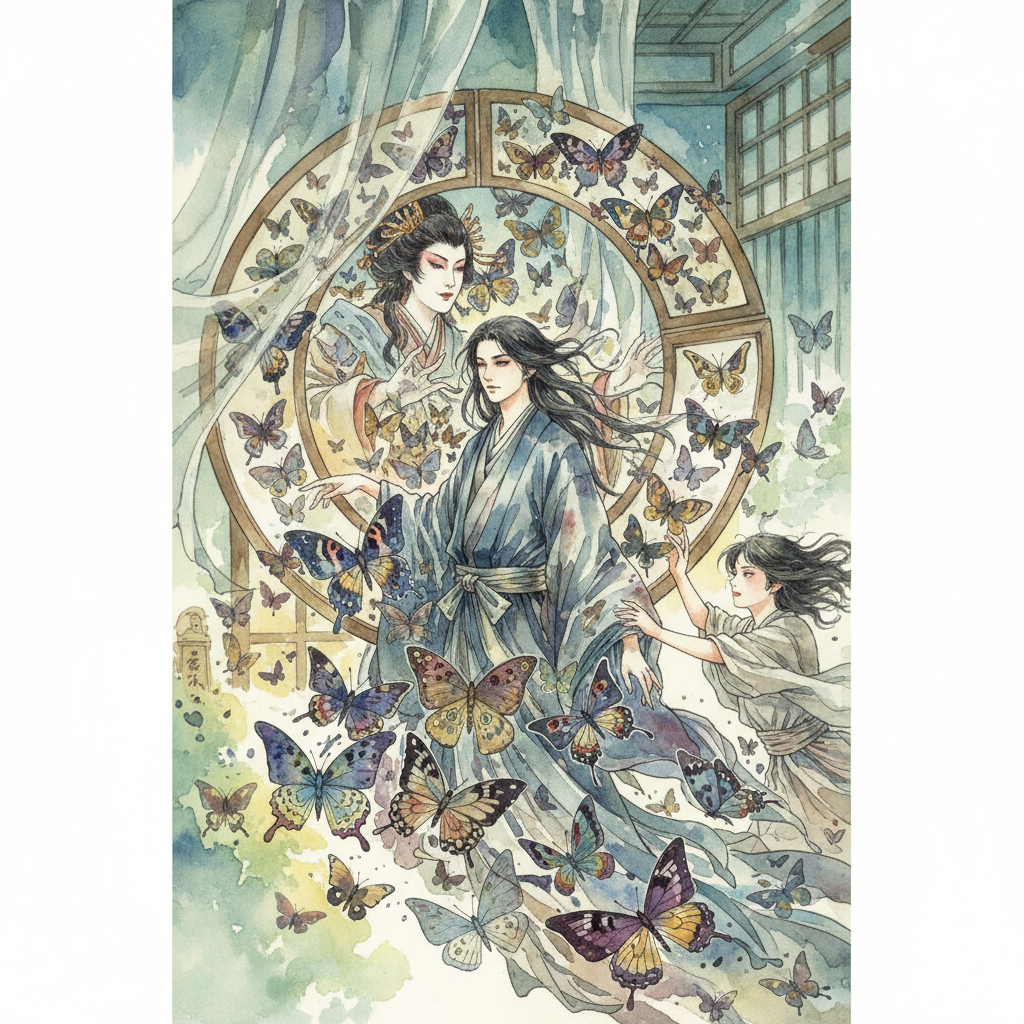
Shūji Terayama’s Kegawa no Marie is not domestic realism. It is a flamboyant, grotesque, queer, and highly theatrical drama in which family relations are already performances. At its center is Marie, a glamorous and unstable figure who exerts powerful control over her idealized son Kinya. Their relationship is intimate, theatrical, protective, and violent at the same time.
The strongest connection to The Piano Lesson is not plot but the question of ownership. In Wilson’s play, Berniece and Boy Willie disagree about what the piano belongs to. Is it a family memorial, a source of capital, or a burden that must be converted into a future? In Terayama’s play, the struggle is more bodily and psychological: who gets to define the child, the home, the family role, and the story that explains their relationship?
Marie’s world is built from inherited theatrical codes. Costumes, gestures, entrances, and declarations do not merely express identity; they manufacture it. Kinya is not allowed to become an ordinary adult because Marie’s image of him depends on preserving him in a particular state. The family bond becomes a stage set that must be maintained even when everyone inside it is suffering.
That is a useful contrast with Berniece. Berniece refuses to let the piano become a decorative object, but she also refuses to let the past dictate every movement of her life. Marie’s attachment to her son is more possessive. She does not simply remember a family history; she stages a version of family history and demands that others perform inside it.
For Western audiences, Kegawa no Marie is a strong companion to The Piano Lesson if you want to move from social realism into anti-realism without abandoning emotional stakes. The play asks directors to make the family’s symbolic system visible. What does a costume remember? What does a room demand? When does a role become a prison?
The production challenge is tonal precision. A performance that treats the play as pure camp can lose its cruelty. A performance that treats it as pure psychological tragedy can flatten its theatrical intelligence. The best approach lets comedy, glamour, danger, and grief exist at the same time.
2. Shintoku-maru (身毒丸) — Shūji Terayama and Etsuko Kishida (岸田理生)
- Japanese Play Library: Shintoku-maru
- Japanese Play Library edition: approximately 120 minutes; 27 performers listed
- Best for The Piano Lesson readers who love: ancestral stories, family curses, the body as an archive, and the return of buried violence
Shintoku-maru draws on the medieval narrative tradition of Shintokumaru, then passes that material through the experimental theater of Terayama and Kishida. The result is a theatrical world of replacement mothers, curses, bodily transformation, desire, ritual, and underworld imagery.
Where Wilson places the family’s history in a carved piano, Shintoku-maru places history in the body. The title character’s body becomes evidence of a social and familial curse. The wound is not merely an individual medical fact. It is a visible sign of exclusion, jealousy, abandonment, and the unstable meanings of motherhood.
This makes the play a compelling response to The Piano Lesson’s material symbolism. Wilson asks the audience to look at an object and see the ancestors who made it possible. Terayama and Kishida ask the audience to look at a body and see the stories that have been forced onto it. The body is treated as a stage where family and society write their explanations.
The two plays also differ in how they handle spiritual pressure. In The Piano Lesson, the possibility of ghosts enters a realistic household and gradually changes what the audience thinks is possible. In Shintoku-maru, the boundary between ritual, memory, fantasy, and theatrical event is unstable from the beginning. The question is not whether the supernatural is “real.” The question is what kind of truth becomes available when realism is no longer the only measure.
For directors, this is not a script to domesticate too quickly. Its images need a formal language. That language might involve chorus work, sound, masks, ritualized entrances, or a deliberately artificial relationship with the audience. The production should not explain every symbol before the spectators have had time to feel its pressure.
If The Piano Lesson teaches that an heirloom can contain a family’s suppressed history, Shintoku-maru expands the idea: the inherited past may be carried not only by objects, but by bodies that have been made to bear meanings they did not choose.
3. The Character (ザ・キャラクター) — Hideki Noda (野田秀樹)
- Japanese Play Library: The Character
- Listed runtime: approximately 150 minutes
- Best for The Piano Lesson readers who love: stories, myth, authorship, family-like hierarchies, and the power to name another person
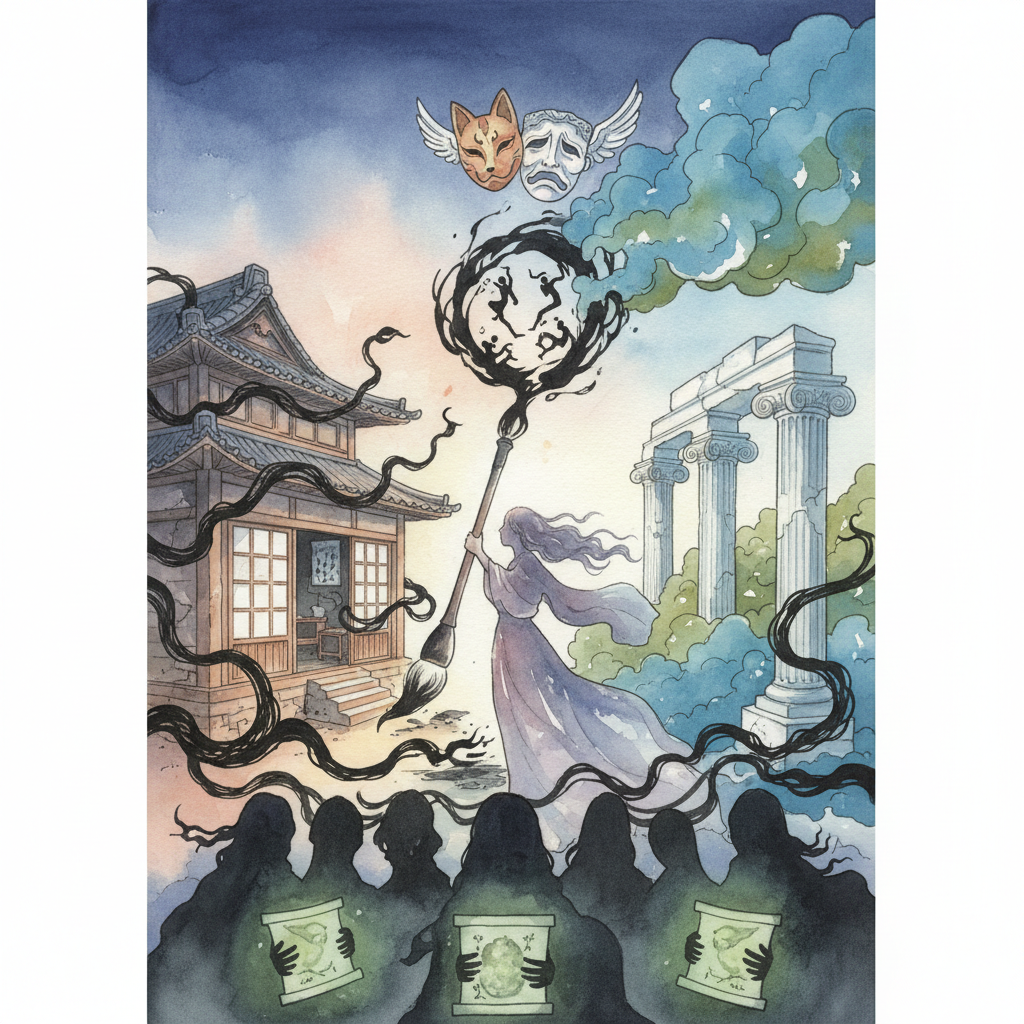
Hideki Noda’s The Character takes place in a small calligraphy school where strange lessons are being conducted. A newcomer named Madoromi enters with a purpose, while the world of Greek mythology and the wrongdoing of the school’s masters begin to overlap.
The connection to The Piano Lesson lies in the politics of inscription. Wilson’s piano is carved with the faces and stories of a family. It is an object that says: these people existed, and what happened to them must not disappear. In Noda’s play, writing itself becomes unstable. Characters are created, named, interpreted, and controlled. The question becomes: who gets to write the story that others are forced to inhabit?
This makes The Character especially useful for readers interested in the relationship between language and inheritance. A family does not pass down only property. It passes down names, categories, myths, roles, and explanations. Those explanations can preserve dignity, but they can also justify domination.
Boy Willie’s argument is economically direct: the piano’s history should help the family acquire land. Berniece’s response is ethical and historical: the family cannot treat its ancestors as raw material. Noda’s drama pushes the dispute into a more abstract register. If a person’s identity can be written by someone else, then inheritance may become a script imposed from above.
The play’s scale also makes it a useful contrast. Unlike a compact family drama, The Character asks for a larger theatrical world and more extensive formal design. The Greek-myth material is not a decorative reference. It creates a machinery of transformation, allowing the production to show how private wrongdoing can become a public story.
For an English-speaking theater-maker, this is a strong text to pair with The Piano Lesson in a course on myth, archive, and performance. Both plays ask what happens when the past is made legible. Both are suspicious of the people who claim to be its official interpreters.
4. Let Them Sing (Utawasetai Otoko-tachi, 歌わせたい男たち) — Ai Nagai (永井愛)
- Japanese Play Library: Let Them Sing
- Cast: 3 men and 2 women listed in the Japanese Play Library guide
- Runtime: approximately 110 minutes
- Best for The Piano Lesson readers who love: public ritual, conscience under pressure, and the conflict between official language and lived memory
Ai Nagai’s Let Them Sing moves away from the family home and into an institutional setting, but it preserves the basic architecture of an inheritance dispute. The inheritance here is civic and ideological: a public ceremony, the language used to justify it, and the pressure placed on individuals who are expected to participate.
This is an important companion to The Piano Lesson because Wilson’s play is never only private. The Charles family’s piano carries the history of slavery, property, migration, labor, and racial violence. The family quarrel is personal, but the history inside the house is public history.
Let Them Sing makes that public dimension more visible. Its characters are caught between institutional expectations and personal judgment. A ceremony may look orderly from the outside, but the language surrounding it can reveal fear, coercion, compromise, and resistance.
The comparison is strongest when we look at performance. In Wilson’s play, the question of whether Berniece will play the piano is also a question of whether she will enter a relationship with the ancestors she has tried to keep at a distance. Music becomes a form of speech. In Nagai’s play, singing and official performance become similarly charged: to participate is not necessarily to agree, but refusing to participate also has consequences.
For actors, the value of this play is in the small shifts of register. A character may speak politely while applying pressure. A public phrase may sound harmless until its historical meaning becomes clear. The conflict is carried not only by what is said but by who has the authority to define the situation.
If you are staging a comparative reading with The Piano Lesson, Let Them Sing can widen the discussion from family inheritance to institutional inheritance. What does a society ask its citizens to repeat? What happens when a ritual survives after its original justification has become impossible to accept? And how does an individual resist without pretending to stand outside history?
5. The Dressing Room (楽屋) — Kunio Shimizu (清水邦夫)
- Japanese Play Library: The Dressing Room
- Cast: four women in the Japanese Play Library’s English-facing guide
- Best for The Piano Lesson readers who love: ghosts, performance as memory, women’s erased labor, and the past returning through repetition
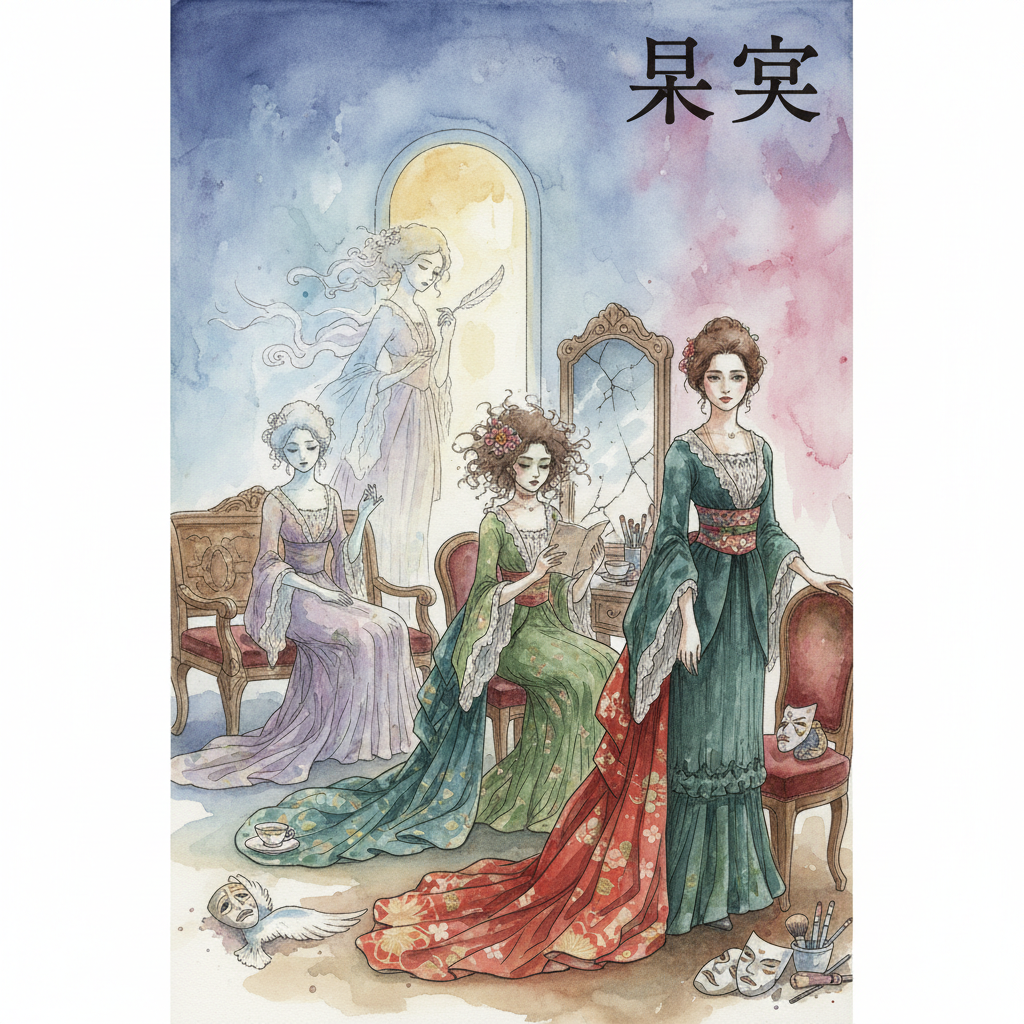
Kunio Shimizu’s The Dressing Room places four actresses in the backstage space around a production of Chekhov’s The Seagull. The dressing room becomes a place where performers wait, repeat, remember, compete, and haunt one another.
This is perhaps the most direct theatrical parallel to The Piano Lesson. The piano is an object that remembers. The dressing room is a space that remembers. It has absorbed the voices, ambitions, failures, costumes, and unfinished roles of the women who pass through it.
The connection is also gendered. In Wilson’s play, Berniece’s relationship to the piano is not simply a disagreement with Boy Willie. It is shaped by the particular burden placed on her as a woman who has survived loss and is expected to protect the household. She has inherited memory, but she has also inherited responsibility.
In The Dressing Room, the actresses inhabit a similar tension between visibility and erasure. They are performers, but their labor is often treated as secondary to the role, the production, or the canonical play being performed. The backstage space contains the history of women who have worked inside theater without necessarily receiving the authority associated with its official narrative.
The Chekhov connection matters because The Dressing Room is not only about individual actresses. It is about theatrical inheritance: how one generation receives roles, gestures, reputations, and disappointments from another. A performance is never made from nothing. Every actress enters a room already filled with previous versions.
For an English-language staged reading, this is one of the most practical choices in the guide. The cast is compact, the setting is concentrated, and the dramatic action depends heavily on rhythm, memory, and the actors’ ability to shift between ordinary conversation and theatrical echo. It also opens useful conversations about translation. What does it mean to perform a Japanese play that is itself in dialogue with Russian drama?
If The Piano Lesson asks whether a family can live with its heirloom, The Dressing Room asks whether artists can live with the roles and histories that theater keeps handing down.
Comparison Table: Which Play Should You Read First?
| Japanese play | Central inheritance | Dramatic form | Practical scale | Best Wilson connection |
|---|---|---|---|---|
| Kegawa no Marie | Family role and possession | Queer anti-realism | Medium ensemble | The home as a symbolic battleground |
| Shintoku-maru | Curse, body, and ritual story | Mythic/ritual theater | Large ensemble | History carried by the body |
| The Character | Naming, writing, and myth | Metatheatrical ensemble | Large-scale | Who controls the family story? |
| Let Them Sing | Civic ritual and official language | Social/political drama | 5 actors | Private conscience inside public history |
| The Dressing Room | Theatrical memory and women’s labor | Backstage ensemble drama | 4 women | The room as a living archive |
How to Use These Plays in a Reading or Season
For a compact staged reading: Start with The Dressing Room or Let Them Sing. Both offer concentrated casts and conflicts that can be carried by actors, language, and a carefully framed space.
For a course on family and history: Pair The Piano Lesson with Kegawa no Marie. Ask students to compare Berniece’s guarded relationship with the piano to Marie’s active construction of the family image. One character resists an inherited symbol; the other tries to keep everyone trapped inside one.
For a course on myth and the body: Pair Wilson with Shintoku-maru. The comparison shows two very different theatrical methods for staging histories that cannot be fully explained by realistic dialogue.
For a course on language and power: Pair The Piano Lesson with The Character and Let Them Sing. The three plays ask who gets to name the past, who must repeat its official version, and what happens when a character refuses the assigned script.
For directors: Do not begin by asking how to make a Japanese play “feel American.” Begin by identifying the play’s own inheritance system. What is the object, ritual, role, or story that carries the past? How does the production make that carrier visible without turning it into a museum piece?
FAQ
What Japanese play is most similar to The Piano Lesson?
No single play is a plot equivalent. The Dressing Room is the closest in its treatment of a space as an archive, while Kegawa no Marie is the closest in its use of family intimacy as a theatrical struggle over ownership and identity.
Are these Japanese plays available in English?
Availability varies by title. The Japan Playwrights Association publishes English translations of selected contemporary Japanese plays, and the Japan Foundation has supported translation and publication projects for theatrical works. An English synopsis does not automatically mean that a licensed English performance text is available. Contact the playwright, publisher, rights holder, or authorized translator before translating or producing any work.
Which play is best for a university staged reading?
The Dressing Room is a strong starting point because of its compact female ensemble, concentrated setting, and clear connection to a canonical Western play. Let Them Sing is another practical choice for programs interested in political theater and actor-centered dialogue.
Why compare a Black American play with Japanese plays?
The purpose is not to claim that the histories are interchangeable. It is to compare dramatic mechanisms: the heirloom, the family house, the inherited story, the contested ritual, and the question of who has authority over memory. Careful comparison can make difference more visible, not less.
What should directors research before producing one of these plays?
Research the playwright’s theatrical context, the social history inside the play, available translation and performance rights, and the production history of the original work. Avoid treating “Japanese theater” as a single style. Terayama’s anti-realism, Nagai’s social drama, Noda’s metatheater, and Shimizu’s backstage ghost story require different rehearsal languages.
Where to Continue Reading
- If You Like Death of a Salesman: Japanese Plays About Work, Family, and Failing Dreams
- How to Choose Japanese Plays for Staged Readings in English (2026)
- Best Japanese Plays in English (2026): 8 Scripts for English-Speaking Theater Makers
Sources and Further Research
- Concord Theatricals, August Wilson’s The Piano Lesson — synopsis and production information: https://www.concordtheatricals.com/p/7625/august-wilsons-the-piano-lesson
- The American Theatre Wing, August Wilson’s The Piano Lesson — production context and the central heirloom piano: https://www.tonyawards.com/shows/august-wilsons-the-piano-lesson/
- Seinendan, “Tokyo Notes” — Play List — an example of an English-facing Japanese play resource and a family/history drama built around a museum space: https://www.seinendan.org/eng/play/1994/tokyonotes/
- Japan Foundation, Translation and Publication of Theatrical Plays — international translation and publication context for contemporary Japanese drama: https://www.jpf.go.jp/e/publish/perform/
- Japan Playwrights Association, English Translations of Plays — information on English-language collections of Japanese plays: https://www.jpwa.org/main/publishing/books/english
- Concord Theatricals, The Methuen Drama Book of Contemporary Japanese Plays — an English-language anthology published alongside the Japan Foundation: https://www.concordtheatricals.co.uk/s/94897/the-methuen-drama-book-of-contemporary-japanese-plays
Japanese Play Library does not claim that an English performance text is available for every title listed above. Verify rights and translation status before production.
この記事で紹介した戯曲


戯曲図書館 編集部・公開日 2026/10/30
演劇経験者が運営する戯曲検索サービスの編集チームです。脚本選びのノウハウ、演劇の最新情報、公演レポートなどを書いています。
関連記事
- If You Like Long Day's Journey Into Night (2026 Guide): 5 Japanese Plays About Family Secrets, Blame, and the Past That Won't Stay BuriedLove Long Day's Journey Into Night? Read 5 Japanese plays about family secrets, inherited grief, and the quiet violence of a past that refuses to stay buried.2026/10/02
- If You Like True West (2026 Guide): 5 Japanese Plays About Brothers, Masculinity, and the Myth You Can't OutrunLove Sam Shepard's True West? Read 5 Japanese plays about brothers, inherited violence, failed masculinity, and the self you cannot shake off — from Matsuo Suzuki to Yu Miri.2026/10/09
- If You Like The Crucible (2026 Guide): 4 Japanese Plays About Scapegoats, Panic, and Public ObedienceLove The Crucible? Read 4 Japanese plays about fear, scapegoats, conformity, and the cost of refusing the crowd.2026/08/21
- If You Like Hedda Gabler (2026 Guide): 4 Japanese Plays About Female Rage, Respectability, and the Need to Burn the ScriptLove Hedda Gabler? Read 4 Japanese plays about boredom, control, female rage, and the social cost of living inside the wrong role.2026/08/14