
The best Japanese plays for staged readings are the ones that generate tension, atmosphere, and character through speech, rhythm, and listening before design does any heavy lifting.
That distinction matters. A staged reading is not a reduced production in the lazy sense. It is a very specific test:
- Can the script survive without scenery doing the explaining?
- Can actors make the audience lean in with language alone?
- Can the play travel into English without losing its pulse?
For international theater makers, that test is often the smartest first way into Japanese drama. You do not need to solve everything at once. You need to find plays that are audible, discussable, and performable in a room with scripts, chairs, and strong actors.
This 2026 guide focuses on 8 Japanese plays that are especially promising for staged reading contexts. Some already have clear international reading or translation histories. Others are practical because their dramatic engine is already text-first: subtext, repetition, compression, moral argument, or tightly structured encounter.
Names appear in Romanization + Japanese on first mention for searchability.
Quick Facts
| Item | Recommendation |
|---|---|
| Best first pick for actor-centered readings | The Dressing Room (Gakuya, 楽屋) |
| Best first pick for civic or institutional conflict | The Men Who Wanted to Sing (Utawasetai Otokotachi, 歌わせたい男たち) |
| Best first pick for compact high-intensity readings | THE BEE (ザ・ビー) |
| Best first pick for quiet ensemble listening | Tokyo Notes (Tōkyō Nōto, 東京ノート) |
| Best first pick for schools or younger ensembles | Boy B (Shōnen B, 少年B) |
| Sweet spot for staged readings | 2-6 actors, 50-100 minutes, text-led dramatic structure |
| Best related English guides on Japanese Play Library | How to Choose Japanese Plays for Staged Readings in English, How Japanese Play Readings Work in 2026 |
What makes a Japanese play good for a staged reading?
For this list, I am using four practical filters.
1) The play must sound active before it looks active
A reading strips away a lot of support systems. If the script only comes alive once you add full visual metaphor, intricate movement, or location realism, it may be a fine production text but a weak reading text.
2) The audience must be able to enter the world quickly
International audiences do not need Japanese drama simplified for them. They do, however, need a usable doorway. Family strain, institutional pressure, outsider fear, theatrical memory, and social awkwardness are all strong entry points because they read clearly without cultural over-explanation.
3) The play should reward actor listening
Readings succeed when actors can shape meaning through interruption, pause, repetition, and withheld feeling. Japanese drama is especially rich here. The point is not “minimalism” for its own sake. The point is that the text already contains playable acoustic structure.
4) Translation should help, not suffocate, the script
Some Japanese plays are compelling on the page but difficult to animate in English without substantial adaptation. Others already have documented international reading histories or a speech pattern that remains strong across languages. Those are usually the best first candidates.
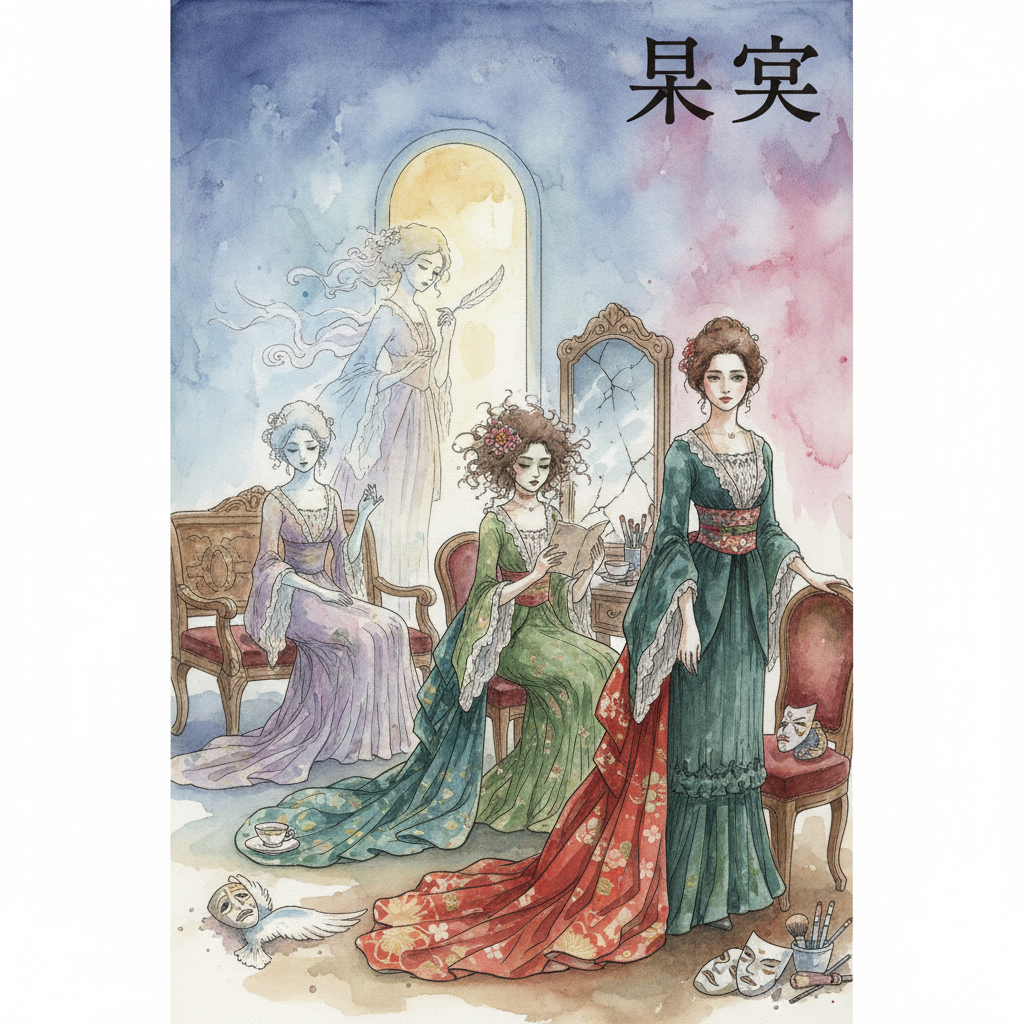
1) The Dressing Room (Gakuya, 楽屋〜流れ去るものはやがてなつかしき〜) — Kunio Shimizu (清水邦夫)
- Japanese Play Library: The Dressing Room
- Cast: 4 women
- Runtime: about 80 minutes
- Why it works in a staged reading: Almost everything important happens through waiting, repeating, remembering, and performing identity through speech.
If I had to recommend one Japanese play for a theater company's first staged reading in English, this would be near the top.
The backstage setting immediately helps. A reading room already resembles a rehearsal room, a holding area, or a theater's half-real interior. That means the form of the event supports the form of the play. You do not need to fight the script with fake realism.
What makes The Dressing Room especially strong is the way it turns actor psychology into structure. Four actresses orbit The Seagull, vanity, memory, disappointment, and ghostliness. The play is funny, eerie, and sad, but never in a loud or over-explained way. It lets a reading use its limitations well:
- scripts in hand do not feel like a problem,
- a bare room can feel haunted rather than empty,
- and repetition becomes music instead of dead air.
For conservatories, women-led ensembles, repertory sidebars, and literary reading series, it is hard to beat.
2) Tokyo Notes (Tōkyō Nōto, 東京ノート) — Oriza Hirata (平田オリザ)
- Japanese Play Library: Tokyo Notes
- Cast: 12
- Runtime: about 100 minutes
- Why it works in a staged reading: Its dramatic power lives in distributed conversation, not scenic spectacle.
Many plays with large casts become muddy in a reading. Tokyo Notes is the exception if the ensemble is precise.
Set in a museum lobby while conflict in Europe grows offstage, the play moves through family fragments, cultural small talk, and social avoidance. It is one of the clearest examples of a Japanese script that can feel quiet on the surface while remaining theatrically alive in the ear.
The key word here is listening. This is not a star-turn reading. It is an ensemble reading. If your actors can manage overlapping attention, partial focus, and emotional drift, the script becomes mesmerizing. If they cannot, it will flatten quickly.
That is why I recommend it less for a casual public reading and more for:
- university departments,
- dramaturgy labs,
- advanced ensemble companies,
- and festivals that trust audiences to attend closely.
Related reading: Play Spotlight: Tokyo Notes
3) THE BEE (THE BEE, ザ・ビー) — Hideki Noda (野田秀樹) / Colin Teevan
- Japanese Play Library: THE BEE
- Cast: 4 in common production use
- Runtime: about 75-80 minutes
- Why it works in a staged reading: It is built around pressure, reversal, and verbal escalation, so the room gets hot fast even with minimal staging.
Some readings aim for delicacy. THE BEE does not. It attacks.
That is precisely why it can be such a strong reading choice. Hideki Noda and Colin Teevan developed it through an English-language collaborative process, and the result is a script whose rhythm already understands the live spoken line in English. It does not merely survive translation. It was shaped through performance-oriented English writing.
This matters for directors outside Japan because the usual anxiety around translated drama is reduced. You still need excellent actors. You still need tonal control. But you are not forcing a mute script to speak.
Choose THE BEE when you want:
- compact running time,
- high dramatic temperature,
- strong audience reaction,
- and a script that proves a staged reading can feel genuinely dangerous.
It is especially effective for festivals, adaptation labs, and audiences that like dark comedy with bite.
4) The Men Who Wanted to Sing (Utawasetai Otokotachi, 歌わせたい男たち) — Ai Nagai (永井愛)
- Japanese Play Library: The Men Who Wanted to Sing
- Cast: 3 men, 2 women
- Runtime: about 110 minutes
- Why it works in a staged reading: Institutional argument, ethical pressure, and public language do most of the dramatic work.
Ai Nagai is often an excellent reading playwright because she understands how ideas become conflict onstage without turning characters into thesis machines.
This play, centered on the politics of singing the national anthem at a school graduation ceremony, has a premise that sounds locally specific but travels well. Every audience understands institutions asking people to perform belief. Every reading room understands what happens when personal dignity collides with workplace obedience.
That is the script's great advantage in English. You may need a little framing, but not much. Once the argument starts, the audience can follow the stakes through the human behavior.
I would recommend this one for:
- civic theater groups,
- schools and universities,
- public humanities programs,
- and post-show discussion events.
If your reading series wants a play that can open conversation about nationalism, conformity, and speech under pressure without losing theatrical tension, this is one of the smartest choices in the Japanese repertoire.
5) Our Planet (Waga Hoshi, わが星) — Yukio Shiba (柴幸男)
- Japanese Play Library: Our Planet
- Cast: 8
- Runtime: about 90 minutes
- Why it works in a staged reading: It balances familiar family-scale interaction with a larger poetic frame, so the reading can feel expansive without expensive staging.
Not every good staged reading has to feel severe. Our Planet is a reminder that a reading can also feel generous, playful, and quietly cosmic.
Yukio Shiba builds the play around an ordinary family and an extraordinary frame of time and planetary scale. Because that scale is conceptual rather than scenic, a reading can carry it beautifully. Actors, rhythm, and narration do much of the imaginative work for the audience.
This is one reason the play travels well in English-facing contexts. It gives audiences a recognizable emotional base while still offering formal surprise. If your company likes ensemble pieces that move between domestic detail and metaphysical lift, Our Planet can be a superb bridge text.
It is particularly strong for:
- reading festivals,
- family-drama themed series,
- ensemble training,
- and audiences who want contemporary Japanese drama without immediate bleakness.
6) Boy B (Shōnen B, 少年B) — Yukio Shiba (柴幸男)
- Japanese Play Library: Boy B
- Cast: 4 men, 1 woman
- Runtime: about 60 minutes
- Why it works in a staged reading: Short runtime and emotionally direct structure make it easy to program, rehearse, and pair with discussion.
Every reading series needs at least one title that is practical in the boring way and moving in the non-boring way. Boy B is that kind of pick.
At about an hour, it is much easier to slot into educational programs, double bills, or one-night events. But the reason to choose it is not just logistics. The play has a compact emotional engine built around youth, memory, and the feeling that life has already tilted before adulthood properly begins.
That gives actors something immediate to play, and it gives audiences something immediate to hear.
I especially like it for:
- student directors,
- youth-oriented festivals,
- first encounters with Japanese drama,
- and translation workshops that want a complete script rather than excerpt work.
Because the frame is compact, the reading does not need to manufacture momentum. The script already brings it.
7) Tomodachi ga Kita (Tomodachi ga Kita, ともだちが来た) — Toshiro Suzue (鈴江俊郎)
- Japanese Play Library: Tomodachi ga Kita
- Cast: 2 actors
- Runtime: about 90 minutes
- Why it works in a staged reading: Two actors, one unstable social encounter, and a gradual build of discomfort are nearly ideal for intimate rooms.
Two-handers can be dangerous in a reading because there is nowhere to hide. That is also why they can be exhilarating.
Tomodachi ga Kita works through hesitation, social mismatch, and the increasingly odd air around a simple visit. The play benefits from exactly the conditions that staged readings provide:
- close audience attention,
- visible actor listening,
- and no pressure to over-illustrate ambiguity.
For small theaters, actor showcases, and portable festival programs, this is a very smart Japanese script to keep in mind. It lets tension emerge from everyday behavior without requiring elaborate explanation.
If your reading room is intimate and your performers are subtle, this play can hit very hard.
8) Metamorphosis (Henshin, 変身) — Norihito Nakayashiki (中屋敷法仁)
- Japanese Play Library: Metamorphosis
- Cast: 1 man, 2 women
- Runtime: about 50 minutes
- Why it works in a staged reading: Short form, stylized language, and symbolic transformation all encourage imaginative staging rather than expensive realism.
For workshop programs and shorter public events, Metamorphosis is one of the most flexible titles on this list.
Its literary recognition helps audience entry, but its real value in a reading is simpler: transformation can be heard as well as seen. When the script and actors make the shift legible, the audience does not need technical illusion to stay engaged.
This makes it especially useful for:
- training programs,
- experimental reading nights,
- adaptation classes,
- and venues that prefer short-form programming.
It is not the most emotionally expansive play here, but it may be the easiest one to test quickly with a small team. That alone gives it real value in 2026 reading culture, where rehearsal time is often scarce and programming windows are tight.
Comparison Table: Which play fits your reading best?
| Play | Cast | Runtime | Best Use | First Reason to Pick It |
|---|---|---|---|---|
| The Dressing Room | 4 | ~80 min | Actor-centered literary reading | Repetition and theatrical memory sound great aloud |
| Tokyo Notes | 12 | ~100 min | Advanced ensemble reading | Quiet conversation carries major social tension |
| THE BEE | 4 | ~75-80 min | Festival or high-intensity event | English-language performance rhythm is already strong |
| The Men Who Wanted to Sing | 5 | ~110 min | Discussion-driven public reading | Institutional conflict is immediately legible |
| Our Planet | 8 | ~90 min | Ensemble reading with wider emotional range | Domestic life expands into cosmic perspective |
| Boy B | 5 | ~60 min | Schools and compact events | Easy to schedule without feeling minor |
| Tomodachi ga Kita | 2 | ~90 min | Intimate room, actor showcase | Tension grows through listening and awkwardness |
| Metamorphosis | 3 | ~50 min | Workshop or double bill | Short, flexible, and symbolically rich |
Where should you start first?
If you only want three Japanese plays for staged readings in English, I would start here:
1) The Dressing Room
The safest all-around recommendation for actor quality, room compatibility, and literary interest.
2) THE BEE
The sharpest choice if you want the reading to feel urgent, contemporary, and physically charged even with minimal means.
3) The Men Who Wanted to Sing
The strongest choice if your audience likes argument, politics, and post-show discussion without losing dramatic clarity.
Then branch by need:
- want ensemble quiet and subtext? -> Tokyo Notes
- want warmth and scale? -> Our Planet
- want something compact for students? -> Boy B
- want a two-actor tension machine? -> Tomodachi ga Kita
- want a short workshop title? -> Metamorphosis
FAQ
What is the best Japanese play for a staged reading in English?
For many companies, The Dressing Room is the safest first recommendation because it is actor-centered, room-friendly, and theatrically rich without requiring full production resources.
Which Japanese play works best for a public reading with discussion?
The Men Who Wanted to Sing is especially strong because its institutional conflict and ethical stakes are easy for audiences to grasp and discuss.
Which Japanese play is best for a small cast reading?
THE BEE and Tomodachi ga Kita are both excellent small-cast options, depending on whether you want explosive escalation or slow-burn discomfort.
Are Japanese plays good for university staged readings?
Yes. Tokyo Notes, Boy B, Our Planet, and The Men Who Wanted to Sing are particularly useful for campuses because they support discussion, ensemble work, and translation-aware performance study.
Do staged readings help before a full production?
Absolutely. They are often the smartest way to test whether a Japanese script's rhythm, translation, and audience entry points are truly working in your specific context.
Sources
- Seinendan, Tokyo Notes official English page (premiere, award, international performance history, translation reach): https://www.seinendan.org/eng/play/1994/tokyonotes/
- Performing Arts Network Japan, Hideki Noda / Colin Teevan: THE BEE (English-language development and performance data): https://performingarts.jpf.go.jp/en/article/6283/
- Performing Arts Network Japan, Tomohiro Maekawa and Six Translators (translated readings, overseas circulation, multilingual publication context): https://performingarts.jpf.go.jp/en/article/68062/
- Japan Society, Our Planet event page (English reading context and translation credit): https://japansociety.org/events/our-planet/
- Bloomsbury, Red Demon English edition page (useful background for Noda's English-facing circulation even beyond the titles listed here): https://www.bloomsbury.com/us/red-demon-9781840023572/
この記事で紹介した戯曲






Written by
戯曲図書館 編集部
演劇経験者が運営する戯曲検索サービス「戯曲図書館」の編集チームです。 脚本選びのノウハウ、演劇業界の最新情報、公演レポートなどを発信しています。
関連記事
Best Japanese Plays in English (2026): 8 Scripts for English-Speaking Theater Makers
A 2026 guide to 8 Japanese plays in English that already travel well, with cast size, runtime, and staging value for theater makers.
2026-07-22
If You Like Long Day's Journey Into Night (2026 Guide): 5 Japanese Plays About Family Secrets, Blame, and the Past That Won't Stay Buried
Love Long Day's Journey Into Night? Read 5 Japanese plays about family secrets, inherited grief, and the quiet violence of a past that refuses to stay buried.
2026-10-02
If You Like The Crucible (2026 Guide): 4 Japanese Plays About Scapegoats, Panic, and Public Obedience
Love The Crucible? Read 4 Japanese plays about fear, scapegoats, conformity, and the cost of refusing the crowd.
2026-08-21
Best Japanese Plays for Low-Budget Productions (2026): 8 Scripts With Minimal Set Demands
A practical 2026 guide to 8 Japanese plays for low-budget productions, with cast size, runtime, and staging notes for small theaters, schools, and readings.
2026-08-19