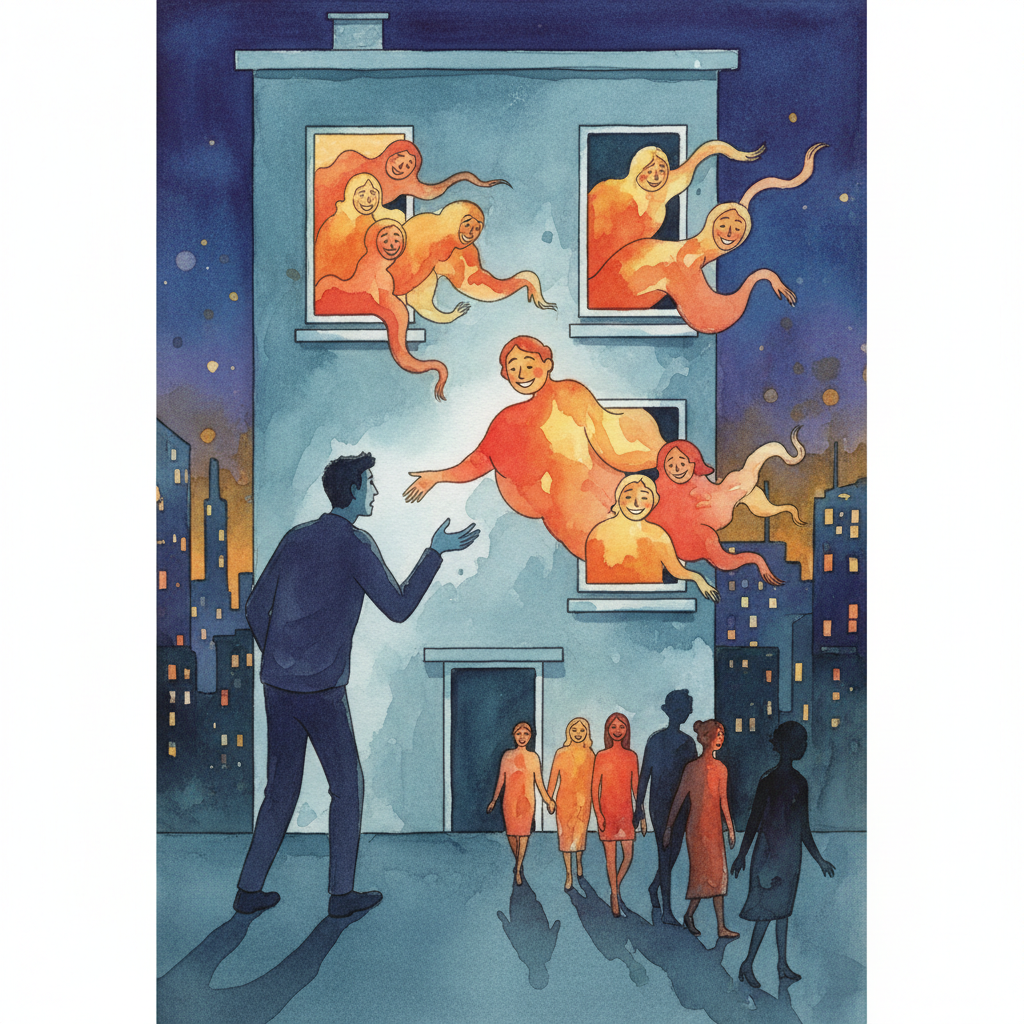
Tomodachi (Friends, 友達) is a Japanese absurdist dark comedy in which a smiling family invades one man's apartment and slowly turns "friendship" into a system of occupation.
For English-speaking theater-makers in 2026, that is the clearest reason to care: this is one of the sharpest Japanese plays about loneliness, conformity, and social coercion ever written, and it remains frighteningly stageable.
Quick Facts
| Item | Details |
|---|---|
| Japanese title | 友達 |
| Common English title | Friends |
| Romanization | Tomodachi |
| Playwright | Kobo Abe (安部公房, Abe Kobo) |
| First major version | 1967 |
| Published revised edition | Included in Shinchosha paperback edition |
| Cast size in Japanese Play Library | 15 performers |
| Cast profile in Japanese Play Library | 9 men, 6 women |
| Runtime in Japanese Play Library | About 130 minutes |
| Core setting | A bachelor's apartment and the social systems around it |
| Best fit for | Large ensembles, actor-centered absurdism, university theater, black comedy programming |
| Core themes | Invasive kindness, anti-loneliness ideology, loss of privacy, collective violence, urban isolation |
Internal play links on Japanese Play Library:
Related English reading on Japanese Play Library:
Why Tomodachi matters in 2026
Some classic plays become easier to admire than to use. Tomodachi is not one of them. It remains disturbingly useful.
The premise is instantly graspable even if you know very little about Japanese postwar theater. A man living alone is visited by a family that insists on becoming his friends. They do not break in like burglars. They enter with smiles, conversational energy, domestic confidence, and the language of care. Soon they are inside his room, inside his schedule, inside his legal and emotional reality. The man tries to resist, but every institution that should defend him either ignores him or quietly joins the family logic.
That is why the play feels current in 2026. Abe understood a kind of pressure that modern societies still produce constantly: control that arrives not as obvious dictatorship, but as intimacy without consent, concern without respect, and collective warmth that erases the individual it claims to save.
Today, theater artists across many countries are looking for plays that can dramatize:
- the instability of private life,
- the moral danger of anti-loneliness rhetoric,
- how bureaucracy and social norms can normalize abuse,
- and the way group belonging can become predatory.
Tomodachi stages all of that with a theatrical directness that still feels fresh. It is funny, but the laughter is corrosive. It is absurd, but the absurdity never floats away from recognizable social behavior. And it is large-cast without being lavish. That combination is rare.
About Kobo Abe (安部公房)
Kobo Abe was born in Tokyo in 1924 and became one of the essential postwar Japanese writers across fiction, drama, photography, and theatrical production. Shinchosha's author profile describes a career that moved from medicine studies at the University of Tokyo to literary breakthrough, major national awards, and the later creation of Abe Kobo Studio in 1973. That matters because Abe did not approach theater as a secondary outlet. He treated it as part of a larger artistic system.
The Kanagawa Museum of Modern Literature's 2024 centenary exhibition is especially useful here. Its framing presents Abe not only as the author of famous novels such as The Wall and The Woman in the Dunes, but also as the playwright of works including Tomodachi, and as an artist deeply invested in the instability of names, bodies, place, and social order. In other words, the museum treats the theater as central to understanding Abe, not peripheral.
That is exactly the right way to approach Tomodachi. This is not a curiosity from a novelist's side career. It is one of the clearest expressions of Abe's theatrical intelligence.
He was exceptionally good at building situations where:
- a room stops being private,
- ordinary language becomes coercive,
- strangers acquire power by acting normal,
- and institutions quietly decide that the individual is less believable than the crowd.
The result is theater that remains internationally legible without becoming generic. If Samuel Beckett shows how emptiness can become pressure, and Harold Pinter shows how speech can become menace, Abe shows how friendliness itself can become a weapon.
Story overview
The action begins with a solitary man in his apartment. Then a family of nine appears: grandmother, parents, siblings, all smiling, all speaking in the register of neighborly good sense. They insist they are his friends. They insist he is lonely. They insist that loneliness is unhealthy and that their presence is therefore a kind of rescue.
This is the crucial inversion. The man never invited them. He does not want them there. But the family's language turns his refusal into proof of need.
As the revised Shinchosha edition summarizes it, a plain man's room is suddenly entered by a family of nine who continue to speak in the name of neighborly love. The Sis Company synopsis for the 2021 stage production sharpens the stage picture further: the man seeks help from the building manager, the police, his fiancee, and a lawyer, yet the surrounding world increasingly sides with the family's logic instead of his own.
That escalation is what makes the play more than a one-joke absurdist setup. The apartment invasion becomes a laboratory for how power operates when no one admits that power is being used.
The family occupies the room gradually but relentlessly. They rearrange physical space. They redefine emotional expectations. They use numbers, confidence, routine, and moral language to make the protagonist appear unreasonable. By the time he understands the scale of the threat, the categories that should protect him, such as law, property, social common sense, and even sympathy, have already become unreliable.
This is why the play is so productive for performance analysis. The plot is simple enough to pitch in one sentence, but the mechanism is rich enough to sustain a full production process. Every entrance, smile, apology, and practical suggestion matters.
A practical production profile
| If your company needs... | Tomodachi offers... |
|---|---|
| A Japanese classic that still feels contemporary | A postwar play that reads like a diagnosis of modern social coercion |
| A large ensemble script without epic scenery | 15 performers and a mostly contained spatial logic |
| A dark comedy with genuine audience pull | Escalating absurdity, strong rhythm, and visible pressure |
| A play for actor-centered staging | Status shifts, chorus-like family behavior, and room-scale menace |
| A university-friendly repertory challenge | Big cast, strong discussion value, and accessible central metaphor |
| A script that can bridge absurdism and social critique | Formal weirdness anchored in recognizable institutions |
The play's central themes
1) Kindness as violence
The most important thing to understand about Tomodachi is that its violence is rarely announced as violence.
The family does not frame itself as monstrous. It frames itself as compassionate. It sees loneliness as a public problem, and itself as the cure. This is what makes the play so unsettling. Abe is not only showing private intrusion. He is showing how moral language can authorize intrusion.
The smiling insistence on "friendship" is not decoration. It is the mechanism of capture.
For English-speaking audiences, this often becomes the play's sharpest surprise. Many invasion dramas operate through obvious threat. Tomodachi operates through help that cannot be refused without making you seem sick, selfish, or socially defective. The family can therefore keep escalating while continuing to feel righteous.
That is a disturbingly modern pattern. Communities, states, platforms, and institutions often justify overreach by claiming to reduce isolation, improve wellbeing, or restore connection. Abe's play does not reject connection itself. It asks who gets to define healthy connection, and what happens when "care" is detached from consent.
2) Loneliness as a political category
The protagonist is alone, and Abe never lets us romanticize that fact. The man is not automatically heroic because he prefers solitude. But neither is solitude a pathology in need of forced correction.
That tension is one reason the play stays interesting rather than turning into a simple allegory about good independence versus bad family values. Abe understands that loneliness is emotionally real and socially dangerous in multiple directions. Isolation can weaken a person. But campaigns against isolation can also become coercive if they deny the right to choose distance, privacy, or self-definition.
In Tomodachi, loneliness becomes a category others use to seize interpretive power over the man's life. Once he is defined as lonely, his testimony begins to matter less. The family becomes credible because it sounds socially useful. He becomes suspect because he sounds resistant.
That is not just a personal drama. It is a political process.
3) The crowd is easier to believe than the individual
One of the most brutal structural insights in the play is that institutions tend to trust organized collectives more easily than isolated persons. The man is alone. The family is numerous, coherent, and fluent in the language of ordinary social life. That asymmetry matters.
The Sis Company production page makes this especially clear in its synopsis. The protagonist seeks help from authorities and acquaintances, but the explanation never lands. Why? Because nothing sounds less persuasive than a solitary person claiming that a smiling family is destroying him.
This is classic Abe. Reality is not decided by truth alone. It is decided by social form.
That insight makes the play useful in classrooms, dramaturgy rooms, and rehearsal halls because it gives performers something larger than "character motivation" to work with. The play is an anatomy of credibility. Who sounds normal? Who sounds useful? Who sounds disruptive? Who gets absorbed into group language first?
4) Domesticity as occupation
Apartments in modern drama often symbolize privacy. Abe turns the apartment into a site where privacy is dismantled under the sign of domestic normalcy.
Meals, conversation, arrangement, household presence, practical concern: all of these things are recognizable markers of family life. In Tomodachi, they become tactics of territorial takeover.
That is one reason the play has real staging bite. Directors do not need abstract metaphors to show domination. Domination is visible in bodies sitting where they should not sit, touching what they should not touch, staying longer than they should stay, and speaking with the confidence of people who have already won.
The apartment becomes colonized not by spectacle, but by routine.
5) Dark comedy as exposure
If the play were only grim, it would probably be less effective. Abe's humor is essential.
The family can be ridiculous. Their certainty is funny. Their group logic is funny. Their relentless polite energy is funny. But every laugh drives the audience closer to a situation it can no longer dismiss.
This is why Tomodachi belongs among the strongest Japanese dark comedies available to English-speaking theater artists. It does not use comedy to soften the material. It uses comedy to reveal how terrifying ordinary social performance can become when detached from reciprocity.
Why Western audiences may connect with it
The play is deeply Japanese in authorship and postwar lineage, but its emotional and theatrical logic travels well. In fact, it may travel especially well now.
English-speaking audiences are already primed to understand:
- invasive positivity,
- institutions that fail to recognize slow coercion,
- the pressure to perform social health,
- and the fear that once a group defines you, your own explanation no longer counts.
The play also offers a useful alternative to more touristic ideas of what "Japanese theater" should be for international viewers. There are no easy exotic hooks here. No ritual is required for entry. No historical primer is needed before the basic dramatic conflict makes sense. Instead, the audience encounters a contemporary social nightmare built from hospitality, loneliness, and procedural normalcy.
That is a major strength if you are programming for viewers who want Japanese drama that feels immediate rather than merely canonical.
Comparison table for international programmers
| Play | Best use | Core pressure | Cast scale | Why choose it |
|---|---|---|---|---|
| Tomodachi | Large-ensemble dark comedy | Friendly invasion and anti-loneliness coercion | 15 | Best when you want swarm energy and social satire |
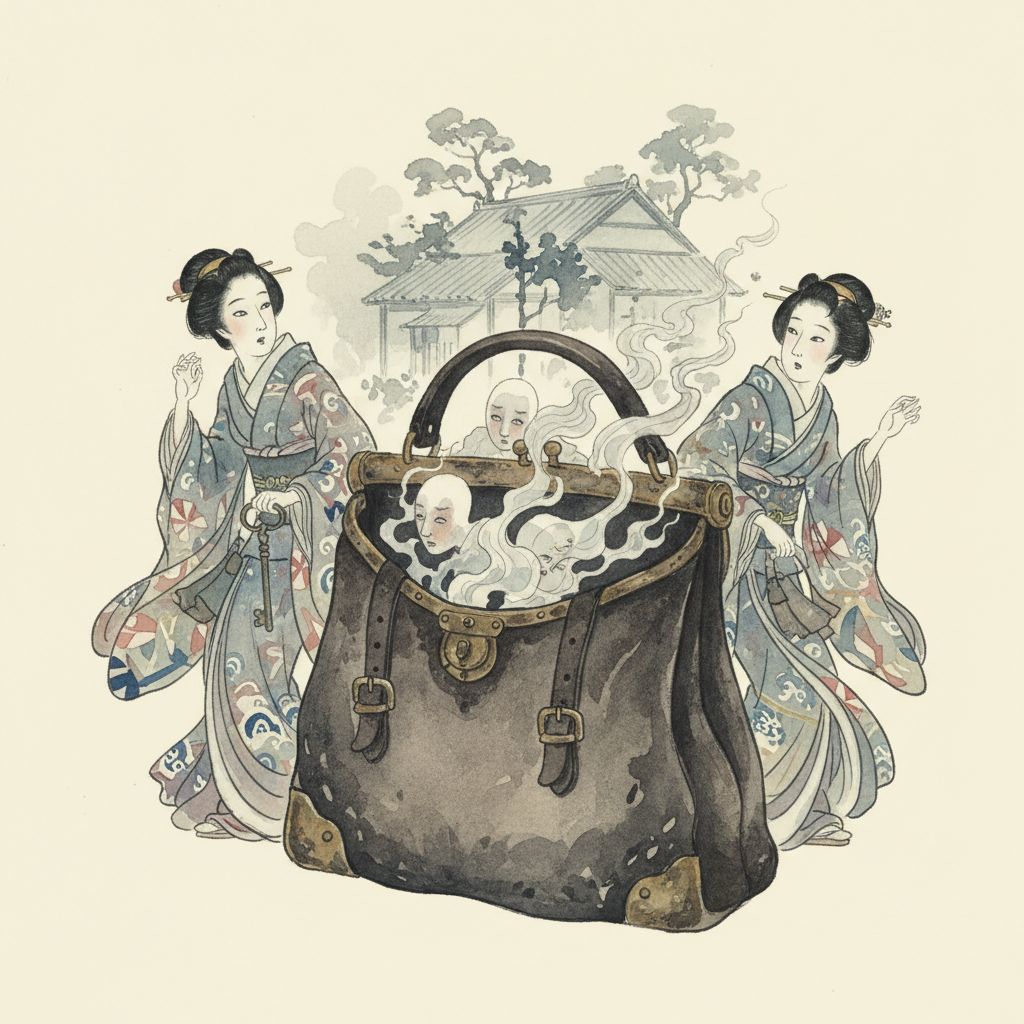
| The Suitcase | Black box absurdism | Object-centered dread and unstable ownership | 3 | Better if you need a smaller Abe entry point |
| The Elephant | Postwar absurdist chamber drama | Illness, memory, and public cruelty | 10 | Better if you want Betsuyaku's quieter but devastating tone |
| Tokyo Notes | Ensemble realism | Social drift and institutional atmosphere | 12 | Better if you want less overt absurdism and more quiet pressure |
This is not a hierarchy. It is a programming tool. If you want Abe at his most immediately performable for a large group, Tomodachi is the strongest first stop.
Production notes for directors, dramaturgs, and teachers
1) Do not make the family too obviously sinister too early
The play works best when the family begins inside the borders of ordinary plausibility. They should be too much, but not yet full caricature. If they begin as obvious horror figures, the play loses its main weapon: social recognizability.
2) Choreograph group rhythm carefully
This is a large-cast play, but not a loose one. The family needs precision. Their timing, overlap, interruptions, stillness, and proximity all shape the experience of pressure. A sloppy family becomes mere noise. A rhythmically exact family becomes terrifying.
3) Treat the apartment as contested territory
The set does not need to be expensive, but it must be legible. Every chair, doorway, object, and threshold should help the audience track how ownership is being dissolved. Space is not background in this play. Space is argument.
4) Keep the humor alive
Directors sometimes over-correct and present the play as pure menace. That usually flattens it. The comedy is part of the menace. If the audience stops laughing altogether, the play can become monotonous. If the audience only laughs, it loses moral depth. The best productions let the laugh curdle in real time.
5) Use it as an ensemble intelligence test
This is an excellent rehearsal-room play because it asks a company to solve collective behavior, not only isolated roles. It is especially useful in universities and ensemble programs because it demands:
- spatial awareness,
- group listening,
- precise tonal control,
- and a shared understanding of how coercion works.
Where to start if this play interests you
Start with the shortest useful pitch:
"A lonely man is invaded by a family that insists on saving him through friendship."
Then widen the frame through related Japanese Play Library pages:
- Tomodachi / Friends (友達) for the direct starting point
- Kaban / The Suitcase (鞄) for a smaller Abe companion text
- The Elephant / Zō (象) if you want another major Japanese absurdist play about social violence
- Tokyo Notes (東京ノート) if you want a quieter ensemble comparison
Then continue into English context:
Those links give you both the author frame and the broader repertoire frame.
FAQ
Is Tomodachi a good first Kobo Abe play for English-speaking readers?
Yes. It has one of Abe's clearest premises and one of his most stageable dramatic engines. If you want an immediate sense of how Abe turns social behavior into nightmare, this is a very strong first choice.
Is Tomodachi more funny or more disturbing?
Both. It is best understood as a dark comedy whose laughter gradually exposes a structure of coercion, humiliation, and fatal social absorption.
Why does the play still feel contemporary?
Because it understands how control often hides inside helpful language, collective confidence, and institutions that trust normal-looking groups over isolated individuals.
Is Tomodachi practical to stage?
Yes, if your company can handle a 15-person ensemble with rhythmic precision. It is more demanding in group coordination than in scenery or technical spectacle.
What is the main idea to carry into rehearsal?
The family should not feel like invaders who know they are invaders. They should feel like people who believe that their intrusion is morally justified.
Final takeaway
Tomodachi remains essential in 2026 because it shows that one of the most dangerous forms of violence is the violence that arrives smiling, speaking the language of friendship, and insisting that your refusal is proof that you need it more.
That is why the play still belongs on global stages. It gives large ensembles a rigorous acting machine, gives audiences a darkly funny social nightmare, and gives programmers a Japanese classic that feels less like a museum object than a live warning.
If you want one sentence to keep, use this one:
Tomodachi is a play about how loneliness becomes lethal when other people decide they have the right to cure it for you.
Sources
- Shinchosha, Tomodachi / The Man Who Turned Into a Stick edition page: https://www.shinchosha.co.jp/book/112119/
- Shinchosha, Kobo Abe author profile: https://www.shinchosha.co.jp/sp/writer/649/
- Kanagawa Museum of Modern Literature, Kobo Abe: The Axis of 21st Century Literature: https://www.kanabun.or.jp/exhibition/project/20944/
- Sis Company, 2021 production page for Tomodachi: https://www.siscompany.com/produce/lineup/tomodachi/
- Japanese Play Library, Tomodachi entry: https://gikyokutosyokan.com/posts/209
この記事で紹介した戯曲
Written by
戯曲図書館 編集部
演劇経験者が運営する戯曲検索サービス「戯曲図書館」の編集チームです。 脚本選びのノウハウ、演劇業界の最新情報、公演レポートなどを発信しています。
関連記事
Tomodachi vs No Exit: A 2026 Guide to Friendly Invasion, Hellish Rooms, and the Violence of Other People
Compare Tomodachi and No Exit through confinement, coercion, group pressure, and the politics of being trapped with others.
2026-08-30
Playwright Profile: Kobo Abe (安部公房) in 2026 — Why Friends and The Suitcase Still Feel Unsettling
A 2026 English guide to Kobo Abe's theatrical career, major plays, style, and why his stage work still matters for global theater artists.
2026-08-20
Play Spotlight 2026: Why Hogiuta (寿歌) Still Feels Urgent on Global Stages
A 2026 English spotlight on Hogiuta, So Kitamura's small-cast post-apocalyptic Japanese play of humor, music, and survival.
2026-08-31
Play Spotlight 2026: Henro (偏路) by Yukiko Motoya
A 2026 English spotlight on Henro, Yukiko Motoya's darkly comic family play about failed ambition, unwanted kindness, and going home.
2026-08-17