Kobo Abe (安部公房, Abe Kobo) is one of the essential postwar Japanese playwrights because he turned ordinary rooms, objects, and social rules into engines of theatrical unease.
For English-speaking readers in 2026, Abe matters not only as the novelist behind The Woman in the Dunes. He matters as a dramatist who made identity, surveillance, belonging, and coercion stageable with unusual clarity. If you are building a world drama syllabus, searching for Japanese plays that work in translation, or looking for compact but intellectually sharp repertoire, Abe is one of the best writers to start with.
Quick Facts
| Item | Detail |
|---|---|
| Japanese name | 安部公房 (Abe Kobo) |
| Born | March 7, 1924, Tokyo |
| Died | January 22, 1993 |
| Main roles | Novelist, playwright, director, theatrical producer |
| Education | University of Tokyo, Faculty of Medicine |
| Major theater platform | Abe Kobo Studio, founded in 1973 |
| Signature theatrical traits | Absurd premises, unstable identity, invasive social systems, spatial anxiety |
| Key honors | Akutagawa Prize, Tanizaki Prize, Yomiuri Literature Prize |
| International recognition | Elected International Honorary Member of the American Academy of Arts and Sciences in 1977 |
| Why he matters in 2026 | His plays still speak directly to life shaped by bureaucracy, isolation, and pressure disguised as normality |
Why Kobo Abe Matters in 2026
Abe feels unusually contemporary because he understood a problem that has only intensified: people are often controlled not by spectacular tyranny alone, but by procedures, labels, polite intrusion, and environments that slowly erase autonomy.
That is why his stage work still lands.
In 2026, theater artists across many countries are asking how to dramatize:
- social isolation inside crowded cities,
- systems that reduce people to roles or functions,
- the instability of identity under pressure,
- and the way ordinary language can become coercive without ever sounding openly violent.
Abe spent decades writing those pressures. He did not usually present them as speeches about ideology. He built situations in which a room becomes a trap, a family becomes an occupying force, or an object becomes the center of a moral crisis. The audience does not just “understand” the problem. It feels the logic closing in.
For international readers, that makes Abe especially practical. He is philosophically serious, but he is also playable. His best theater is not abstract in the sense of being distant. It is abstract in the sense of stripping away excuses.
Biography and Theatrical Formation
A writer formed across genres
Shinchosha's author profile presents Abe as a major literary figure who moved with force across fiction and drama: born in Tokyo in 1924, educated in medicine at the University of Tokyo, awarded the Akutagawa Prize for The Wall, and widely recognized for The Woman in the Dunes as well as for his dramatic writing. That combination matters because Abe never approached theater as a side hobby. He came to it as a writer already deeply interested in how identity can fracture under social and physical pressure.
Columbia University Press describes Abe as one of Japan's greatest postwar writers, acclaimed for both imaginative fiction and plays of the absurd. That dual framing is useful. In English, Abe is often introduced through novels first. But his dramaturgy is not secondary. The plays are one of the clearest places to watch his ideas become spatial, physical, and collective.
Theater as total design
One of the most important details in Abe's career is the founding of Abe Kobo Studio in 1973. Shinchosha highlights the studio as a major part of his independent theatrical activity, and the American Academy of Arts and Sciences member page identifies him not just as a writer but also as a theatrical producer and director. That is a crucial distinction. Abe was not merely handing scripts to other people. He was shaping a performance ecology.
This matters for reading the plays. Abe's theater is rarely just “literary absurdism.” It is built through stage image, pacing, sound, object relations, and bodily arrangement. The text does a lot, but the text is not the whole machine.
Ongoing institutional recognition
Abe's reputation is not frozen in the twentieth century. The Kanagawa Museum of Modern Literature's 2024 centenary exhibition described his activity as ranging from student poetry to novels such as The Wall and The Woman in the Dunes, to plays such as Tomodachi (Friends), photography, and the integrated artistic experiments of Abe Kobo Studio. The museum's framing is especially revealing because it asks what Abe's themes mean in the twenty-first century, not only what they meant historically.
That exhibition matters as evidence of present-tense relevance. Abe is still being curated not as a classroom obligation, but as an artist whose treatment of names, bodies, place, and social inversion continues to illuminate current life.
What Makes Abe's Theater Distinct
1) The absurd emerges from social behavior
Abe is often grouped with absurdist dramatists, and the label is useful as long as it is not flattened. His plays do not usually begin in a cosmic void. They begin in recognizable social arrangements: a visit, a conversation, an apartment, a household rule, a practical request.
Then the logic bends.
The disturbing part is that the characters often keep behaving as if everything remains reasonable. That is the source of much of Abe's theatrical pressure. The world does not explode; it normalizes the intolerable.
2) Objects become dramatic systems
Many playwrights use props. Abe uses objects as conceptual traps.
A suitcase is never just a suitcase. A room is never just a room. An intrusion is never just an interruption. Objects in Abe carry social pressure. They expose what characters think they own, what they fear, and how fragile their boundaries really are.
That makes him especially valuable for directors working in modest spaces. He does not require expensive scenography to produce complexity. He requires accuracy.
3) Identity is unstable by design
Abe's plays repeatedly ask what makes a person a person: name, body, memory, private space, social recognition, or legal status. The answer is never secure. That instability is one reason his work still reads so sharply in a digital and bureaucratic age. Contemporary life constantly sorts people through paperwork, systems, profiles, and roles. Abe saw early how violent that process could become.
4) Comedy and dread coexist
English-speaking readers sometimes encounter Abe through existential seriousness and miss how funny he can be. But the humor is essential. In Abe, politeness, repetition, misplaced confidence, and deadpan escalation often create laughter at exactly the moment the situation becomes most unbearable.
That tonal mix is one reason his work stages well. The audience is pulled forward by wit even while the moral atmosphere darkens.
Essential Works on Japanese Play Library
For readers using Japanese Play Library, two currently listed pages offer a strong first route into Abe's theater.
1) Tomodachi (Friends, 友達)
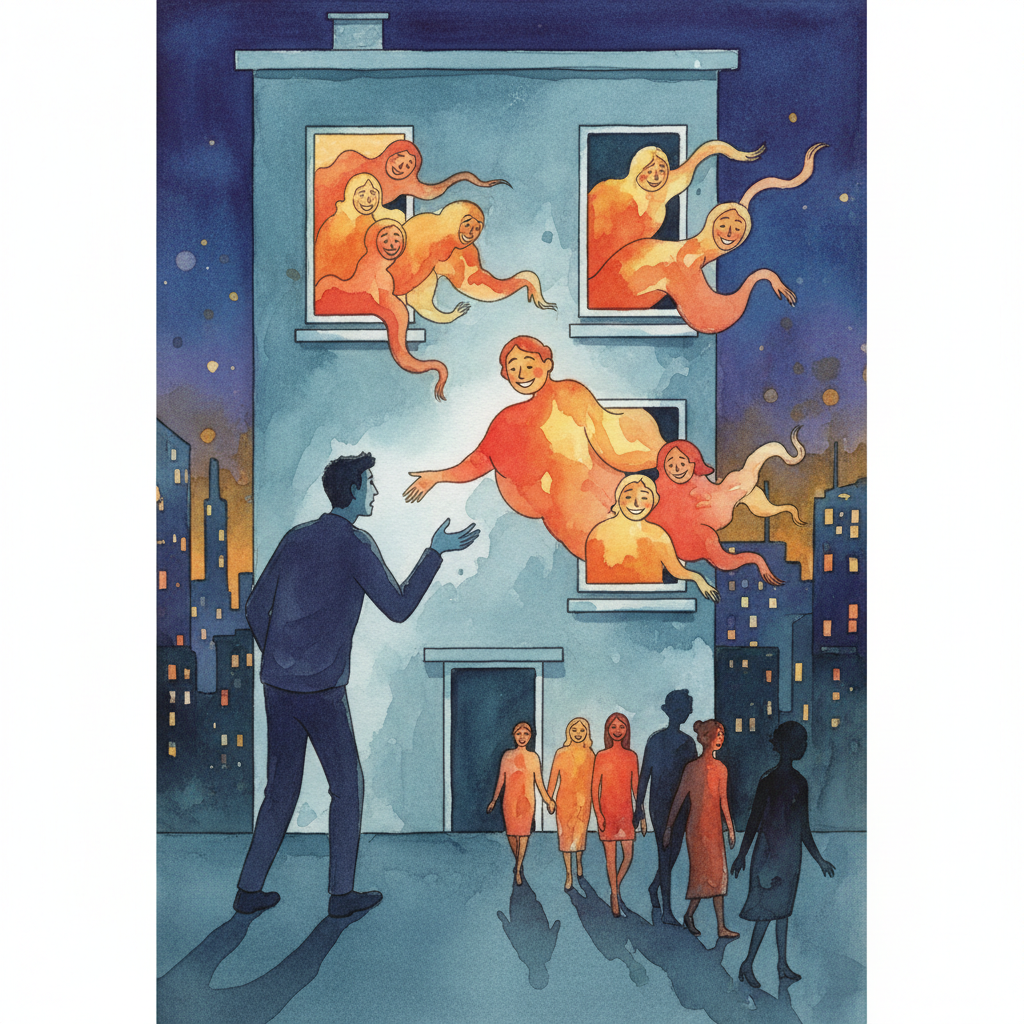
This is the best first stop for many English-speaking theater artists. A man in his apartment is visited by a family of nine who insist they are his friends. The visit becomes occupation, and the occupation becomes a devastating study of conformity, invasion, and the violence hidden inside collective warmth.
Why it matters:
- It shows Abe's gift for turning politeness into coercion.
- It works as absurd comedy and as social nightmare at the same time.
- It is especially relevant for audiences thinking about group pressure, surveillance, and the erosion of private life.
Internal link: Tomodachi / Friends
2) Kaban (The Suitcase, 鞄)
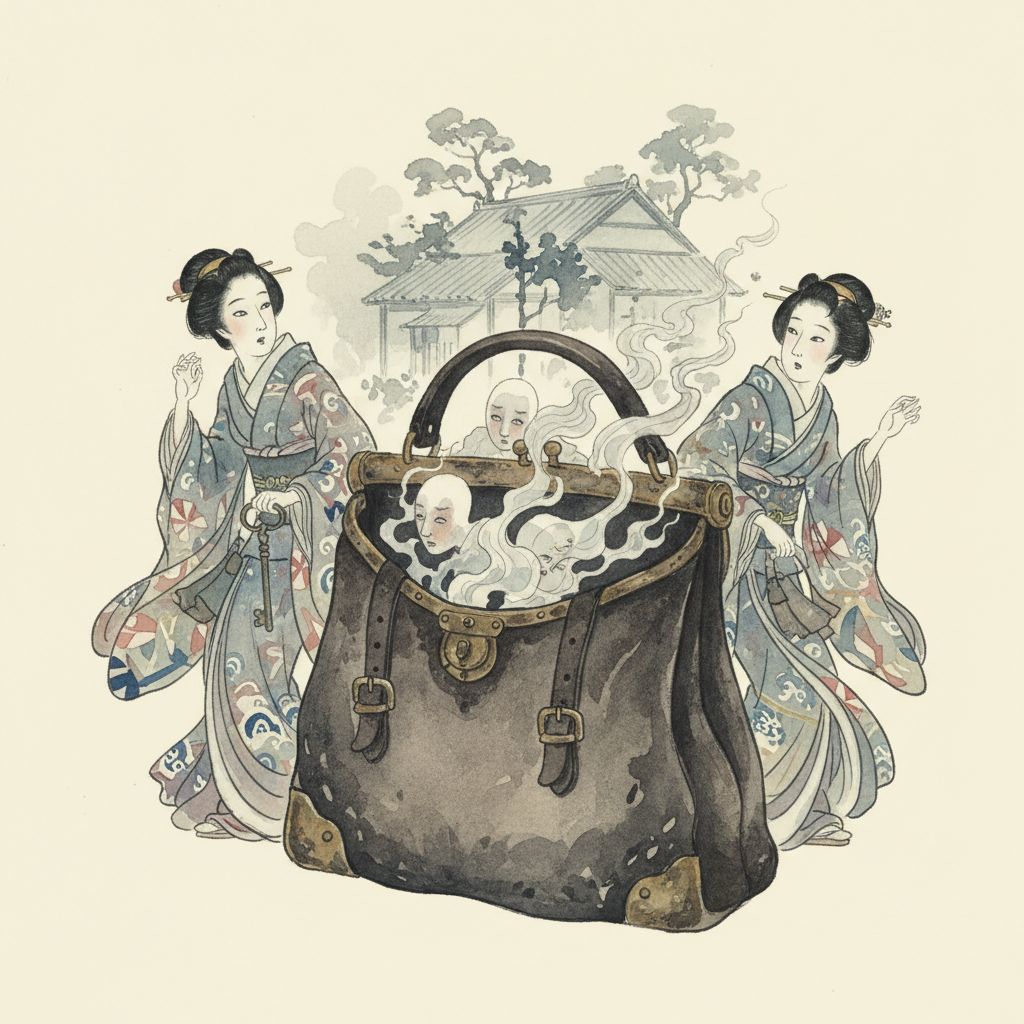
This play is a superb entry point if you want Abe in a smaller, more concentrated mode. A woman asks a visitor to inspect a suitcase that supposedly contains an “ancestor.” The premise is absurd immediately, but the real force lies in the way the play destabilizes ownership, inheritance, fear, and bodily imagination.
Why it matters:
- It shows how Abe can generate major pressure from one object and one room.
- It is excellent for black box production, readings, and classroom analysis.
- It demonstrates that Abe's weirdness is structural, not decorative.
Internal link: Kaban / The Suitcase
If you want a wider database view after those two, the author hub is also useful:
Abe in Global Context
| Dimension | Kobo Abe | Samuel Beckett | Harold Pinter |
|---|---|---|---|
| Social setting | Everyday civic or domestic spaces under pressure | Sparse existential landscapes | Rooms defined by menace and status games |
| Comic method | Bureaucratic or polite absurd escalation | Repetition and existential deadpan | Verbal threat, evasion, pause |
| Core anxiety | Identity and autonomy eroded by systems | Meaning drained from existence | Power shifts inside speech and silence |
| Staging resource | Object logic and conceptual space | Rhythm and emptiness | Subtext and territorial control |
| Best keyword | Invasion | Waiting | Menace |
This table is not claiming direct equivalence. It is a programming tool. For English-speaking curators, Abe often sits productively between Beckett's ontological severity and Pinter's room-scale intimidation, while remaining distinctly shaped by postwar Japanese social forms.
What International Directors Should Know Before Staging Abe
Play the situation truthfully
The temptation with Abe is to “perform absurdism” too hard. That can flatten the work into a style exercise. Usually the better approach is to let the characters behave as if their logic is normal. The horror grows from sincerity.
Treat space as argument
The New National Theatre Tokyo's presentation of The Fortress described Abe as the author of an ambitious work from the Showa 30s and framed the production as a fresh contemporary reading. That is a useful reminder: Abe's plays are not just stories. They are arguments made through space.
Where is the threshold? Who has the right to sit, enter, touch, or remain? When does hospitality become capture? These are not secondary staging questions in Abe. They are the structure.
Keep the comedy alive
If every line is played as solemn allegory, the drama loses oxygen. Abe's comedy is not relief from the critique; it is the delivery system for the critique. Actors need to hear how procedural language, over-familiarity, and misplaced practicality produce rhythm.
Minimalism is not emptiness
Abe can work beautifully with minimal design, but “minimal” does not mean emotionally blank. The stage picture should be exact enough that every object and spatial shift registers. One chair in the wrong place can matter more than an expensive concept set.
Why Teachers, Dramaturgs, and Programmers Keep Returning to Abe
Abe is unusually useful because one playwright opens several conversations at once:
- postwar Japanese literature and theater history,
- absurdism outside Europe,
- the politics of private space,
- theater and bureaucracy,
- object dramaturgy,
- and adaptation between fiction, drama, and performance design.
He is also a strong corrective to a common Anglophone habit of reducing Japanese theater either to classical heritage or avant-garde spectacle. Abe belongs to neither category neatly. He writes modern, stageable, intellectually rigorous plays that speak directly to contemporary institutions and ordinary life.
For classroom use, a practical sequence is:
- Tomodachi for invasion, group logic, and dark comedy.
- Kaban for object-centered dread and small-scale precision.
- A comparative discussion with Beckett or Pinter to clarify what is specifically Abe's.
Related English Reading on Japanese Play Library
If you want to keep going in English after this profile, these are useful next steps:
- If You Like Waiting for Godot: 6 Japanese Plays of Waiting, Failure, and Strange Survival
- Best Japanese Plays for Dark Comedy Lovers in 2026
The first is a helpful crossover route for readers coming from European absurdism. The second places Abe alongside other Japanese writers who use humor to expose cruelty, discomfort, and social collapse.
FAQ
Who was Kobo Abe?
Kobo Abe (1924-1993) was a major Japanese novelist, playwright, director, and theatrical producer known for works that explore alienation, unstable identity, and the absurd pressures of modern life.
Is Kobo Abe important as a playwright or mainly as a novelist?
He is important as both, but his theater should not be treated as secondary. His plays are among the sharpest postwar Japanese works for staging social coercion, spatial anxiety, and conceptual absurdity.
What is the best first Kobo Abe play to read?
For many readers, Tomodachi (Friends) is the strongest first choice because its premise is immediately legible and theatrically powerful.
Is Abe difficult to stage in English?
Not necessarily. His work is intellectually demanding, but often practical to stage because it relies on precise acting, spatial logic, and tonal control more than on expensive production infrastructure.
Why does Abe still matter in 2026?
Because his plays remain strikingly relevant to societies shaped by systems, paperwork, social conformity, invasive politeness, and unstable personal identity.
Conclusion
Kobo Abe remains essential in 2026 because he understood that modern life often becomes terrifying not through open catastrophe alone, but through the slow normalization of intrusion, abstraction, and role-based control.
That is why his plays still work. They are conceptually sharp without becoming inert, funny without becoming light, and theatrical without requiring excess. For English-speaking readers who want Japanese drama that is both intellectually rich and vividly stageable, Abe is not an optional detour from the canon. He is part of the core route through it.
Start with Tomodachi. Then read Kaban. Once you see how Abe turns rooms, objects, and friendly language into instruments of pressure, it becomes clear why his theater still feels less historical than diagnostic.
Sources
- Shinchosha, author profile for Kobo Abe — biography, awards, Abe Kobo Studio, and international recognition: https://www.shinchosha.co.jp/sp/writer/649/
- Kanagawa Museum of Modern Literature, Kobo Abe: The Axis of 21st Century Literature — centenary framing of novels, plays, photography, and Abe Kobo Studio: https://www.kanabun.or.jp/exhibition/20944/
- New National Theatre Tokyo, The Fortress page — evidence of continuing institutional staging and contemporary framing of Abe's drama: https://www.nntt.jac.go.jp/play/thefortress/
- American Academy of Arts and Sciences, Kobo Abe member page — 1977 International Honorary Member listing and role description: https://www.amacad.org/person/kobo-abe
- Columbia University Press, The Traitor author page — concise English positioning of Abe as a major postwar writer acclaimed for fiction and plays of the absurd: https://cup.columbia.edu/book/the-traitor/9780231212946/
この記事で紹介した戯曲
Written by
戯曲図書館 編集部
演劇経験者が運営する戯曲検索サービス「戯曲図書館」の編集チームです。 脚本選びのノウハウ、演劇業界の最新情報、公演レポートなどを発信しています。
関連記事
Playwright Profile: Minoru Betsuyaku (別役実) in 2026 — The Quiet Force Behind Japanese Absurdist Theater
A 2026 English guide to Minoru Betsuyaku’s life, major plays, theatrical method, and why his absurdist drama still matters internationally.
2026-07-30
Tomodachi vs No Exit: A 2026 Guide to Friendly Invasion, Hellish Rooms, and the Violence of Other People
Compare Tomodachi and No Exit through confinement, coercion, group pressure, and the politics of being trapped with others.
2026-08-30
Play Spotlight 2026: Tomodachi (Friends, 友達) by Kobo Abe (安部公房)
A 2026 English spotlight on Tomodachi, Kobo Abe's invasive dark comedy about loneliness, conformity, and kindness as violence.
2026-08-24
Playwright Profile: Shuji Terayama (寺山修司) in 2026 — The Angura Poet Who Turned Theater Into a Weapon
A 2026 English guide to Shuji Terayama's life, Tenjo Sajiki troupe, major plays, and why his angura theater still shapes global performance in 2026.
2026-10-01