Shuji Terayama (寺山修司, Terayama Shūji) is the single most important writer to understand if you want to grasp how Japanese avant-garde theater weaponized poetry, pop culture, horse racing, and the street into one of the twentieth century's most radical performance languages.
For English-speaking theater makers, students, and festival programmers in 2026, Terayama is not a historical curiosity. He is a direct ancestor of a huge amount of what we now call immersive theater, site-specific performance, queer underground performance, performance art, and intermedia work. He died in 1983, but his aesthetic logic is still being quoted — sometimes consciously, sometimes not — on stages from Taipei to Berlin.
This profile explains who Terayama was, how his Tenjō Sajiki (天井棧敷) troupe worked, which of his plays translate best for international audiences, and why Japanese Play Library treats him as essential repertoire.
Quick Facts
| Item | Detail |
|---|---|
| Japanese name | 寺山修司 (Terayama Shūji) |
| Born | December 10, 1935, Hirosaki, Aomori Prefecture |
| Died | May 4, 1983, Tokyo (cirrhosis of the liver, age 47) |
| Main roles | Poet, playwright, film director, essayist, photographer, horse-racing commentator |
| Education | Waseda University, Faculty of Education (dropped out due to illness) |
| Signature theater company | Tenjō Sajiki (天井棧敷), co-founded 1967 |
| Early breakthrough | Tanka Studies Award at 18 |
| Signature traits | Poetic language, carnival imagery, blurred stage/street boundary, queer and grotesque bodies, folklore inversion |
| Representative play | Kegawa no Marie (毛皮のマリー, "La Marie-Vison" / "Fur Marie") |
| International reputation | Cited as an influence across experimental theater, Japanese New Wave cinema, and post-shingeki underground performance |
| Why he matters in 2026 | He is the proof that theater can be literature, pop, politics, image, and street action at the same time |
Why Shuji Terayama Matters in 2026
Terayama matters right now because contemporary theater keeps re-discovering problems he already solved sixty years ago.
In 2026, performance makers are asking:
- How do we build immersive theater that is not just a themed experience?
- How do we stage queer bodies and queer family structures with aesthetic bite instead of brand-safe affirmation?
- How do we treat the stage as a public space rather than a private commercial product?
- How do we make poetic language land for audiences shaped by screens?
Terayama answered all of those questions in practice. Tenjō Sajiki staged work in private homes and on the streets of Tokyo, not just in theaters. He wrote plays that are explicitly poetic texts, not naturalistic dialogue scripts. He put trans, gay, grotesque, and taboo bodies on stage decades before mainstream Japanese theater would. And he treated the audience as a political subject, not a customer.
If a 2026 director is thinking about immersive queer underground performance that keeps intellectual weight, Terayama is the baseline reference.
Biography and Theatrical Formation
Aomori, poetry, illness
Terayama was born in 1935 in Hirosaki, Aomori, on the far northern tip of Japan's main island. His childhood was shaped by catastrophe. He lived through the Aomori air raids. His father died at the end of the Pacific War in Indonesia in September 1945. His mother went to work at a US military base in Kyushu, leaving him to live with relatives.
That northern, war-haunted, mother-haunted biography shows up again and again in his theater. The lost mother, the stepmother, the rural darkness, the collision between occupation modernity and folk memory — these are not abstract symbols for Terayama. They are the material of his own childhood pushed up on stage.
He entered Waseda University in 1954 to study Japanese language and literature, but soon dropped out when he fell ill with nephrotic syndrome. He kept writing. By 18 he had won the Tanka Studies Award — one of the earliest signals that this was not an ordinary playwright, but a poet first.
Tenjō Sajiki (1967): a theater of the "peanut gallery"
In 1967, Terayama founded Tenjō Sajiki (天井棧敷) with his then-wife Kyōko Kujō, the queer icon Akihiro Maruyama (Miwa), designer Tadanori Yokoo, and collaborator Yutaka Higashi.
The name is a joke that matters. "Tenjō Sajiki" literally means "ceiling gallery" — in English theater slang, the "peanut gallery," the cheap seats up near the roof where working-class audiences sat. By naming the troupe after the cheap seats, Terayama was announcing that his theater was not for the Shingeki (modern Western-style) bourgeoisie. It was for the people in the back.
Tenjō Sajiki became one of the four defining engines of Angura (アングラ) theater — the Japanese underground theater movement of the 1960s and 70s, alongside Kara Jūrō's Jōkyō Gekijō, Suzuki Tadashi's Waseda Shōgekijō, and Satoh Makoto's Black Tent Theater. Angura rejected the realism and left-wing didacticism of Shingeki, and reached back toward folk ritual, body, image, and poetry.
Terayama's wing of Angura was distinctive because it was explicitly intermedia. He treated theater as something continuous with poetry, film, photography, graphic design, music, and even horse racing commentary. Posters by Tadanori Yokoo and Aquirax Uno were themselves part of the aesthetic. Composer J.A. Seazer and folk musician Kan Mikami built the sonic texture. The stage image was total.
Street theater and the collapse of the fourth wall
A huge part of what makes Terayama matter internationally is that Tenjō Sajiki did not stay inside theaters.
They staged plays in private homes. They staged plays on the streets of Tokyo. They staged plays over several city blocks with the audience moving through the space. One of Terayama's most famous theoretical gestures was to argue that the stage/street boundary was an ideological fiction that had to be destroyed.
This is why today's immersive, site-specific, and participatory theater makers keep rediscovering him. He was not doing "experiences." He was redistributing where the political act of theater can happen.
Poet first, playwright second
Terayama was always a poet before he was a playwright. He wrote tanka, free verse, essays, and radio drama before he staged his first play. That order is important. His stage writing is not naturalistic. It is image-first, rhythm-first, and often openly non-realistic. Characters are archetypes, not psychological case studies. Dialogue is closer to incantation than to conversation.
The Routledge Encyclopedia of Modernism places him as an avant-garde poet, playwright for stage and radio, filmmaker, and photographer, "associated with New Wave cinema and underground theatre movements such as post-shingeki." That multi-vocational framing is not optional biographical trivia. It is how his theater actually works.
Signature Themes
The lost mother and the toxic family
Terayama's plays return obsessively to the Oedipal wound. The mother is absent, dead, replaced, monstrous, or seductive. The family is not a safe origin point. It is the first prison.
In Shintokumaru (身毒丸), based on a medieval saint legend, a boy's dead mother is replaced by a stepmother who curses him, blinds him, and ultimately pulls him back into a nightmare of maternal engulfment. In Kegawa no Marie (毛皮のマリー / La Marie-Vison), a transgender sex-worker "mother" controls her beautiful adopted son by keeping him locked away from the world.
For a 2026 reader, these look like plays about queer parenthood, non-biological family, abuse, control, and desire — long before those became discussion-group categories.
Queer bodies and gender as performance
Terayama staged queer, trans, and gender-fluid bodies as central figures, not as decoration. His collaboration with Akihiro Miwa (Maruyama) was foundational. According to European research on the piece, La Marie-Vison originated in 1969 when Terayama met Miwa — then a key figure of the queer and transvestite scene in Tokyo — and built the lead role around him through continuous collective improvisation with the Tenjō Sajiki troupe.
This matters today. Terayama was not using queer bodies as shock. He was asking what gender and desire look like when they are no longer tied to biological family or civic respectability.
Folk horror and the modern underside
A huge amount of Terayama's work mines Japanese folklore — saint legends, demon tales, village curses, horse-racing superstition — and twists it into something that reads like horror. He is one of the writers who taught Japanese theater that folklore is not nostalgia. It is a technology for staging what modernity has repressed.
International reviewers of Ninagawa Yukio's 1997 Barbican production of Shintoku-Maru (adapted by Rio Kishida from Terayama) described it as "a broth of hyperreality, surrealism and the supernatural." That phrase is a good shorthand for Terayama's whole folk-horror register.
Theater as political action
Terayama was not a party-line political writer. He had no interest in agitprop. But his theater is deeply political in a different way: he kept asking what public space is, who gets to use it, and whose stories get to be visible there. The street actions, the private-home performances, the explicit queer casting, the rejection of state-approved Shingeki aesthetics — all of this is political work in the structural sense.
Major Plays
Kegawa no Marie (毛皮のマリー / "La Marie-Vison" / "Fur Marie"), 1967
Terayama's most internationally circulated play. The title has been translated, adapted, and restaged under multiple names — La Marie-Vison, Marie in Furs, Fur Marie — and that mutability is part of its identity.
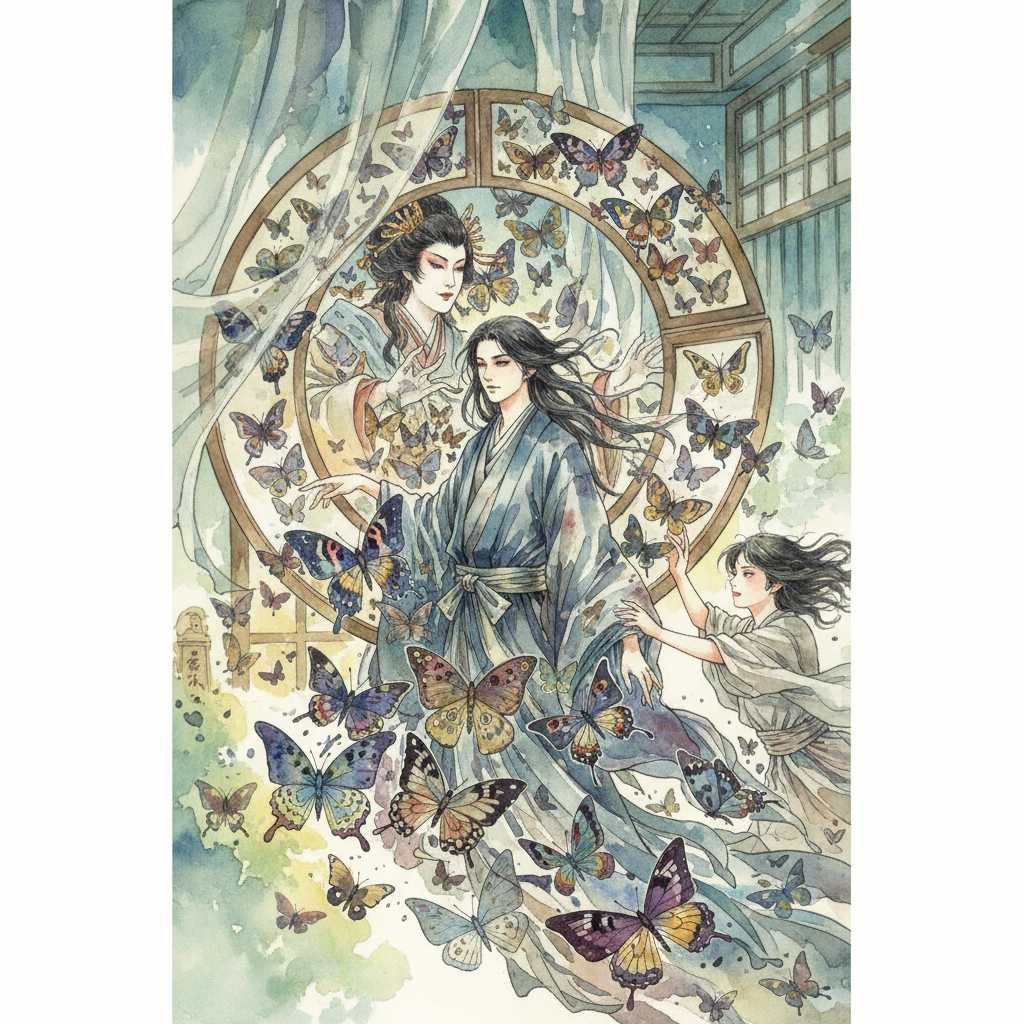
The premise: Marie, a transgender sex worker, lives in elegant squalor with her beautiful adult son whom she keeps isolated from the world, chasing butterflies and pinning them as specimens. One day a young girl breaks into the room and tries to lure the boy outside. Marie will not allow it.
This is a play about control, non-biological parenthood, queer desire, and the violence hidden inside aesthetic refinement. It is still being staged internationally — including recent Shinehouse Theatre productions in Taiwan — because it keeps generating new readings. A production in 2026 can treat it as a queer family drama, a #MeToo-adjacent control narrative, or a brutal fairy tale about raising a child inside your own fantasy.
Cast size in the Japanese Play Library edition: 15 performers, roughly 120 minutes. Explore the full data: https://gikyokutosyokan.com/posts/220
Shintokumaru (身毒丸), 1978
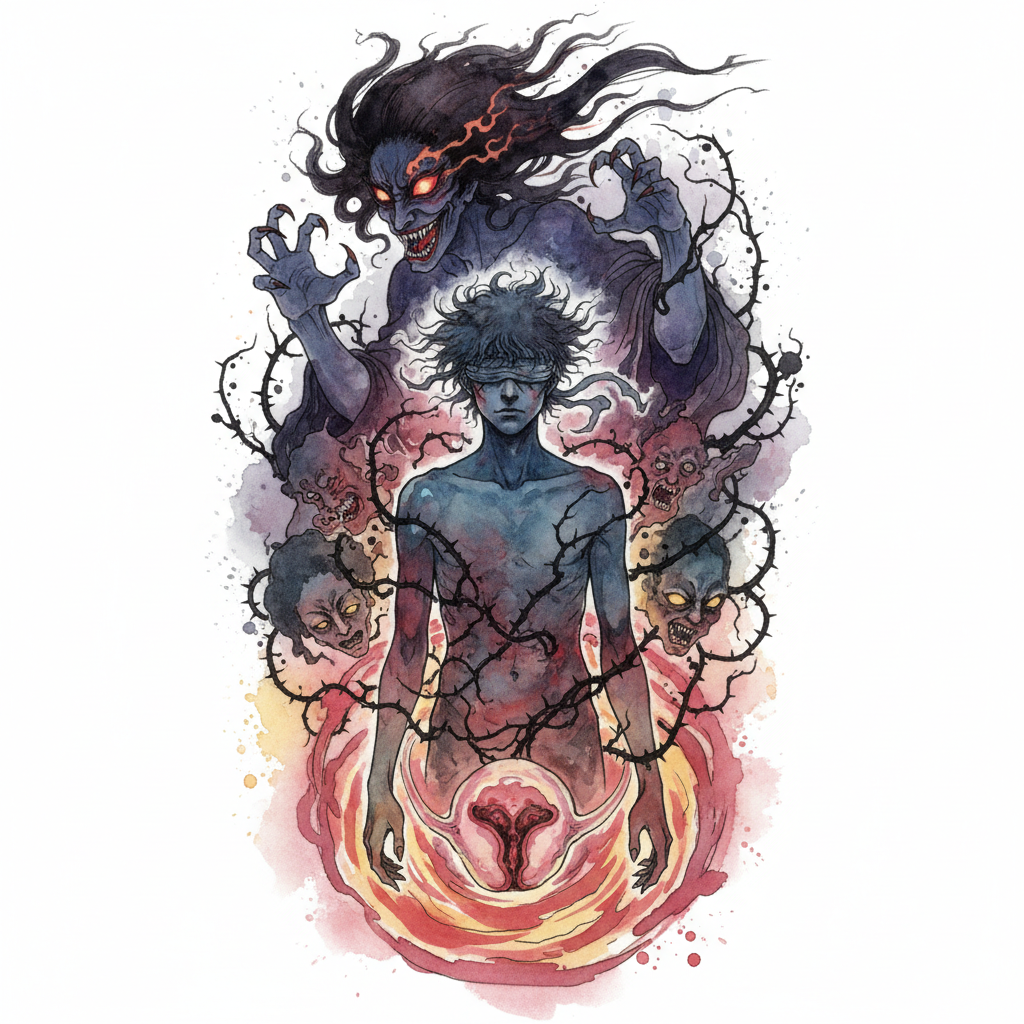
A reworking of a medieval saint legend (the Shintoku story) into a modern poetic horror. A boy's mother dies in childbirth. A stepmother arrives. She resents him, curses him, blinds him, and makes him sick. He wanders. He returns home seeking revenge. The stepmother and the son fall into a vortex of hatred, desire, and maternal engulfment — ending with the son's return to the mother's body.
This is one of the most famous Angura plays, and it is especially important internationally because of Ninagawa Yukio's acclaimed 1997 adaptation (reworked by Rio Kishida), which played at the Barbican in London in October 1997 with a taped English synopsis read by Alan Rickman. The Independent's critic noted the production's extraordinary lighting; other reviewers described it as "a broth of hyperreality, surrealism and the supernatural."
Shintokumaru is also where Terayama's folk-horror register is clearest. If you want to understand how Japanese underground theater fuses medieval legend with queer modern anxiety, this is the single best entry point.
Cast size in the Japanese Play Library edition: 27 performers (10 men / 13 women / 4 others), roughly 120 minutes. Explore the full data: https://gikyokutosyokan.com/posts/123
Throw Away Your Books, Rally in the Streets! (書を捨てよ、町へ出よう), 1967–1971
A multi-form project — essay collection, play, and later Terayama's own feature film — that became the manifesto of Japan's late-60s "runaway" counterculture. The title is itself a thesis: formal education is a trap, and the real curriculum of life is in boxing, horse racing, the streets, and the body.
For international readers, this is the key Terayama work to pair with the plays. It explains the ethic behind Tenjō Sajiki.
Aohigeko no Shiro ("Bluebeard"), Inugami ("Dog God"), The Crime of Fatso Oyama (大山デブコの犯罪)
Terayama's broader stage output includes "Bluebeard" (青ひげ), "Yes" (イエス), "The Crime of Fatso Oyama" (大山デブコの犯罪), and Inugami (犬神). These plays are harder to find in good English translation, but they are important for understanding his range — fairy-tale re-tellings, grotesque comedy, political parable.
Terayama's Collaborators (and Why They Matter)
Terayama's theater is unthinkable without his collaborators. If you are researching Angura, you are also researching:
- Akihiro Miwa / Maruyama — queer performer, chanteuse, Tenjō Sajiki co-founder, lead of Kegawa no Marie.
- Tadanori Yokoo — graphic designer whose Tenjō Sajiki posters are now canonical twentieth-century design.
- Aquirax Uno — illustrator and poster designer.
- J.A. Seazer — experimental composer who built Tenjō Sajiki's sonic world.
- Kan Mikami — folk musician.
- Rio Kishida — playwright and adaptor; her reworking of Shintokumaru for Ninagawa is a touchstone.
- Yukio Ninagawa — director who later carried Terayama's work to international mainstream audiences.
This matters because it tells you that Terayama's work is a collective aesthetic. If you program a Terayama play, you are not just staging a text. You are stepping into a design, music, and performance tradition.
For Western Audiences: What to Expect
If you are coming to Terayama from a Western theater training, these are the adjustments to make.
Expect poetry, not psychology
Terayama is not Chekhov or Mamet. He does not write subtext for naturalistic actors to mine. He writes image, rhythm, and incantation. Train your cast to deliver language the way a chorus delivers verse, not the way a sitcom cast delivers a scene.
Expect frontal address
Terayama's characters often speak outward — to the audience, to the room, to the dead — as much as to each other. This is closer to Noh, cabaret, and ritual than to the modern well-made play.
Expect queer, grotesque, and taboo bodies
Terayama's plays are not safe. They stage trans sex workers, incestuous desire, stepmother sadism, blinded saints, caged children. A production that softens these elements to protect audience comfort will lose the play. Terayama is not asking you to be comfortable. He is asking you to look.
Expect the stage to want to be a street
If you have the physical option, resist putting Terayama fully behind a proscenium. He wrote plays that keep leaking out of the theater. Even a Western production can honor that by letting the audience arrive through the performance space, or by placing performers among the audience.
Where to Find Terayama in English
In 2026, available English resources on Terayama include:
- Carol Fisher Sorgenfrei, Unspeakable Acts: The Avant-Garde Theatre of Terayama Shūji and Postwar Japan — the standard English-language monograph on his theater.
- The Routledge Encyclopedia of Modernism — concise biographical and critical entry.
- Senses of Cinema — long-form "Great Directors" essay covering his film and theater work in a single frame.
- Wikipedia — a solid English overview with references for further reading.
For scripts in good English translation, availability is uneven. Several Tenjō Sajiki plays exist in academic translation (often inside Sorgenfrei's volume or in anthologies of Angura drama). Non-Japanese productions of La Marie-Vison have been staged in multiple languages, including recent Taiwanese productions, which can be a useful comparison point for directors.
For the two Terayama plays in the Japanese Play Library catalog with cast and runtime data, see:
- Kegawa no Marie (毛皮のマリー): https://gikyokutosyokan.com/posts/220
- Shintokumaru (身毒丸): https://gikyokutosyokan.com/posts/123
FAQ
Was Shuji Terayama a playwright or a filmmaker?
Both, plus poet and photographer. He treated these as a single practice. The theater work and the film work share a visual vocabulary.
Is Terayama still performed in 2026?
Yes. Internationally, Kegawa no Marie / La Marie-Vison continues to be staged — including in Taiwan — and Shintokumaru remains an acclaimed international property thanks largely to Ninagawa Yukio's adaptation. In Japan, Tenjō Sajiki successor companies and repertory productions keep his work in active circulation.
What is Tenjō Sajiki?
Tenjō Sajiki (天井棧敷) is the theater troupe Terayama founded in 1967. The name means "ceiling gallery" — the cheap seats. It became one of the four pillars of Japanese Angura (underground) theater and operated until Terayama's death in 1983.
What does "Angura" mean?
Angura (アングラ) is Japanese shorthand for "underground" — specifically the underground theater movement of the 1960s and 70s that rejected Western-style Shingeki realism and reached back toward folk ritual, body, and image. Terayama, Kara Jūrō, Suzuki Tadashi, and Satoh Makoto are usually named as its central figures.
Where should I start if I have never read Terayama?
Start with Kegawa no Marie (La Marie-Vison). It is his most internationally circulated play, it has the clearest dramatic shape for a reader coming in cold, and it is still being produced in 2026.
Can my company stage Terayama in English?
Yes, with rights clearance. His estate controls performance rights. English-language productions have occurred. Expect to work with academic translations or to commission a new one.
Related Reading on Japanese Play Library
If you found this profile useful, these other English guides on Japanese Play Library will deepen the picture:
- Playwright Profile: Kobo Abe — Terayama's postwar contemporary, closer to literary absurdism, farther from street theater.
- Playwright Profile: Toshiki Okada — one of the most important living Japanese playwrights, and a useful comparison for anyone tracking how post-Angura theater evolved into the twenty-first century.
The Takeaway
Shuji Terayama is the writer who proved that Japanese theater did not have to choose between poetry and politics, between folk memory and modernist experiment, between stage and street, between art and the body.
For 2026 readers, that is not a dead historical lesson. It is an active challenge. Every time an international company builds an immersive piece in a disused building, every time a queer performer takes a lead role in a poetic text, every time a director refuses the comfort of psychological realism, Terayama is somewhere in the lineage.
Japanese Play Library catalogues Kegawa no Marie and Shintokumaru with full cast and runtime data so that English-speaking directors, dramaturgs, and translators can start planning. If you are reading this and thinking about a 2026 or 2027 season — Terayama belongs in it.
Sources consulted: English Wikipedia ("Shūji Terayama"); Routledge Encyclopedia of Modernism entry on Terayama Shūji; Senses of Cinema "Great Directors" essay on Terayama; Carol Fisher Sorgenfrei's Unspeakable Acts (reviewed in Performance Paradigm); contemporary reviews of Ninagawa Yukio's 1997 Barbican production of Shintoku-Maru (The Independent; Theatricalia); production notes from Shinehouse Theatre and Single Eyelid on La Marie-Vison; the Japanese Play Library catalog.
この記事で紹介した戯曲
Written by
戯曲図書館 編集部
演劇経験者が運営する戯曲検索サービス「戯曲図書館」の編集チームです。 脚本選びのノウハウ、演劇業界の最新情報、公演レポートなどを発信しています。
関連記事
Playwright Profile: Kobo Abe (安部公房) in 2026 — Why Friends and The Suitcase Still Feel Unsettling
A 2026 English guide to Kobo Abe's theatrical career, major plays, style, and why his stage work still matters for global theater artists.
2026-08-20
Playwright Profile: Toshiki Okada (岡田利規) in 2026 — Why chelfitsch Changed Contemporary Japanese Theater
An English guide to Toshiki Okada’s career, major plays, style, and why chelfitsch remains vital for global theater in 2026.
2026-08-13
Playwright Profile: Minoru Betsuyaku (別役実) in 2026 — The Quiet Force Behind Japanese Absurdist Theater
A 2026 English guide to Minoru Betsuyaku’s life, major plays, theatrical method, and why his absurdist drama still matters internationally.
2026-07-30
Playwright Profile: Oriza Hirata (平田オリザ) in 2026 — Why Quiet Theater Still Travels
An English guide to Oriza Hirata’s career, major plays, style, and why his quiet theater still matters globally in 2026.
2026-06-18