If you like The Cherry Orchard, the best Japanese plays to read next are works that stage social change through everyday speech, fading status, and people who cannot adapt in time.
Anton Chekhov’s The Cherry Orchard remains globally influential because it captures a historical turning point without reducing it to slogans: old elites decline, new economic actors rise, and almost nobody feels ready for what comes next. In Japan, modern and contemporary theater has repeatedly explored the same pressure point—especially the clash between inherited identity and rapidly changing social systems.
This guide introduces five Japanese plays for Cherry Orchard readers who want that same bittersweet dramatic texture: humor mixed with loss, small interpersonal moments carrying large historical forces, and characters trapped between memory and survival.
Quick Facts
| Item | Summary |
|---|---|
| Best match for Cherry Orchard fans | Tokyo Notes (東京ノート) by Oriza Hirata (平田オリザ) |
| Core shared theme | Social transition and the collapse of familiar status systems |
| Typical cast range in this list | 4–8 actors |
| Typical runtime range | 80–130 minutes |
| Best for directors/readers who enjoy | Ensemble tension, subtext, and “quiet catastrophe” |
Why This Comparison Works
The Cherry Orchard is often discussed as a portrait of aristocratic decline and social mobility at the turn of the 20th century. Japanese modern theater developed under similarly intense modernization pressures, including class reshuffling, urbanization, postwar rebuilding, and institutional transformation.
So the overlap is not superficial. In both traditions, drama asks:
- Who benefits when systems change?
- Who cannot translate their values into the new order?
- What does “home” mean when economic logic wins?
- How does comedy expose cruelty without preaching?
1) Tokyo Notes (東京ノート, Tōkyō Nōto) — Oriza Hirata (平田オリザ)
If your favorite part of The Cherry Orchard is how social collapse appears through ordinary conversation, start here.
Set in a museum lobby in near-future Tokyo while conflict spreads abroad, Tokyo Notes avoids melodramatic plot twists. Instead, it tracks family fragments, polite misunderstandings, and small social evasions. Like Chekhov, Hirata builds meaning through what people don’t say directly.
Why Cherry Orchard fans connect with it
- Decline appears as atmosphere, not a single catastrophe.
- Characters are surrounded by change but emotionally late to it.
- Humor and awkwardness reveal class and value shifts.
🔗 Internal reference: https://gikyokutosyokan.com/posts/162
🔗 Related reading: https://gikyokutosyokan.com/blog/en/kishida-work-tokyo-notes
2) The Men Who Wanted to Sing (歌わせたい男たち, Utawasetai Otokotachi) — Ai Nagai (永井愛)
Ai Nagai’s work is often sharper and more argumentative than Chekhov, but Cherry Orchard readers will recognize the core conflict: institutions changing faster than people’s moral language.
The play examines competing social values through verbal confrontation and public performance. Where Chekhov shows erosion through hesitation, Nagai often shows it through explicit ideological friction.
Why this is a useful crossover
- Both playwrights stage social change through ensemble dynamics.
- Public systems intrude into private ethics.
- No character fully “wins” the historical argument.
🔗 Internal reference: https://gikyokutosyokan.com/posts/22
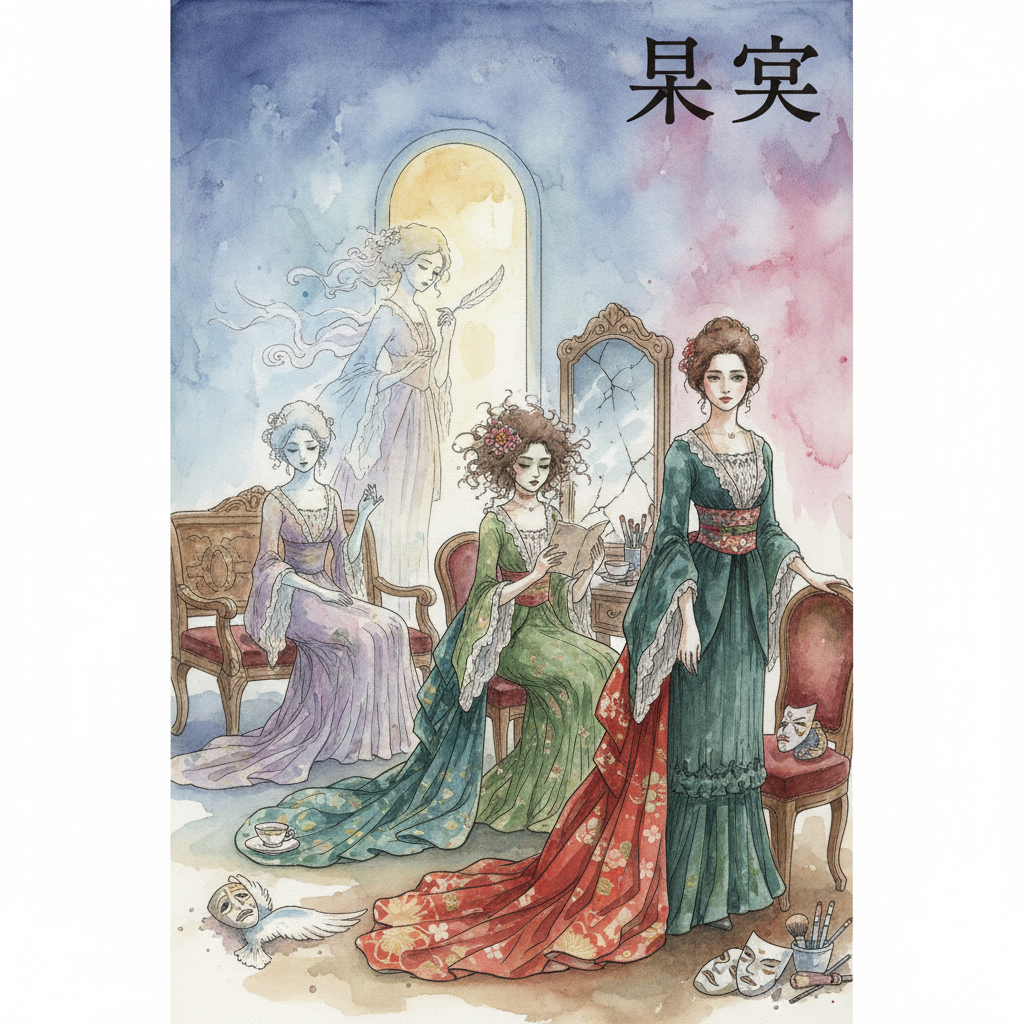
3) The Dressing Room (楽屋, Gakuya) — Kunio Shimizu (清水邦夫)
At first glance, The Dressing Room feels more theatrical and meta than The Cherry Orchard. But both plays are haunted by people living inside a world that is already disappearing.
Shimizu’s backstage setting becomes a psychological museum of performance, memory, and repetition. Characters hold onto identity through ritual long after the surrounding structure has lost stability.
Shared Chekhovian DNA
- Nostalgia as both comfort and trap.
- Ensemble melancholy with comic flashes.
- Time felt as accumulation rather than plot momentum.
🔗 Internal reference: https://gikyokutosyokan.com/posts/208
4) The Bee (THE BEE, ザ・ビー) — Hideki Noda (野田秀樹) / Colin Teevan
This is the most tonally extreme recommendation in this list, but it belongs here for one reason: it stages how fragile civilized identity becomes under social pressure.
Based on Kōbō Abe’s story, The Bee escalates from ordinary life to terrifying reversals of power. Compared with Chekhov, Noda is more violent, faster, and more surreal—but both expose the instability of social roles we assume are permanent.
Why include a darker, faster piece?
Because Cherry Orchard is not only about nostalgia. It is also about the terror of losing one’s position in the social order. The Bee turns that terror into a contemporary pressure-cooker.
🔗 Internal reference: https://gikyokutosyokan.com/posts/28
5) On Mothers and Planets, and the Records of Women Who Rotate (母と惑星について、および自転する女たちの記録) — Ryūta Hōrai (蓬莱竜太)
If you are looking for a contemporary Japanese counterpart to Chekhov’s multigenerational sensitivity, this is a strong choice.
Hōrai maps emotional inheritance, social expectation, and gendered labor across relationships shaped by changing norms. Like The Cherry Orchard, the drama is not “about one event”; it is about people trying to live through structural transition with dignity.
Why Cherry Orchard readers may value it
- Family intimacy becomes social analysis.
- Historical change is embodied in personal choices.
- Loss is real, but not romanticized.
🔗 Internal reference: https://gikyokutosyokan.com/posts/219
Comparison Table: If You Like The Cherry Orchard, Start Here
| Japanese Play | Best Match Element | Energy Level | Best For |
|---|---|---|---|
| Tokyo Notes | Quiet social drift under historical pressure | Low | Readers who love subtext and ensemble realism |
| The Men Who Wanted to Sing | Institution vs individual ethics | Medium | Audiences who want verbal conflict and civic stakes |
| The Dressing Room | Nostalgia, ritual, and fading identity | Low-Medium | Fans of melancholic, actor-centered drama |
| The Bee | Social role collapse under pressure | High | Viewers open to darker, sharper contemporary form |
| On Mothers and Planets... | Family + structural social transition | Medium | Readers seeking contemporary multigenerational perspective |
How to Read Them in Sequence
For a smooth transition from Chekhovian tone to broader Japanese range:
- Tokyo Notes (closest in quiet social texture)
- The Dressing Room (memory and decline)
- On Mothers and Planets... (contemporary social inheritance)
- The Men Who Wanted to Sing (explicit institutional clash)
- The Bee (high-pressure endpoint)
This order preserves the emotional continuity of The Cherry Orchard while expanding your sense of what “social transition drama” can look like in Japanese theater.
FAQ
Which Japanese play is most similar to The Cherry Orchard?
Tokyo Notes is often the closest tonal match because it stages large historical anxiety through ordinary conversation and quiet ensemble behavior.
Are these plays all realistic like Chekhov?
No. Some are realist-adjacent (Tokyo Notes), while others are stylized or surreal (The Bee). The common thread is social transition, not one fixed style.
Do I need background in Japanese theater to read these?
No. Start with theme and character systems. If you want context, read a short overview of shingeki (新劇) and postwar contemporary theater.
Which one is best for small companies?
The Bee and The Dressing Room are often practical for compact ensembles, depending on your adaptation and staging approach.
Continue Exploring
If you want more production-oriented recommendations, also read:
- https://gikyokutosyokan.com/blog/en/guide-best-japanese-plays-for-first-time-directors
- https://gikyokutosyokan.com/blog/en/guide-best-japanese-plays-for-small-cast-3-5-actors
Sources
- Encyclopaedia Britannica, The Cherry Orchard overview: https://www.britannica.com/topic/The-Cherry-Orchard
- Encyclopaedia Britannica, Shingeki overview: https://www.britannica.com/art/shingeki
- Performing Arts Network Japan (Japan Foundation), Hideki Noda / Colin Teevan, THE BEE: https://performingarts.jpf.go.jp/en/article/6283/
- Seinendan official page, Tokyo Notes: https://www.seinendan.org/eng/play/1994/tokyonotes/
この記事で紹介した戯曲



Written by
戯曲図書館 編集部
演劇経験者が運営する戯曲検索サービス「戯曲図書館」の編集チームです。 脚本選びのノウハウ、演劇業界の最新情報、公演レポートなどを発信しています。
関連記事
The Dressing Room vs The Seagull: A 2026 Guide to Backstage Time, Failed Dreams, and Women Watching the Stage
Compare Kunio Shimizu's The Dressing Room and Chekhov's The Seagull through backstage longing, theatrical memory, and role-making.
2026-07-26
Best Japanese Plays for Staged Readings (2026): 8 Scripts That Sound Alive in the Room
A 2026 guide to 8 Japanese plays for staged readings, with cast size, runtime, and translation-friendly notes for directors and dramaturgs.
2026-09-02
Tomodachi vs No Exit: A 2026 Guide to Friendly Invasion, Hellish Rooms, and the Violence of Other People
Compare Tomodachi and No Exit through confinement, coercion, group pressure, and the politics of being trapped with others.
2026-08-30
If You Like The Crucible (2026 Guide): 4 Japanese Plays About Scapegoats, Panic, and Public Obedience
Love The Crucible? Read 4 Japanese plays about fear, scapegoats, conformity, and the cost of refusing the crowd.
2026-08-21