
目次12項目開く
- 1.Quick Facts
- 2.Why The Voice of the Mountain matters in 2026
- 3.About Masanori Otakeno (大竹野正典)
- 4.The mountain behind the play
- 5.Story overview
- 6.The play’s central themes
- 7.Why Western audiences may connect with it
- 8.Production notes for directors and actors
- 9.Where to begin exploring Otakeno
- 10.FAQ
- 11.Final takeaway
- 12.Sources
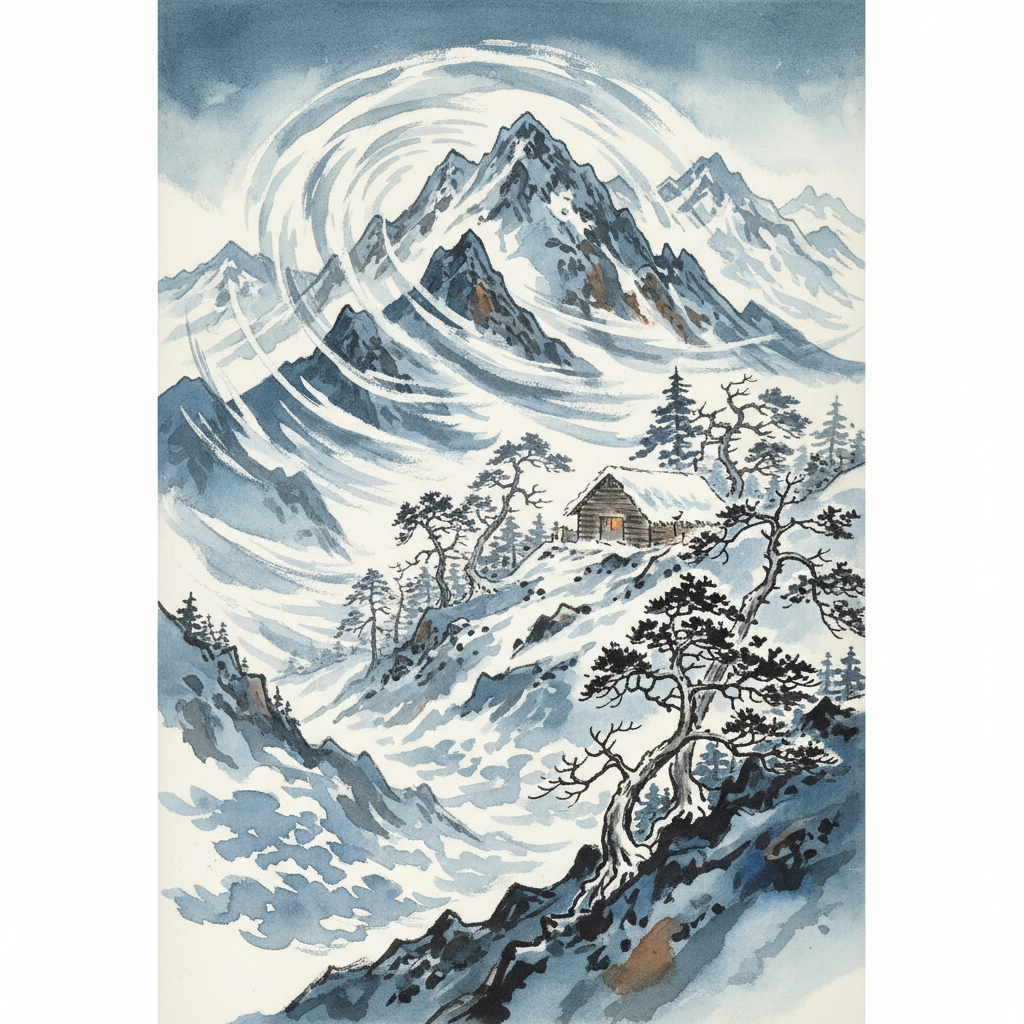
The Voice of the Mountain (山の声, Yama no Koe) is a Japanese two-hander about two mountaineers trapped in a mountain hut, where survival becomes a test of friendship, memory, ambition, and the human need to answer to something larger than oneself.
For English-speaking theater readers, directors, and actors in 2026, that is the clearest reason to encounter Masanori Otakeno’s play. It is a concentrated chamber drama, but its scale is psychological rather than scenic. The setting is a snowbound hut on Mount Yari (槍ヶ岳) in the early Shōwa period. The cast is only two men. The conversation, however, opens onto an entire life: work, risk, class, loneliness, physical endurance, and the question of whether a person can ever stop answering the call of the mountain.
The play is also an important introduction to Otakeno, a major Kansai playwright whose writing often confronted real events and the darkness inside ordinary human relationships. The Voice of the Mountain is not an adventure story in the simple sense. It is a drama about what adventure costs, and about the difficulty of returning to everyday life after discovering a form of freedom that everyday life cannot provide.
Quick Facts
| Item | Details |
|---|---|
| Japanese title | 山の声 |
| Romanization | Yama no Koe |
| Common English title | The Voice of the Mountain |
| Longer title used in performances | The Voice of the Mountain: Recollections of a Mountaineer |
| Playwright | Masanori Otakeno (大竹野正典) |
| First publication / creation period | 2008 |
| Award | 16th OMS Drama Award Grand Prize, 2009 |
| Cast size in Japanese Play Library | 2 actors |
| Runtime in Japanese Play Library | About 110 minutes |
| Main setting | A mountain hut on Mount Yari in the early Shōwa period |
| Dramatic form | Two-hander, chamber drama, mountaineering play |
| Source material | The writings of mountaineer Buntarō Katō, including Dokukō (単独行) |
| Best fit for | Two-actor companies, intimate venues, actor-led festivals, staged readings |
| Main themes | Solitude, friendship, risk, masculinity, memory, survival, vocation |
Read the original catalog entry:
Related reading on Japanese Play Library:
- The Elephant (象) by Minoru Betsuyaku
- The Iliad: An Epic of Anger, War, and Fate (イリアス)
- Ippen: Dancing Monk (一遍)
- Japanese Plays for Two Actors
Why The Voice of the Mountain matters in 2026
A two-person play can look small on paper. The Voice of the Mountain proves that “small cast” does not mean “small world.” Its two characters carry different ideas of what it means to live well, and the mountain makes those ideas impossible to hide.
The play’s central situation is immediately playable. A blizzard forces two climbers into a hut. They are not strangers in the broadest sense: one is the famous mountaineer Katō Buntarō (加藤文太郎), while the other is his younger companion and climbing partner, Yoshida Tomikuma (吉田登美久). The weather suspends ordinary time. There is nowhere to go, no audience to impress, and no practical task that can permanently settle the conflict between them. They must wait, talk, remember, and listen to the mountain outside.
That pressure gives the play unusual value for contemporary theater-makers. It does not need a large production apparatus to create danger. The danger is already in the bodies of the performers, in the cold they imagine, in the friendship they test, and in the future each man thinks he is choosing. A director can make the hut almost bare. The more important question is whether the actors can make the audience feel that the outside world is physically present even when it is never fully shown.
About Masanori Otakeno (大竹野正典)
Masanori Otakeno was born in Osaka in 1960. After high school, he studied screenwriting at the Yokohama Academy of Broadcasting and Film, where he learned from teachers including Shun’ya Hashimoto and Makoto Baba. After returning to Osaka, he worked through the theater company Inu no Jimusho and later founded the producing unit Kujira Kikaku (くじら企画).
Otakeno developed a reputation as a playwright who looked directly at human darkness. His plays frequently took real incidents, social pressures, or damaged domestic relationships as starting points. That does not mean his work is documentary theater. Rather, reality gives the plays a hard surface. The characters are not abstract symbols of “society” or “trauma”; they are people who have made choices and must live inside the consequences.
His career included recognition from several Japanese theater awards. Yoru ga Tsukamu (Night Grabs, 夜が掴む) received a Teatro in Cabin Drama Award commendation. Kaizenban: Waru Tansu and K no Trunk received Space Zero recognition, and Yoru, Naku, Tori (Night, Crying, Bird, 夜、ナク、鳥) became a finalist for the Kishida Kunio Drama Award. The Japanese Playwrights Association’s digital archive records that Otakeno began writing The Voice of the Mountain in 2008, after a period in which he had stepped away from writing and repeatedly climbed mountains.
That biographical detail is important, but it should not be used to reduce the play to autobiography. Otakeno’s relationship with climbing helped him understand its physical and emotional language, yet the play is not simply a diary transferred to the stage. It is a crafted encounter between two dramatic figures, two histories, and two ways of imagining freedom.
Otakeno died in an accident in 2009 at the age of 48. Later that year, The Voice of the Mountain received the 16th OMS Drama Award Grand Prize. The award gave the play a significant afterlife, and subsequent revivals have continued to introduce it to new actors and audiences across Japan.
The mountain behind the play
The historical figure at the center of the play is Katō Buntarō, a legendary Japanese mountaineer of the early Shōwa period. Katō was known for extraordinary physical endurance and for undertaking difficult climbs with a striking degree of independence. He became associated with the ideal of the self-reliant climber: someone who moves through the mountains without depending on the scale, prestige, or convenience of a large expedition.
The play draws on Katō’s writings, especially the record associated with Dokukō—often translated as Solo Climbing or Going Alone. It also uses the winter climb of Mount Yari’s Kitakama Ridge as a dramatic background. This does not make the play a reenactment of an expedition in the documentary sense. Otakeno is interested in what remains after the facts have become memory: the voice of a companion, the shape of a decision, and the difference between surviving an experience and understanding it.
For international audiences, it helps to resist the temptation to treat Mount Yari as merely an exotic landscape. The mountain is not decorative scenery. It is a force that reorganizes human scale. Inside the hut, a sentence about a career or a relationship can feel as consequential as a decision about whether to step into a storm. Outside, nature is indifferent. Inside, the two men continue to create meanings for one another.
The phrase “the voice of the mountain” therefore has more than one possible meaning. It can refer to the literal environment: wind, snow, rock, and altitude. It can also refer to the internal call that makes a person return to danger. The mountain speaks through weather, but it also speaks through desire. The climber hears an invitation that other people cannot hear, and that invitation can become stronger than ordinary obligations.
Story overview
The play begins with Katō Buntarō and Yoshida Tomikuma taking shelter in a mountain hut during a severe winter climb. The two men are physically close but temperamentally different. Katō is intensely committed to the mountain and to his own method of climbing. Yoshida, younger and less established, admires him but is not simply a disciple. Their companionship contains loyalty, rivalry, affection, and an unequal distribution of authority.
The hut becomes a temporary world. The men discuss the climb, the weather, their bodies, and the mountain routes they know. Gradually, the conversation expands beyond the immediate crisis. We learn how they came to the mountain and what each believes the mountain has given him. We also begin to see that the same quality that makes Katō remarkable—his refusal to compromise his relationship with climbing—can make him difficult to live beside.
The play does not turn this conflict into a simple argument between courage and fear. Yoshida is not merely the cautious man who wants to go home, and Katō is not merely the heroic man who wants to continue. Both understand that the mountain can destroy them. The question is what kind of life each man considers worth risking.
In the confined space, their stories begin to overlap with the history of Japanese mountaineering. The hut holds the present climb, but memory brings in earlier journeys, past decisions, and the people who remain outside the mountain. The men talk about the ordinary world even as they move farther away from it. Work, family, reputation, and aging appear not as separate subjects but as pressures that define what “freedom” can mean.
The result is a drama of two people who are trying to decide whether the mountain is a place they visit or a place that has already claimed them.
The play’s central themes
1. Freedom versus responsibility
At first glance, the play seems to celebrate escape. The mountain offers distance from work, domestic expectations, and the routines of ordinary society. A climber can choose a route, carry only what is necessary, and measure achievement in direct physical terms.
But The Voice of the Mountain is too serious to leave freedom at the level of romantic fantasy. Every act of escape creates responsibility. A climber’s independence affects companions. A dangerous decision becomes someone else’s rescue problem. A person who defines himself through exceptional achievement may make it difficult for others to ask for care.
The play asks a question that will be familiar to anyone who has built a life around a vocation: when does dedication become an obligation imposed on the people around you? Katō’s commitment is powerful because it is not casual. It is also frightening because it cannot easily be negotiated.
For a Western audience, this makes the play an interesting companion to dramas about artists, athletes, explorers, and workers whose identities depend on extreme commitment. The mountain is a specific setting, but the structure is recognizable. One person’s calling can become another person’s burden.
2. Friendship under pressure
The two-hander form makes friendship visible as a dramatic action. There is no crowd to absorb tension and no subplot to provide relief. Every pause belongs to the relationship. Every change in tone matters.
Katō and Yoshida do not simply exchange information. They test one another. Admiration can sound like criticism. Concern can sound like weakness. A joke can conceal fear. The dialogue constantly asks whether the men are speaking as equals, teacher and student, rivals, or friends who have run out of safe subjects.
This is one of the play’s strongest assets for actors. The relationship should not be played as a sequence of clearly labeled emotional states. The men may be affectionate and irritated in the same moment. They may want the other to understand them while also wanting to preserve their own mystery. The audience should feel that the friendship is real precisely because it contains contradiction.
3. Masculinity and the performance of endurance
The climber’s body is central to the play. Strength, pain tolerance, balance, stamina, and technical skill are not metaphors added from outside; they are part of the characters’ daily reality. Yet the play also examines how men perform toughness for one another.
To admit fear may be practical. It may save a life. But it may also threaten a carefully built identity. Katō and Yoshida must decide what kind of vulnerability is possible between men who are used to proving themselves through action.
The setting intensifies this problem. The mountain does not care whether a man is admired. It exposes the body without offering social recognition in return. A person can be famous in the city and still become cold, exhausted, or lost in the snow.
This is why the play should not be marketed only as a mountaineering drama. It is also a study of how people learn to hide dependence, how pride becomes a survival strategy, and how the performance of self-sufficiency can isolate the person performing it.
4. Memory and the making of a legend
Katō Buntarō enters the play as a historical figure, but the drama is not interested in a polished heroic statue. It is interested in the distance between a living person and the legend that forms around him.
Memory edits. It turns difficult decisions into principles and accidents into destiny. A climber becomes “the great soloist,” and the ordinary details of his life begin to disappear. The play pushes against that simplification by putting the legendary figure in a room where another person can interrupt him.
Yoshida’s presence is crucial. He prevents Katō from becoming a monologue about greatness. He remembers, questions, and reacts. The relationship creates a second version of the hero: not the figure seen from below, but the companion seen from the side.
For directors, this suggests a useful production principle. Do not treat Katō as a monument from the beginning. Let the audience encounter a difficult, funny, intelligent, physically vulnerable man. His legendary status should emerge through the pressure of the conversation, not through grand entrance music or explanatory staging.
5. The mountain as vocation
Many stories use mountains as symbols of transcendence. The Voice of the Mountain is more complicated. The mountain is beautiful, dangerous, indifferent, and addictive. It offers a form of truth, but not necessarily comfort.
The men do not climb because the mountain solves their problems. They climb because it changes the terms of the problems. On the mountain, ambition becomes route-finding. Fear becomes weather knowledge. Friendship becomes rope technique and shared shelter. But when the climbers return to ordinary life, the old questions wait for them.
The mountain’s “voice” is therefore not a moral instruction. It does not say, “Be brave,” or “Leave society.” It calls, and the characters decide how much of themselves to surrender to that call.
Why Western audiences may connect with it
The play has a strong point of entry for international audiences because its conflict is concrete. Two people are trapped in a dangerous place and must decide what they owe one another. No specialized knowledge of Japanese theater is necessary to understand the pressure.
At the same time, the play offers cultural specificity without turning that specificity into a barrier. The early Shōwa setting, Japanese mountaineering history, and regional context shape the drama, but they do not replace character. An English-language production would not need to explain every social detail before the audience could care. The emotional grammar is already active.
The play may appeal especially to audiences who enjoy:
- two-person dramas built around changing power;
- stories about vocation and obsession;
- historical figures seen through private relationships;
- survival narratives without conventional action spectacle;
- quiet plays that become physically intense through listening;
- Japanese drama outside the most familiar classical forms.
It also has a useful relationship to Western theatrical reference points. Readers who like Harold Pinter may recognize the pressure placed on pauses, status, and withheld information. Readers who like Samuel Beckett may notice the importance of waiting and repeated routines, though Otakeno is more historically grounded and emotionally expansive. Readers drawn to mountaineering literature will find a stage version of the conflict between the record of an expedition and the private cost of the expedition.
Production notes for directors and actors
Casting
The Japanese Play Library lists two performers. That is not simply a logistical convenience; it is the play’s central engine. The actors must be able to sustain a relationship through silence, physical adjustment, and small changes in attention.
Katō and Yoshida should not look like interchangeable “mountain men.” Their bodies may share the practical demands of climbing, but their rhythms should differ. One may occupy space with certainty; the other may observe before acting. One may speak in declarations; the other may use questions as a way of resisting authority.
The production becomes more compelling when the audience can see that both men are capable of changing the balance of power.
Space and design
A realistic hut is possible, but realism should serve pressure rather than decoration. The most important elements are a sense of shelter, limited visibility, and the physical fact of cold. A bench, sleeping platform, climbing equipment, lantern, rope, or pack may be enough to establish the world.
Sound can carry the mountain without turning it into an illustration. Wind should not become a constant film-score effect. Its arrival and disappearance can mark changes in attention. Silence may be more powerful after a long period of weather than during a speech about nature.
The audience should feel that the hut is protective and fragile at the same time. It is the only place keeping the men alive, but it cannot make the mountain safe.
Movement
This is a talk-heavy play, but it should not be staged as two people sitting in chairs for 110 minutes. Physical tasks can keep the argument alive: checking equipment, tending a stove, preparing food, adjusting clothing, looking toward an unseen opening, or responding to a sudden change in weather.
The movement must remain economical. Excessive business can weaken the play’s concentration. The goal is not to fill every silence but to make the audience aware of what the body is doing while the mind is trying to remain controlled.
Translation
A translation should preserve the play’s physical vocabulary and its shifts in status. Climbing terminology needs to be understandable, but it should not be over-explained in the dialogue. The characters are not giving a lecture to the audience. They are speaking as people who already share knowledge.
The translator also faces a tonal challenge. The play needs room for ordinary humor, irritation, and practical speech. If every line is made solemn because the setting is dangerous, the relationship will lose its life. The mountain becomes frightening partly because the men continue to behave like people rather than symbols.
As of October 2026, the available English-language record clearly confirms the play’s Japanese publication and performance history, but I have not found evidence of a widely circulating commercial English script edition. Companies interested in producing it should therefore begin with rights and translation research rather than assuming that a ready-to-license English text is available.
Staged readings
The play is especially suitable for a staged reading, provided the actors commit to the physical circumstances. A bare script-in-hand presentation can reveal the structure, but the reading should still establish cold, altitude, fatigue, and the changing distance between the men.
A useful reading might include minimal sound, a visible map or climbing route, and a short program note introducing Katō Buntarō and the historical context. Avoid turning the introduction into a textbook chapter. The play itself should remain the main source of information.
Where to begin exploring Otakeno
Start with the catalog entry for The Voice of the Mountain (山の声), which records the two-person cast and approximately 110-minute runtime. Then place it beside The Elephant (象), another Japanese modern drama in which two people confront illness, history, and the question of how to live when society would rather look away.
For a larger historical frame, compare the play’s relationship to biography and legend with The Iliad: An Epic of Anger, War, and Fate. Both works place individuals inside stories that have already become larger than the people who lived them. If you are interested in historical and spiritual theater with a strong physical dimension, Ippen: Dancing Monk offers a very different but productive contrast.
For companies seeking more two-actor repertoire, see Japanese Plays for Two Actors. The practical needs of a small company can be a starting point for artistic discovery rather than a limitation.
FAQ
Is The Voice of the Mountain a realistic play?
It begins from a realistic situation and historical figures, but its dramatic method is more than documentary realism. Memory, legend, and the psychological force of the mountain give the dialogue a heightened quality. Directors should preserve the concrete physical world while allowing the conversation to become poetic when the characters’ experience requires it.
How many actors are needed?
Two actors. The Japanese Play Library lists The Voice of the Mountain as a two-person play with an approximate runtime of 110 minutes.
Is the play mainly for mountaineers?
No. Mountaineering is the play’s specific world, but the central conflicts concern friendship, pride, vocation, responsibility, and the difficulty of returning from an experience that has changed you. Audiences do not need technical climbing knowledge to follow the drama.
Who was Masanori Otakeno?
Masanori Otakeno was an Osaka-born Japanese playwright and theater-maker who founded and worked through companies including Inu no Jimusho and the producing unit Kujira Kikaku. He was known for plays that confronted social darkness and difficult human relationships. He died in 2009 at age 48.
What award did the play receive?
The Voice of the Mountain received the 16th OMS Drama Award Grand Prize in 2009. The OMS Drama Award was established to support playwrights connected to the Kansai region and has helped bring attention to important Japanese contemporary drama.
Can an English-speaking company perform it?
Potentially, yes, but rights and translation must be investigated. The play’s small cast and concentrated setting make it practical for international production. The main access question is whether an authorized English translation can be obtained or commissioned.
What is the best one-sentence pitch?
Two climbers shelter from a blizzard in a mountain hut and discover that the hardest ascent is deciding what they owe one another.
Final takeaway
The Voice of the Mountain deserves a place in the international conversation about Japanese plays because it demonstrates how much dramatic force can fit inside a small physical frame.
Two men, one hut, and a mountain outside are enough. The play does not need to show the summit to make the audience feel altitude. It does not need a large cast to create a social world. It does not need an elaborate action sequence to make survival immediate.
Otakeno’s achievement is to turn climbing into a language for human attachment. Katō and Yoshida do not merely ask whether they can endure the mountain. They ask whether endurance is a virtue when it separates you from everyone who cannot follow. They ask whether friendship can survive unequal ambition. They ask what remains of a person when the legend has become stronger than the life.
For directors, the play offers a rigorous two-actor challenge. For actors, it offers roles that depend on listening as much as speaking. For audiences, it offers an unfamiliar world that becomes intimate without losing its distance.
The mountain is outside the hut. Its voice is also inside the room.
Sources
- Japanese Playwrights Association, The Voice of the Mountain digital archive
- Osaka Gas Network, OMS Drama Award overview
- Stage Web, Report on the 16th OMS Drama Award
- Onsen Dragon, The Voice of the Mountain: Recollections of a Mountaineer
- Japanese Play Library, Masanori Otakeno author page
- Japanese Play Library, The Voice of the Mountain (山の声)
この記事で紹介した戯曲

戯曲図書館 編集部・公開日 2026/10/26
演劇経験者が運営する戯曲検索サービスの編集チームです。脚本選びのノウハウ、演劇の最新情報、公演レポートなどを書いています。
関連記事
- Play Spotlight 2026: Henro (偏路) by Yukiko MotoyaA 2026 English spotlight on Henro, Yukiko Motoya's darkly comic family play about failed ambition, unwanted kindness, and going home.2026/08/17
- Play Spotlight 2026: Why Hogiuta (寿歌) Still Feels Urgent on Global StagesA 2026 English spotlight on Hogiuta, So Kitamura's small-cast post-apocalyptic Japanese play of humor, music, and survival.2026/08/31
- Play Spotlight 2026: Tomodachi (Friends, 友達) by Kobo Abe (安部公房)A 2026 English spotlight on Tomodachi, Kobo Abe's invasive dark comedy about loneliness, conformity, and kindness as violence.2026/08/24
- Play Spotlight 2026: The Dressing Room (楽屋) by Kunio Shimizu (清水邦夫)A 2026 English spotlight on The Dressing Room: ghosts, actresses, memory, and why Kunio Shimizu's backstage classic still travels.2026/08/10