
If you like Death of a Salesman, the best Japanese plays to read next are those that stage the same pressure triangle: work, family, and identity—especially when success stories start breaking down.
Arthur Miller’s Death of a Salesman (written in 1948, produced in 1949) endures because it never treats career failure as “just economics.” Willy Loman’s collapse is emotional, social, and theatrical: he is constantly performing a version of himself that no longer works in the world he lives in. That dramatic structure remains painfully current.
Japanese modern and contemporary theater has repeatedly explored the same fault line in different historical contexts: postwar rebuilding, rapid growth, institutional rigidity, and changing family structures. The result is not one Japanese “equivalent” of Salesman, but a rich set of plays that speak to Miller’s core anxieties while offering distinct dramatic tools.
This guide recommends five Japanese plays for readers, actors, and directors who want that crossover conversation.
Quick Facts
| Item | Summary |
|---|---|
| Best first pick for Salesman fans | The Men Who Wanted to Sing (歌わせたい男たち) by Ai Nagai (永井愛) |
| Shared core theme | Identity collapse under social performance pressure |
| Typical cast range in this list | 4–9 actors |
| Typical runtime range | 90–140 minutes |
| Best for | Directors/actors interested in dialogue-driven social tragedy |
Why This Comparison Works
At first glance, Miller and Japanese contemporary playwrights may seem far apart in style. But Death of a Salesman is not only “American Dream tragedy.” It is also a play about:
- the violence of being measured by productivity,
- a parent trying to transmit a survival myth to children,
- public confidence as a performance mask,
- and the inability to update one’s life script when history moves.
Those questions appear across many Japanese plays, especially in works that examine postwar institutions, middle-class aspiration, and civic pressure. The overlap is strongest when we compare structure and social mechanism, not surface plot.
1) The Men Who Wanted to Sing (歌わせたい男たち, Utawasetai Otokotachi) — Ai Nagai (永井愛)
If your strongest reaction to Death of a Salesman is “this is how institutions invade private life,” start here.
Nagai’s play examines how authority, ideology, and social conformity push individuals into scripted behavior. While Miller stages a family in free fall, Nagai stages a public/social field where people negotiate dignity under institutional pressure. The emotional texture is different, but the dramatic engine is close: people are forced to perform a role that may contradict their inner life.
Why Salesman readers connect with it
- Social systems dictate what “good” citizens should sound like.
- Personal ethics and public success pull in opposite directions.
- Intergenerational expectations become a pressure chamber.
Useful contrast with Miller
Willy Loman’s crisis is often internalized and memory-driven. Nagai’s conflicts are usually more explicit and civic. Reading both together shows two modes of social tragedy: private implosion and public confrontation.
🔗 View on Japanese Play Library
2) Tokyo Notes (東京ノート, Tōkyō Nōto) — Oriza Hirata (平田オリザ)
If you admire Miller’s attention to subtext and family drift, Tokyo Notes offers a quieter—but equally sharp—diagnosis of social anxiety.
Set in a museum lobby while distant geopolitical conflict unfolds, the play focuses on siblings and everyday conversation. Nobody delivers a “big speech” about collapse. Instead, decline appears as ambient behavior: evasive politeness, postponed decisions, and subtle emotional distance.
Why this belongs in a Salesman guide
- Like Miller, Hirata asks how ordinary talk carries structural pressure.
- Family obligation appears in practical questions (care work, responsibility, distance), not sentimental declarations.
- Characters struggle to remain stable while historical conditions shift around them.
Key difference
Miller compresses crisis into high emotional peaks; Hirata diffuses it into micro-vibrations of daily language. For production teams, this contrast is a masterclass in tempo design.
🔗 View on Japanese Play Library 🔗 Related: Understanding "Tokyo Notes"
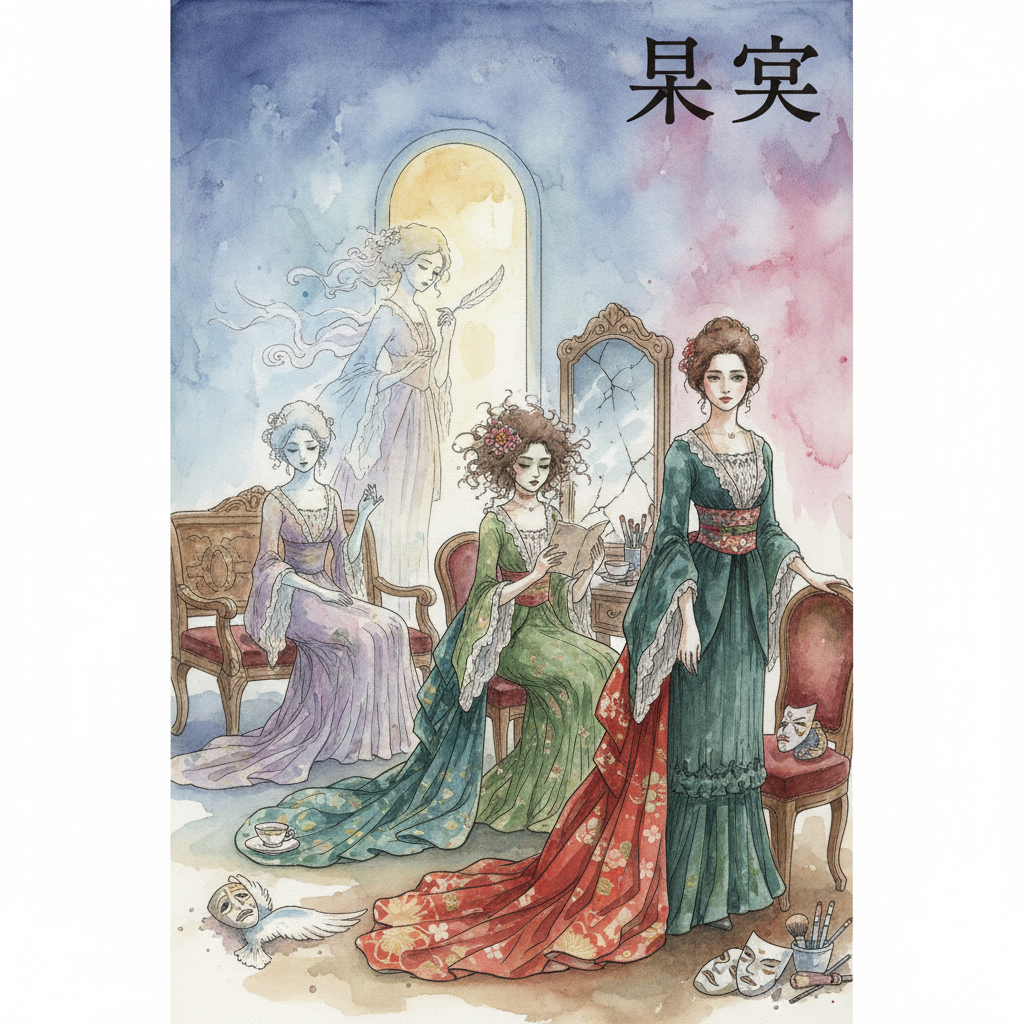
3) The Dressing Room (楽屋, Gakuya) — Kunio Shimizu (清水邦夫)
Many Salesman readers are deeply moved by Miller’s use of performance metaphor—Willy as someone always “on stage,” selling an image of himself. The Dressing Room turns that metaphor into literal theatrical space.
Set backstage, the play becomes a chamber of memory, repetition, identity rehearsal, and emotional residue. Characters inhabit roles even when roles no longer save them. That tension strongly echoes Willy Loman’s tragic logic: if performance is all you have, what happens when performance no longer persuades?
Why this crossover is productive
- Identity is built through repeated scripts.
- Nostalgia acts as both comfort and trap.
- The line between authentic self and performed self keeps dissolving.
For actors and directors
Pairing Salesman and The Dressing Room is ideal for rehearsal rooms investigating vocal mask, tempo shifts, and ritualized behavior.
🔗 View on Japanese Play Library
4) THE BEE (ザ・ビー) — Hideki Noda (野田秀樹) / Colin Teevan
This is the darkest and most explosive recommendation in the list—but it is essential if you read Salesman as a study of what social pressure does to personality.
Based on Yasutaka Tsutsui’s short story and developed as an English-language collaboration, THE BEE pushes an ordinary citizen into escalating violence through role reversal and coercion. Compared with Miller, it is more stylized and extreme. But both works ask the same core question: how fast can “decent normal life” collapse when status and control disappear?
Shared ground with Death of a Salesman
- Masculinity performed as competence under pressure.
- Social role instability triggering ethical breakdown.
- Family as both emotional refuge and coercive structure.
Why include a formally different play?
Because crossover reading should broaden your aesthetic vocabulary. Salesman shows slow-burn implosion. THE BEE shows accelerated implosion. Both reveal social cruelty through performance logic.
🔗 View on Japanese Play Library
5) On Mothers and Planets, and the Records of Women Who Rotate (母と惑星について、および自転する女たちの記録) — Ryūta Hōrai (蓬莱竜太)
If your interest in Salesman includes family inheritance—what parents pass down as fear, ambition, and unfinished life plans—this contemporary play is a strong final recommendation.
Hōrai’s writing tracks emotional labor and generational negotiation with precision. While Miller centers a father-son line of expectation and disappointment, Hōrai maps broader family structures and social roles, including gendered burdens and care obligations in contemporary life.
Why Salesman readers often respond
- Family love and family pressure are inseparable.
- Economic and social systems shape intimate choices.
- Characters try to protect others while reproducing harm.
Comparative payoff
Reading Miller with Hōrai helps you move from mid-20th-century male career tragedy to a wider 21st-century family-system perspective.
🔗 View on Japanese Play Library
Comparison Table: If You Like Death of a Salesman, Start Here
| Japanese Play | Strongest Match Element | Energy Level | Best For |
|---|---|---|---|
| The Men Who Wanted to Sing | Institution vs personal dignity | Medium | Readers who want social argument and civic stakes |
| Tokyo Notes | Family drift under historical pressure | Low | Fans of subtext, realism, and ensemble listening |
| The Dressing Room | Identity as repeated performance | Low-Medium | Actor-centered study of role and memory |
| THE BEE | Collapse under status and control pressure | High | Teams open to sharp, stylized contemporary form |
| On Mothers and Planets... | Intergenerational emotional inheritance | Medium | Readers seeking contemporary family-social analysis |
A Practical Reading/Production Sequence
If you are coming directly from Death of a Salesman, this order works well:
- The Men Who Wanted to Sing (closest institutional pressure logic)
- Tokyo Notes (quiet social/family drift)
- The Dressing Room (performance and memory)
- On Mothers and Planets... (expanded family-system perspective)
- THE BEE (high-intensity endpoint)
This progression preserves Miller’s emotional concerns while gradually widening form and style.
For Directors and Dramaturgs: Rehearsal Bridges from Miller to Japanese Plays
Comparative reading becomes most useful when it changes rehearsal practice. Here are five concrete bridges.
1) Build a “social mask map” for each character
In Salesman, characters constantly adjust how they sound depending on audience (family, boss, neighbor, self-memory). Apply the same method to Japanese plays in this list:
- public mask,
- private mask,
- emergency mask,
- collapse voice.
Track where masks fail. That failure point is often the dramatic climax—even when the script appears quiet.
2) Rehearse status in tempo, not posture
Status shifts are often audible before they are visible.
- In Miller: interruption, repetition, defensive speed.
- In Hirata: delayed response, soft deflection, polite drift.
- In Noda/Teevan: escalation and rhetorical overdrive.
Run at least one rehearsal with “tempo-only notes” before psychological notes.
3) Define what each character believes success means
Willy Loman’s tragedy is tied to one success script (“well-liked,” charismatic, socially legible). Comparative productions get sharper when each character’s success script is explicit.
Ask actors:
- What does this person think a successful life looks like?
- Who taught them that definition?
- What happens when social reality no longer rewards it?
This approach connects Miller directly to Japanese social-dramatic structures.
4) Stage family affection and coercion simultaneously
A recurring crossover mistake is splitting families into “loving” vs “toxic.” Better productions hold both at once.
Across these plays, families often:
- protect and damage,
- support and police,
- empathize and misrecognize.
Direct scenes so contradictory impulses coexist in one beat. That complexity is where the tragedy breathes.
5) Use silence as social data
In comparative drama, silence is never empty.
- It can signal shame.
- It can signal strategic self-protection.
- It can signal impossible choice.
- It can signal emotional debt.
If you annotate silence function scene by scene, cross-cultural interpretation becomes more precise and less stereotyped.
Deep Comparison: Five Analytical Axes for Readers and Researchers
If you are using this guide for study, criticism, or dramaturgical preparation, compare Death of a Salesman and the five Japanese plays through these axes.
1) Myth of mobility
In Miller, the central myth is personal upward mobility through charisma, sales skill, and social likability. Willy’s tragedy comes from the gap between that promise and material reality.
In Japanese plays from this list, mobility myths vary:
- institutional loyalty as upward path,
- educational/cultural legitimacy as status currency,
- or emotional self-management as proof of adulthood.
The key analytical question is the same: What social promise has each character invested in, and what evidence shows that promise failing?
2) Family as economic relay system
Death of a Salesman is often taught as a family drama, but its family system is also an economic relay: the father transmits a market ideology to children.
The Japanese plays complicate this relay in different ways:
- siblings negotiating care responsibility (Tokyo Notes),
- multigenerational emotional labor (On Mothers and Planets...),
- social conformity pressure passing through public institutions (The Men Who Wanted to Sing).
Instead of asking whether families are “good” or “bad,” a stronger comparative question is: How does each family distribute risk, debt, hope, and shame?
3) Performance of normality
Willy Loman performs confidence even when his social position is eroding. This pattern appears in all five recommendations, but with different theatrical grammars:
- polite conversational smoothness,
- bureaucratic language,
- rhetorical aggression,
- ritualized backstage identity,
- explosive role reversal.
Directorially and analytically, this is crucial: normality is staged behavior, not neutral background.
4) Time structure and collapse
Miller uses memory intrusions and temporal blending to show psychic fracture. By contrast, the Japanese plays distribute collapse differently:
- slow atmospheric erosion (Tokyo Notes),
- argument-driven social pressure (The Men Who Wanted to Sing),
- recursive ritual time (The Dressing Room),
- crisis acceleration (THE BEE),
- layered familial duration (On Mothers and Planets...).
Comparative payoff: tragedy is not only about what happens, but about how time is organized on stage.
5) Ethical endpoint
In Salesman, the ending exposes the lethal cost of confusing self-worth with market value. In the Japanese works, endpoints are often less singularly climactic but equally severe: endurance without resolution, relational thinning, moral compromise, or institutional normalization of harm.
This allows a richer conclusion for readers: modern drama does not always end with one “final event.” Sometimes it ends with a durable condition.
Production Notes: Adapting the Crossover for International Audiences
If you are planning workshops, readings, or educational programming, here are practical choices that improve cross-cultural clarity without flattening differences.
Translation strategy
Keep romanized Japanese names and titles alongside original characters on first mention (for example, Tokyo Notes [東京ノート], Oriza Hirata [平田オリザ]). This helps non-Japanese audiences retain references while preserving specificity.
Program note design
Avoid “Japan’s version of X” language. Instead, use two-part framing:
- one sentence on structural resonance with Salesman,
- one sentence on historical/stylistic difference.
That format invites entry while avoiding hierarchy.
Audience talkback prompts
Use prompts that connect personal response to structural analysis:
- Which character most clearly performs success, and at what cost?
- Where did silence feel protective, and where did it feel destructive?
- What definition of “a good life” was rewarded in the play’s world?
These questions produce more useful discussion than “Which play did you like better?”
Casting and acting note
In crossover repertory, do not assume one acting register. A company may need to shift between Miller-style emotional realism, Hirata-style micro-listening, and Noda/Teevan-style rhetorical velocity. Build rehearsal blocks by register rather than by scene chronology.
Educational use
For classes, pair one Miller scene with one short scene from each Japanese play and run comparative close reading in four layers:
- objective action,
- status negotiation,
- temporal pressure,
- language texture.
Students quickly see that “social tragedy” is a portable dramatic problem with multiple formal solutions.
FAQ
Which Japanese play is most similar to Death of a Salesman?
The Men Who Wanted to Sing is usually the strongest first match because it directly dramatizes institutional pressure shaping personal dignity and social voice.
Are these all realist plays like Miller?
No. Tokyo Notes leans quiet realism, The Dressing Room is meta-theatrical, and THE BEE is highly stylized. The common thread is social-performance pressure, not one style.
Can these plays work for educational or community productions?
Yes, but with different demands. Tokyo Notes rewards ensemble listening; THE BEE requires strong rhythm control and tonal precision; The Dressing Room benefits from actor-led rehearsal depth.
Why include plays that are tonally very different from Miller?
Because meaningful comparison is structural, not cosmetic. Different theatrical forms can expose the same social mechanics—work pressure, family expectation, identity fracture.
What should I read next on Japanese theater context?
Start with modern Japanese theater background and then move to practical viewing guides for international audiences.
Continue Exploring
- If You Like The Cherry Orchard: 5 Japanese Plays About Fading Worlds and Social Upheaval
- How to Watch Theater in Japan: A Practical Guide for International Visitors
Sources
- Encyclopaedia Britannica, Death of a Salesman (updated Mar. 12, 2026): https://www.britannica.com/topic/Death-of-a-Salesman
- Encyclopaedia Britannica, Shingeki overview: https://www.britannica.com/art/shingeki
- Performing Arts Network Japan (The Japan Foundation), Hideki Noda / Colin Teevan, THE BEE: https://performingarts.jpf.go.jp/en/article/6283/
- Seinendan official English page, Tokyo Notes: https://www.seinendan.org/eng/play/1994/tokyonotes/
この記事で紹介した戯曲



Written by
戯曲図書館 編集部
演劇経験者が運営する戯曲検索サービス「戯曲図書館」の編集チームです。 脚本選びのノウハウ、演劇業界の最新情報、公演レポートなどを発信しています。
関連記事
If You Like The Crucible (2026 Guide): 4 Japanese Plays About Scapegoats, Panic, and Public Obedience
Love The Crucible? Read 4 Japanese plays about fear, scapegoats, conformity, and the cost of refusing the crowd.
2026-08-21
Best Japanese Plays for Staged Readings (2026): 8 Scripts That Sound Alive in the Room
A 2026 guide to 8 Japanese plays for staged readings, with cast size, runtime, and translation-friendly notes for directors and dramaturgs.
2026-09-02
Tomodachi vs No Exit: A 2026 Guide to Friendly Invasion, Hellish Rooms, and the Violence of Other People
Compare Tomodachi and No Exit through confinement, coercion, group pressure, and the politics of being trapped with others.
2026-08-30
Best Japanese Plays for Low-Budget Productions (2026): 8 Scripts With Minimal Set Demands
A practical 2026 guide to 8 Japanese plays for low-budget productions, with cast size, runtime, and staging notes for small theaters, schools, and readings.
2026-08-19