Kōbō Abe (安部公房, 1924–1993) is often introduced as the novelist behind The Woman in the Dunes. For theater-makers, that is only the beginning: Abe built a stage where identity, language, and the idea of a stable self could come apart in front of the audience.
His plays are strange without being ornamental. A family can arrive at your door and refuse to leave. A man can become a stick. A ghost can enter a room and behave as though the living are the unreasonable ones. Underneath the surreal premises is a practical theatrical question: what happens to a person when the social world no longer confirms who they are?
This 2026 profile looks at Abe as a playwright and theater-maker, not only as a novelist. It introduces the work represented in the Japanese Play Library, places his theater in the postwar Japanese context, and offers a starting point for directors, dramaturgs, students, and readers approaching his plays in English.
Quick Facts
| Item | Detail |
|---|---|
| Japanese name | 安部公房 (Abe Kōbō) |
| Lifespan | 1924–1993 |
| Primary roles | Novelist, playwright, director, theatrical producer |
| Theater company | Abe Kōbō Studio, founded in 1973 |
| Signature concerns | Alienation, unstable identity, social roles, language, absurdity |
| Japanese Play Library | Abe Kōbō author page |
| Recommended starting point | Friends (Tomodachi, 友達) for ensemble theater; The Suitcase for a compact surrealist study |
From Novelistic Alienation to Stage Action
Abe was born in Tokyo in 1924 and became one of the defining postwar Japanese writers. He won the Akutagawa Prize for The Crime of S. Karma in 1951, and his fiction made him internationally known. But theater was not a side project. According to the Japan Center of the International Theatre Institute, Abe wrote nearly a hundred play scripts across his career and continued to write, direct, and lead a theater troupe until his health declined.
That theatrical commitment matters because Abe's stage work is not simply fiction placed in front of actors. He was interested in rehearsal, bodies, objects, sound, and the way a performance changes the audience's sense of ordinary space. A door is never only a door. A name is never only a name. A group of visitors is never merely a group of visitors.
His theater emerged from the pressures of postwar modernity: cities rebuilt and reorganized, institutions claiming to know people better than people knew themselves, and individuals forced to perform identities that no longer felt secure. Abe's characters are often not searching for a hidden authentic self. They are discovering that the self may be a temporary arrangement made by other people.
The Abe Kōbō Studio
In 1973, Abe founded the Abe Kōbō Studio. The company gave him a direct environment in which writing, directing, acting, and design could be tested together. That combination helps explain the physical intelligence of his plays. His worlds are conceptual, but they are never merely abstract. The actors must carry the problem in their bodies.
For programmers, this makes Abe especially useful beside writers such as Eugène Ionesco, Samuel Beckett, Harold Pinter, or Edward Albee. The comparison should not flatten Abe into a Japanese version of European absurdism. It is more accurate to say that he shares a suspicion of realistic stability while developing his own postwar Japanese vocabulary of confinement, bureaucracy, family pressure, and social disappearance.
Three Plays to Start With
Friends (Tomodachi, 友達)
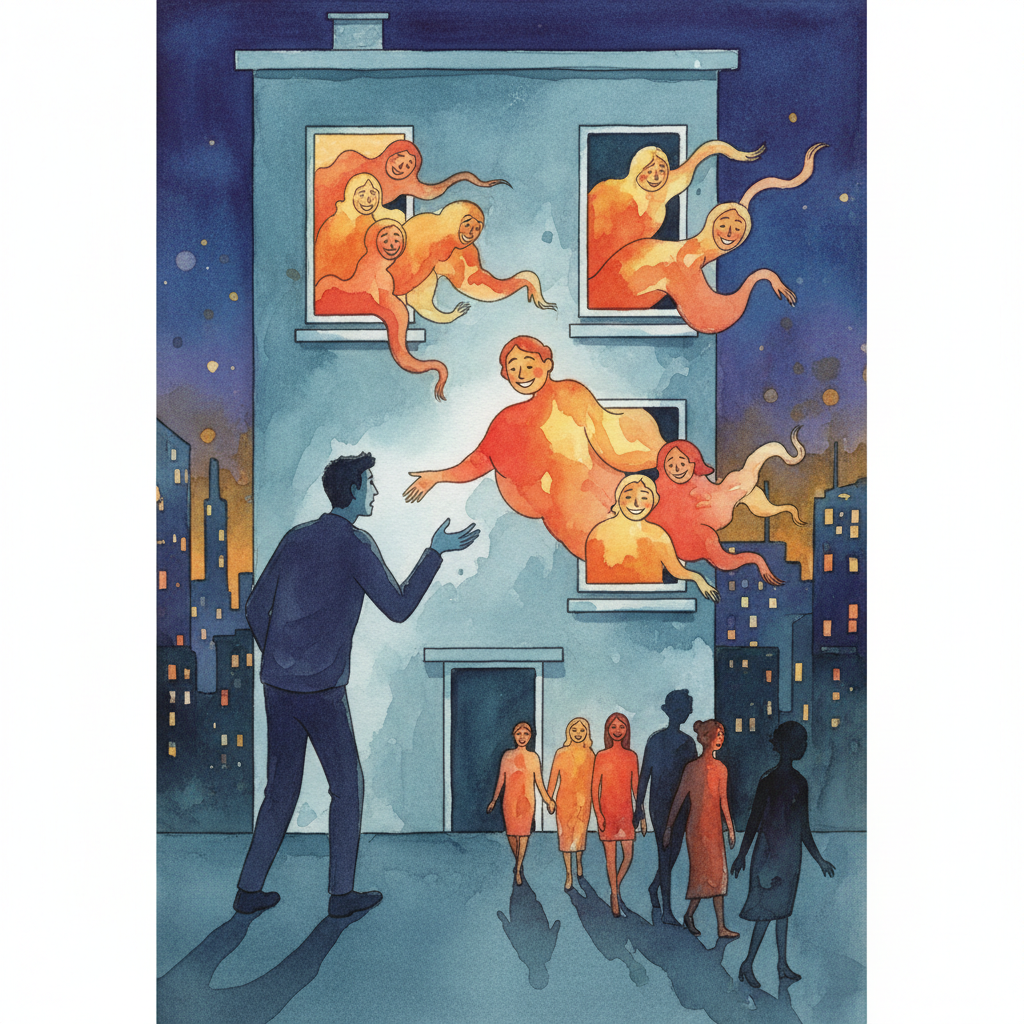
The Japanese Play Library lists Friends as a full-length work for 15 performers, with an approximate running time of two hours. Its premise is one of Abe's most theatrically efficient: a group of people enters a man's home and gradually treats the home — and the man — as something they collectively own.
The play begins with an intrusion and develops into a social nightmare. The visitors call themselves friends, but their friendliness becomes coercive. Their language is polite enough to make resistance seem unreasonable. The central horror is not that the group is irrational; it is that the group can make its irrationality feel normal.
For directors, Friends offers a strong ensemble problem. The visitors can be played as individuals, as a chorus, or as a shifting social organism. The production does not need elaborate spectacle. It needs precise control of proximity, repetition, politeness, and the audience's changing allegiance.
The Japanese Play Library's Tomodachi page is a useful place to begin reading about the work.
The Suitcase (Kaban, 鞄)
The Library lists The Suitcase as a three-person play with an approximate running time of one hour and forty minutes. The title object is simple, portable, and immediately theatrical — exactly the kind of object Abe can turn into a philosophical trap.
A suitcase suggests travel, ownership, evidence, and a life reduced to what can be carried. In Abe's hands, an object that should clarify a person's situation instead makes identity more unstable. Who owns the suitcase? What does it contain? What kind of person is defined by carrying it, losing it, or being unable to explain it?
For a small company or classroom, The Suitcase is an attractive entry point because its scale is manageable while its interpretive possibilities are large. A production can remain spare, or it can let the object accumulate visual, bureaucratic, and psychological meaning over the evening.
The Man Who Turned into a Stick (Bō ni natta otoko, 棒になった男)
This one-act play is one of Abe's best-known theatrical images. A man becomes a stick, and the transformation is treated not as a fantasy escape but as a change in social legibility. The body becomes an object. The object becomes a sign. The audience is asked to consider how easily a person can be reduced to a function, a shape, or a thing that others can use.
Donald Keene translated the play into English, and it appears with The Suitcase and The Cliff of Time in the collection The Man Who Turned into a Stick: Three Related Plays. The three works are often read together as a movement through birth, life, and death, although each can also be approached as an independent theatrical machine.
This is a particularly useful play for actors and directors who want to explore the border between psychological realism and material performance. The transformation does not need to be explained. It needs to be staged with enough clarity that the audience feels the consequences before it decides what the image means.
What Makes Abe's Theater Distinctive?
Identity is social before it is psychological. Abe's characters do not merely feel alienated inside themselves. They are made strange by rooms, groups, labels, and expectations.
Objects carry dramatic pressure. A suitcase, a stick, a door, or a household interior can become the central relationship of a scene. The object does not symbolize one fixed idea; it changes as the people around it change.
Politeness can be violent. Abe's most frightening exchanges often remain calm. The danger lies in the group's confidence that its behavior is reasonable.
The audience is part of the problem. Abe repeatedly makes spectators evaluate what counts as normal, responsible, or humane. The stage does not provide a safe outside position.
Programming Abe in 2026
Abe's work is well suited to companies building a season around unstable identity, social conformity, or the collapse of private space. A practical three-play sequence would be:
- Start with The Suitcase for a small-cast introduction to Abe's object-centered theater.
- Move to Friends for the ensemble and the politics of forced belonging.
- Finish with The Man Who Turned into a Stick for the most concentrated image of a person becoming a thing.
Design should resist the urge to make the work look generically “Japanese.” Abe's strangeness comes from the rules of the room, not from decorative atmosphere. A contemporary apartment, a neutral rehearsal space, or an almost empty stage may be more revealing than period detail.
The same restraint applies to acting. The characters do not need to announce that the world is absurd. They need to behave as if its rules are perfectly ordinary — until the audience notices that those rules have quietly become impossible.
Frequently Asked Questions
Is Kōbō Abe mainly a novelist or a playwright?
He is both. His novels are more widely known internationally, but his career included sustained playwriting, directing, and theatrical production. The Abe Kōbō Studio made theater a central part of his practice rather than an occasional adaptation of his fiction.
Which Abe play is best for a small cast?
The Japanese Play Library currently lists The Suitcase as a three-person work. It is the clearest practical starting point for a small company, while Friends is the stronger choice for an ensemble interested in group behavior and coercive “friendship.”
Are Abe's plays available in English?
Several are. Donald Keene translated The Man Who Turned into a Stick: Three Related Plays, and English readers can also find translations of works such as Friends and The Ghost Is Here in published collections and academic sources. Rights and translation editions should be confirmed with the relevant publisher or rights holder before a production.
What should I read after Abe?
Try Yukio Mishima's modern Noh plays for a more formal, classical architecture; Shuji Terayama for a more openly poetic and underground theatrical world; or Minoru Betsuyaku for a different route into Japanese absurdist drama.
The Takeaway
Kōbō Abe's theater does not ask the audience to choose between realism and fantasy. It asks a more unsettling question: what if the ordinary world is already a performance, and the strange thing is simply the moment when its rules become visible?
That is why Abe remains useful in 2026. His plays can be staged with modest means, but they demand exact thinking about bodies, objects, groups, and language. They give actors concrete actions and directors abstract problems. They give audiences a room that looks familiar until the room begins deciding who they are.
For an English-language company looking for a first encounter, begin with The Suitcase or Friends. Then let the stick appear.
Sources consulted: Japanese Play Library, Kōbō Abe author page and Tomodachi page; Japan Center of the International Theatre Institute, Theatre Yearbook 2024, “Abe Kobo and the Theater”; Donald Keene, The Plays of Kōbō Abe: An Introduction; Open Library record for The Man Who Turned into a Stick: Three Related Plays.
The Japanese Play Library (戯曲図書館) is Japan's largest online database of Japanese dramatic literature. Browse plays by cast size, runtime, theme, and author at gikyokutosyokan.com.
この記事で紹介した戯曲
Written by
戯曲図書館 編集部
演劇経験者が運営する戯曲検索サービス「戯曲図書館」の編集チームです。 脚本選びのノウハウ、演劇業界の最新情報、公演レポートなどを発信しています。
関連記事
Playwright Profile: Kobo Abe (安部公房) in 2026 — Why Friends and The Suitcase Still Feel Unsettling
A 2026 English guide to Kobo Abe's theatrical career, major plays, style, and why his stage work still matters for global theater artists.
2026-08-20
Playwright Profile: Minoru Betsuyaku (別役実) in 2026 — The Quiet Force Behind Japanese Absurdist Theater
A 2026 English guide to Minoru Betsuyaku’s life, major plays, theatrical method, and why his absurdist drama still matters internationally.
2026-07-30
Playwright Profile: Yukio Mishima (三島由紀夫) in 2026 — The Nobel-Nominated Novelist Who Rewired Noh for the Modern Stage
A 2026 English guide to Yukio Mishima as a playwright: his Five Modern Noh Plays, Madame de Sade, kabuki writing, politics, death, and how to program his work today.
2026-10-08
Playwright Profile: Shuji Terayama (寺山修司) in 2026 — The Angura Poet Who Turned Theater Into a Weapon
A 2026 English guide to Shuji Terayama's life, Tenjo Sajiki troupe, major plays, and why his angura theater still shapes global performance in 2026.
2026-10-01