
If you like Top Girls, the Japanese plays most worth reading next are the ones that ask what success costs women when family, work, class, and performance all pull in different directions at once.
Caryl Churchill’s Top Girls premiered at the Royal Court Theatre in London on August 28, 1982, and it still feels brutally current in 2026 because it never mistakes individual achievement for liberation. Marlene rises. She wins. She becomes legible to the world as a success story. But Churchill’s play keeps asking a colder question: who had to absorb the damage so that this version of success could exist?
That question travels remarkably well into Japanese drama. Not because Japanese playwrights simply reproduce Thatcher-era feminism in another language, but because many of them are equally alert to the systems around “successful” women: family obligation, workplace ideology, the politics of being agreeable, the demand to keep performing competence, and the social punishment that arrives when women refuse assigned roles.
For English-speaking readers, directors, dramaturgs, and teachers, that makes Top Girls a useful bridge text. If you already know Churchill, these Japanese plays can widen the conversation beyond British office satire or feminist canon-building. They let you compare how different theatrical cultures stage ambition, sacrifice, and women’s self-fashioning under pressure.
Quick Facts
| Item | Details |
|---|---|
| Western anchor text | Top Girls by Caryl Churchill |
| Best Japanese matches here | The Dressing Room, On Mothers and Planets..., Frozen Beach, The Men Who Want Us to Sing |
| Shared concerns | Women’s ambition, role performance, labor, class pressure, family cost |
| Most practical cast range here | 4-5 actors |
| Best use case | Feminist theater courses, women-led programming, staged readings, repertory discovery |
| Best first read | Frozen Beach if you want sharp contemporary damage; The Dressing Room if you want women trapped inside performance itself |
What makes Top Girls such a strong gateway?
People often summarize Top Girls too quickly. They call it a feminist classic, or an anti-Thatcher play, or a drama about career women. All of that is true, but none of it is enough.
What gives the play its afterlife is structure. Churchill begins with a surreal dinner party of women from history and legend, then shifts into office life, family history, regional class difference, and emotional abandonment. The result is not a simple argument that “work is bad” or “success is fake.” It is a harsher diagnosis:
- women can achieve visibility without changing the rules,
- workplace success can depend on adopting values that injure other women,
- family labor does not disappear just because one woman escapes it,
- and the role called “strong woman” can become its own costume.
That last point matters especially for Japanese drama. Many Japanese plays about women are not interested in triumphant emancipation as a clean endpoint. They are interested in aftereffects: what remains after duty, memory, care, and social expectation have already shaped a life. In that sense, Japanese theater often extends Top Girls rather than echoing it.
Instead of asking only whether a woman can “make it,” these plays ask:
- What kind of self had to be edited out to survive?
- Who gets left doing the unpaid emotional work?
- When does competence become another prison?
- Can solidarity survive class difference and personal compromise?
Those are Top Girls questions. They simply return in different theatrical temperatures.
1. The Dressing Room (Gakuya, 楽屋〜流れ去るものはやがてなつかしき〜) — Kunio Shimizu (清水邦夫)
- Japanese Play Library: The Dressing Room
- Cast: 4 women
- Runtime: about 80 minutes
- Best for Top Girls fans who love: role performance, female self-fashioning, and the feeling that womanhood itself can become a theatrical script
If your deepest fascination with Top Girls is not the office plot but the dinner scene and its larger question of how women are forced to narrate themselves, start with The Dressing Room.
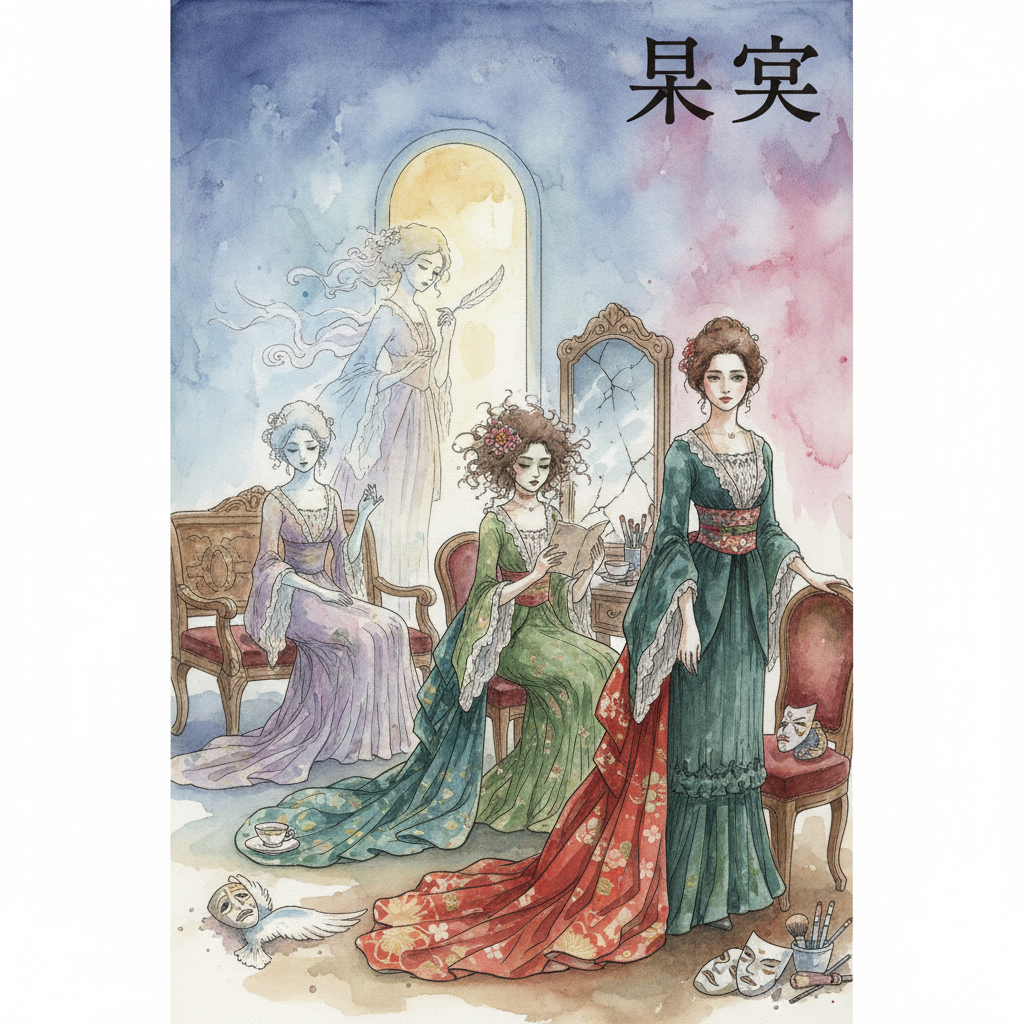
Shimizu sets the play backstage during a production of Chekhov’s The Seagull. Four actresses wait in a dressing room. All are connected to the role of Nina. Two are already dead. One has returned from a psychiatric hospital. Another clings to status inside the room. Desire, resentment, memory, and theatrical hierarchy all begin to rot together.
This makes the play an excellent Japanese companion to Churchill because both works are obsessed with women as performed entities. In Top Girls, women tell achievement stories, justify compromises, and negotiate the scripts history handed them. In The Dressing Room, women do not simply perform for society or for men. They perform for the theater machine itself, for recognition, for the fantasy that one perfect role will finally stabilize identity.
That is where the connection becomes productive for English-speaking readers. Marlene appears to have escaped confinement by becoming legible as a winner. Shimizu’s actresses reveal a darker version of the same logic: if your entire self has been organized around being cast, seen, and validated, then even the stage may become another domestic interior you cannot leave.
What is different from Churchill is equally important. Top Girls moves through explicit ideological conflict: careerism, family resentment, class mobility, political speech. The Dressing Room is more ghostly and recursive. It turns social role into theatrical haunting. Yet the underlying wound is familiar. Women are asked to become excellent at inhabiting identities they did not author.
For directors, the play is also practical. Four performers, one core setting, and actor-centered tension make it attractive for repertory programming or paired readings. If you want to put Top Girls beside a Japanese play that asks what performance does to women over time, this is the sharpest first choice.
Related reading: Best Japanese Plays for Women-Led Ensembles
2. On Mothers and Planets, and the Records of Women Who Rotate (Haha to Wakusei ni Tsuite, Oyobi Jitensuru Onna-tachi no Kiroku, 母と惑星について、および自転する女たちの記録) — Ryuta Horai (蓬莱竜太)
- Japanese Play Library: On Mothers and Planets...
- Cast: 4 women
- Runtime: about 150 minutes
- Best for Top Girls fans who love: the family plot, the class wound under success, and the question of what women inherit from mothers and sisters
One reason Top Girls keeps hurting audiences is that Marlene’s “success” is inseparable from what she abandons. Churchill never lets career achievement float free from kinship. Family is not a sentimental background in that play. It is the buried accounting system.
Horai’s On Mothers and Planets... is a powerful Japanese follow-up if that is the part of Churchill you cannot shake.
The play follows three sisters traveling to Istanbul to scatter their dead mother’s ashes. On paper that sounds like a grief play. In practice it is much more unstable than that: comic, painful, disorganized, loving, defensive, and fiercely aware that mothers continue structuring daughters’ lives long after death. Memory does not heal neatly here. It rotates, returns, embarrasses, and reassigns blame.
This is where the play speaks directly to Top Girls. Churchill asks what a woman must amputate in order to become exceptional under existing conditions. Horai asks what remains in the emotional bloodstream after generations of women have already been shaped by duty, motherhood, care work, and survival. Marlene’s choices are singular and brutal. Horai widens the lens to show how women’s lives are made relationally and historically, not only individually.
For English-speaking theater makers, this matters because it resists a flattened feminism of personal branding. The women here are not symbols of empowerment or failure. They are contradictory adults living with inheritance. Their conflict is not “traditional women vs liberated women.” It is more difficult than that. They are all already modern, and all still burdened.
The play also offers one of the strongest ensemble structures available to women-centered programming on Japanese Play Library. Each woman has substantive emotional weight. No one exists merely to support another’s self-realization arc. That makes the piece especially valuable in classrooms and companies that want to move beyond token “strong female roles” into actual distributed dramatic power.
If Top Girls leaves you thinking about sisters, mothers, class, and the emotional debris hidden under triumphant biographies, On Mothers and Planets... is essential.
3. Frozen Beach (Furozun Bichi, フローズン・ビーチ) — Keralino Sandorovich / KERA (ケラリーノ・サンドロヴィッチ)
- Japanese Play Library: Frozen Beach
- Cast: 4 women
- Runtime: about 130 minutes
- Best for Top Girls fans who love: sharp female conflict, moral ugliness, class texture, and the sense that survival can deform intimacy
If you want the Japanese recommendation on this list with the most immediate dramatic bite, read Frozen Beach.
KERA’s play is often described as a serious comedy or suspense comedy, and that tonal instability is part of its power. Set around women whose lives intersect through family, money, resentment, concealment, and long-buried violence, the play moves across years while exposing the emotional wreckage under surface competence. It is witty, cruel, surprising, and structurally confident.
The link to Top Girls is not office politics in a literal sense. It is the way both plays understand that women’s damage is social before it is psychological. Churchill refuses to sentimentalize female ambition. KERA refuses to sentimentalize female suffering. His women are not noble victims. They are strategic, compromised, funny, dangerous, lonely, and shaped by the brutal economies around them.
That makes Frozen Beach a strong recommendation for readers who love how Top Girls refuses moral simplification. Churchill never gives us “career woman bad, family woman good,” or the reverse. KERA is equally suspicious of tidy ethical sorting. He stages women who have endured, manipulated, and adapted inside systems that reward distortion.
For comparison work, this play is especially useful if you want to talk about class without becoming didactic. Top Girls famously ties gender mobility to class fracture. Frozen Beach does something adjacent through atmosphere and relationship damage rather than speechifying. The result is different in style but similar in force: a world where women’s choices are real, yet never fully free.
In production terms, it also offers a gift to advanced ensembles: four major roles with tonal range extending from comedy to dread. If your company loves Churchill because she gives actresses intelligence, danger, and contradiction, Frozen Beach will feel like a live wire.
4. The Men Who Want Us to Sing (Utawasetai Otokotachi, 歌わせたい男たち) — Ai Nagai (永井愛)
- Japanese Play Library: The Men Who Want Us to Sing
- Cast: 5 actors
- Runtime: about 110 minutes
- Best for Top Girls fans who love: institutions, ideology, workplace pressure, and dialogue as a site of political control
This is the most overtly workplace-and-system recommendation on the list, and it earns that position.
Ai Nagai’s The Men Who Want Us to Sing is a social comedy set in a school workplace around the politics of singing the national anthem at a graduation ceremony. A struggling chanson singer turned music instructor is pulled into a conflict between authority, conscience, professional obligation, and institutional performance. The premise is specific. The stakes are much larger.
Why include it after Top Girls? Because Churchill’s play is not only about women and success. It is also about institutions teaching people which speech is acceptable, which self is promotable, and which compromises get normalized as adulthood. Nagai understands that mechanism very well.
In this play, “singing” is never just singing. It becomes a test of obedience, employability, civic conformity, and social survival. That makes it a rich counterpart to Marlene’s world. The office in Top Girls rewards a certain kind of female fluency. The school in Nagai’s play pressures characters to perform consent in public. In both cases, the institution does not merely organize labor. It shapes identity.
This is also where Japanese drama adds something Churchill-adjacent but distinct. Top Girls is often staged through irony, fracture, and explicit historical framing. Nagai works through argumentative comedy and social realism. Her dramaturgy is tighter at the level of practical conflict: who says what, who signs off, who backs down, who pays. That makes the play especially good for directors and students interested in how ideology enters ordinary professional life.
For international readers, this recommendation is useful because it widens the meaning of “women’s issue” beyond family and selfhood. Women’s work is always political, but sometimes the politics arrive not through intimacy alone. They arrive through institutions demanding a ritual display of agreement.
If your favorite thing about Top Girls is that it shows success and workplace language as ideological theater, this is the Japanese play to read next.
Related reading: How to Choose Japanese Plays for Staged Readings in English (2026)
Comparison Table: If you like this in Top Girls, start here
| If this is what you love in Top Girls | Read this Japanese play next | Why it fits |
|---|---|---|
| Women trapped inside roles they must keep performing | The Dressing Room | It turns female identity, ambition, and recognition into theatrical haunting |
| Family damage underneath female achievement | On Mothers and Planets... | It shows how mothers, sisters, grief, and inheritance shape adult women’s lives |
| Sharp, unsentimental women under social pressure | Frozen Beach | It offers four contradictory women shaped by class, secrecy, and survival |
| Workplaces that demand ideological performance | The Men Who Want Us to Sing | It exposes how institutions police behavior, speech, and compliance |
Where should you start?
If you only choose one Japanese play after Top Girls, the best starting point depends on which part of Churchill matters most to you.
- Start with The Dressing Room if you think Top Girls is fundamentally about women being forced to perform identities for systems that consume them.
- Start with On Mothers and Planets... if the family and sister plot is what stays with you after the curtain call.
- Start with Frozen Beach if you want women written with intelligence, cruelty, humor, and damage rather than moral decoration.
- Start with The Men Who Want Us to Sing if your strongest interest is in institutions, labor, and how public conformity gets produced.
That is the best way to read across cultures here. Do not ask which one is “the Japanese Top Girls.” Ask which one continues the argument you care about most.
How these pairings help English-speaking theater makers
These plays are not only reading recommendations. They are practical programming tools.
1. Build a women-and-work season that avoids obvious repetition
Many English-language companies move from Ibsen to Churchill to contemporary American office satire and stop there. Adding Japanese drama changes the energy. You get questions of role performance, kinship inheritance, and institutional pressure without repeating the same dramaturgical shape.
2. Teach feminism as structure, not only theme
Students often recognize feminist content faster than feminist form. These Japanese plays help. The Dressing Room shows how performance structure can trap women. On Mothers and Planets... distributes dramatic weight across women rather than centering a single exemplary heroine. Frozen Beach resists moral flattening. The Men Who Want Us to Sing shows political coercion entering everyday labor.
3. Expand women-led repertoire beyond familiar Anglophone titles
If you program women-centered work only through canonical English plays, you unintentionally narrow the available emotional and formal range. Japanese scripts on this list open different routes: ghostly meta-theater, intergenerational travel drama, suspense comedy, and institutional social comedy.
4. Give actresses contradictory material
One of the strongest things Top Girls offers performers is contradiction. These Japanese plays do the same. None of their women exist to symbolize virtue. They strategize, fail, remember, protect themselves badly, and sometimes hurt each other. That is exactly why they are worth staging.
FAQ
What Japanese play is most like Top Girls?
The closest overall thematic match is The Dressing Room, because it explores women as performers inside roles they did not fully choose, while also giving an all-women structure strong comparative value.
Which recommendation is best for women-led ensembles?
Start with The Dressing Room, On Mothers and Planets..., or Frozen Beach. All three give substantial material to women performers rather than token visibility.
Which play is most useful for a class on women and work?
The strongest direct companion for that topic is The Men Who Want Us to Sing, because it stages professional pressure, ideology, and institutional compliance very clearly.
Which play is easiest to stage in a small space?
The Dressing Room is the most immediately practical: four actors, one concentrated setting, and a runtime around 80 minutes.
Do these plays simply repeat Western feminist arguments in Japanese?
No. They often shift the emphasis toward memory, social atmosphere, kinship, and institutional ritual, which makes the comparison more useful rather than less.
Final Take
If Top Girls matters to you because it refuses to confuse female success with freedom, Japanese drama has a great deal to offer next.
These plays do not imitate Churchill. They complicate her. They show women not only at the point of promotion or ideological declaration, but inside rehearsal rooms, family afterlives, damaged friendships, and institutions that demand visible compliance. They ask what happens after the script of “successful woman” has already been accepted, rewarded, or internalized.
That is why these four Japanese plays are worth reading after Top Girls. They do not make the argument smaller. They make it harder, stranger, and more alive.
Sources
- Concord Theatricals, “Top Girls”
https://www.concordtheatricals.com/p/1798/top-girls - Columbia University Press, The Columbia Anthology of Modern Japanese Drama
https://cup.columbia.edu/book/the-columbia-anthology-of-modern-japanese-drama/9780231128308/ - Performing Arts Network Japan, “Ai Nagai | Utawasetai Otokotachi (Men Who Want Us to Sing)”
https://performingarts.jpf.go.jp/en/article/6247/ - Performing Arts Network Japan, “Keralino Sandorovich”
https://performingarts.jpf.go.jp/en/article/6965/ - Performing Arts Network Japan, “Ryuta Horai”
https://performingarts.jpf.go.jp/en/article/person/ryuta-horai/
この記事で紹介した戯曲



Written by
戯曲図書館 編集部
演劇経験者が運営する戯曲検索サービス「戯曲図書館」の編集チームです。 脚本選びのノウハウ、演劇業界の最新情報、公演レポートなどを発信しています。
関連記事
If You Like Hedda Gabler (2026 Guide): 4 Japanese Plays About Female Rage, Respectability, and the Need to Burn the Script
Love Hedda Gabler? Read 4 Japanese plays about boredom, control, female rage, and the social cost of living inside the wrong role.
2026-08-14
If You Like A Doll’s House: 4 Japanese Plays About Women, Marriage, and Refusing Assigned Roles
Love A Doll’s House? Discover 4 Japanese plays that explore marriage, female identity, social roles, and the cost of walking out of the script.
2026-07-24
If You Like The Crucible (2026 Guide): 4 Japanese Plays About Scapegoats, Panic, and Public Obedience
Love The Crucible? Read 4 Japanese plays about fear, scapegoats, conformity, and the cost of refusing the crowd.
2026-08-21
If You Like Hedda Gabler: 5 Japanese Plays of Social Confinement, Performance, and Controlled Destruction
Love Hedda Gabler? Try 5 Japanese plays about control, performance, social confinement, and destructive desire.
2026-07-17