
Samuel Beckett’s Waiting for Godot remains one of those plays people keep returning to, even when they can’t quite explain why. Two men wait for someone who never comes. Almost nothing happens. Time stretches, folds, and repeats itself. The stage can be close to bare. Yet audiences keep watching, directors keep staging, and actors keep trying to discover where, exactly, the pain and comedy balance each other.
If you love Godot, you probably love at least one of these things:
- language that circles around what it cannot say,
- humor that comes from failure rather than success,
- characters who are trapped and somehow still keep going,
- minimal theatrical means that produce maximal emotional pressure,
- and the sensation that a play is talking about everything while pretending to talk about almost nothing.
This guide introduces five Japanese plays that can speak directly to that appetite. Not because they are copies of Beckett (they are not), but because they wrestle with similar theatrical questions: what is left when plot thins out, certainty vanishes, and human beings are forced to exist in each other’s company?
To keep this honest and useful, we’ll do two things at once:
- Clarify what makes Waiting for Godot work as theater.
- Show how Japanese playwrights transformed comparable concerns through their own social histories, languages, and stages.
In other words, this is not “Japan does Beckett.” It is a conversation between traditions.
What Makes Waiting for Godot Special
Beckett called Waiting for Godot a “tragicomedy in two acts,” and that subtitle is not decorative. The play’s emotional logic depends on tonal instability: laughter appears in the middle of dread; dread appears in the middle of clowning. In one recent major review, this tension was described as a balance between “the absurd and desolate, the funny and dreadful.” That formula still captures the play’s central mechanism.
1) Waiting as structure, not just theme
Most plays use waiting as a temporary state before action begins. Godot reverses that relation: waiting is the action. Vladimir and Estragon do not wait in order to get to life; waiting is life. This is one reason the play feels endlessly contemporary. We may have different technologies and different political crises than in 1953, but the sense of postponement—of living on a promised tomorrow—remains familiar.
2) Minimal stage, maximal metaphysics
A tree. A road. Light changes. Entrances and exits. The dramaturgical economy is radical: almost all interpretive weight sits on rhythm, repetition, interruption, and silence. Directors often describe Godot as a test of theater itself: can bodies, voices, and time alone produce meaning without explanatory machinery?
3) Language as survival behavior
Vladimir and Estragon talk partly to communicate, but mainly to fend off voids—silence, fear, abandonment, mortality. Their banter is not merely witty writing; it is a tactic for staying alive in the moment. Even insults and routines become forms of mutual care.
4) Hope without guarantee
“Let’s go.” They do not move. This is often read as nihilism, but that is too simple. Beckett’s world is cruelly uncertain, yet his characters keep performing small acts of persistence: they remain together, they speak, they remember (or fail to), they try again tomorrow. The play offers no transcendent answer, but it does not abolish human attachment.
These features matter because the Japanese plays below engage them from very different angles: postwar memory, urban alienation, theatrical meta-space, and social absurdity in everyday speech.
Japanese Plays You’ll Love
1) Asahi no Yō na Yūhi o Tsurete(朝日のような夕日を連れて) by Kōkami Shōji(鴻上尚史)
- The connection to Beckett: direct dialogue with Godot plus existential comedy in a fractured structure.
- What’s different: a distinctly Japanese 1980s pop-theatrical energy, blending youth-culture speed with philosophical unease.
- Cast & runtime: 5 actors, approximately 90 minutes.
- 🔗 View on Gikyoku Tosyokan
If you want the clearest bridge from Godot to Japanese contemporary theater, start here.
The play famously intersects multiple zones—including a section explicitly framed as “waiting for Godot”—while moving through workplace and identity-centered scenes. That collage-like architecture matters: instead of reproducing Beckett’s stripped road one-to-one, Kōkami asks what Beckettian waiting looks like once it enters modern social systems (labor, performance, public persona, urban life).
A useful critical anecdote comes from reporting on Japanese Godot productions in the Reiwa era: actor Hiroo Ōtaka (大高洋夫) recalled that his earlier hit with Daisan Butai (第三舞台), Asahi no Yō na Yūhi o Tsurete, included a “businessman similar in many ways to Vladimir.” This isn’t a random resemblance. It reveals how Beckett’s figure of suspension migrated into Japan’s own theatrical vernacular.
Where Beckett places two men in a near-void, Kōkami places existential drift inside systems that are crowded, noisy, and supposedly functional. The result is a productive contrast:
- Beckett: emptiness exposes dependence.
- Kōkami: busyness exposes emptiness.
For Godot fans, the pleasure lies in seeing similar anxieties translated into a new tempo. Kōkami’s language and staging tend to be sharper, quicker, and more socially populated than Beckett’s ascetic frame, but underneath that velocity is the same pressure: what if our roles, routines, and ambitions are elaborate methods of waiting for meaning to arrive from outside?
If Godot is your desert island text, this play feels like hearing its echo in a neon city.
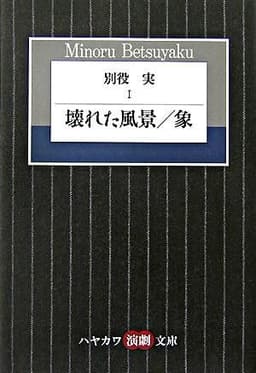
2) Zō(象, The Elephant) by Betsuyaku Minoru(別役実)
- The connection to Beckett: sparse absurdist logic, estranged dialogue, and characters trapped in irresolvable situations.
- What’s different: postwar Japanese memory—especially the politics of witnessing and victimhood—sits at the core.
- Cast & runtime: 10 actors, approximately 150 minutes.
- 🔗 View on Gikyoku Tosyokan
Betsuyaku Minoru is essential if you are tracing what happened to absurdist theater outside Europe. In interviews and critical profiles, he is repeatedly identified as foundational to Japanese fujōri-geki(不条理劇, theater of the absurd). Crucially, this label is not mere import branding. Betsuyaku’s work metabolizes Beckett and Kafka through specifically Japanese postwar conditions.
In Zō, the absurd is never only metaphysical. It is historical.
At the center is an atomic-bomb survivor who tries to turn scarred bodily evidence into public recognition. The play asks terrifying questions: what happens when catastrophe becomes spectacle? What does “witnessing” mean when the audience wants emotional impact more than ethical relation? Can suffering be represented without being consumed?
Beckett’s characters wait for a missing figure; Betsuyaku’s characters wait for acknowledgment that may be morally impossible. Both dramatize failed arrival, but the referent changes:
- In Godot, absent meaning.
- In Zō, absent justice.
Stylistically, you still get many pleasures familiar to Beckett readers: repetition, off-kilter exchanges, and tonal slips between grotesque comedy and despair. But Betsuyaku’s stage is populated by social structures Beckett often abstracts away: postwar denial, public sentiment, memory politics, and the uneasy economies around victimhood.
So if Godot made you think “this is about human existence,” Zō may push you to ask, “whose history does existential theater include, and whose does it omit?”
That question is not a rejection of Beckett. It is a deepening.
3) Macchi Uri no Shōjo(マッチ売りの少女, The Little Match Girl) by Betsuyaku Minoru(別役実)
- The connection to Beckett: comic estrangement, circular unease, and domestic situations that open into ontological instability.
- What’s different: postwar social pressures and family-space invasion shape the absurd from the inside out.
- Cast & runtime: 4 actors, approximately 90 minutes.
- 🔗 View on Gikyoku Tosyokan
A major advantage of reading Betsuyaku after Beckett is that you can compare how “small situations” produce large philosophical effects.
In Beckett, two men by a tree become an image of the human condition. In Betsuyaku’s Macchi Uri no Shōjo, a seemingly contained everyday setup is gradually disrupted by newcomers carrying the burdens of immediate postwar life. Critics have often pointed to this as one of Betsuyaku’s key methods: not symbolic grandiosity, but ordinary frames that become untenable.
Why Godot fans should care:
-
Conversation as misfiring mechanism
Like Beckett, Betsuyaku writes dialogue where people appear to be speaking “normally,” yet semantic alignment never fully settles. Meaning slides, stalls, and circles. -
Humor as emotional anesthesia and revelation
You laugh first, then notice the social wound underneath. This sequencing resembles Beckett’s best comic cruelty. -
No cathartic resolution
The play resists clean closure. Characters do not “learn the lesson” and move on. They remain in compromised structures.
If Godot gave you a taste for theater where unresolvedness is not failure but form, Macchi Uri no Shōjo will feel immediately legible—and newly unsettling.
It also helps clarify a historical point: Japanese absurdist theater did not simply imitate European modernism. It used absurd form to process local fractures in postwar social life.
4) Inu ga Nishi Mukya O wa Higashi(犬が西向きゃ尾は東) by Betsuyaku Minoru(別役実)
- The connection to Beckett: linguistic play, anti-teleological momentum, and characters caught in comic-philosophical loops.
- What’s different: idiomatic Japanese verbal texture and social absurdity rooted in speech habits.
- Cast & runtime: 6 actors, approximately 100 minutes.
- 🔗 View on Gikyoku Tosyokan
One reason Beckett ages so well is that his jokes are structural, not topical: rhythm, contradiction, ritual, collapse. Betsuyaku’s Inu ga Nishi Mukya O wa Higashi offers a related pleasure through Japanese idiom and conversational misdirection.
Even the title signals a world where directional logic and verbal habit coexist in unstable ways. For non-Japanese readers, this play can be a masterclass in how absurdism changes when language itself carries different assumptions about politeness, indirection, and social position.
Beckett often strips language toward near-zero, exposing repetitive need. Betsuyaku, by contrast, may keep language socially alive while making its coordination fail. The result is less “void speech” and more “everyday speech gone strange.”
This distinction matters for theater-makers:
- If you stage Beckett, you calibrate silence and minimal gesture against textual precision.
- If you stage Betsuyaku, you also calibrate the sociolinguistic choreography of misunderstanding.
For Godot lovers, this play is a reminder that absurdism is not one style. It is a family of strategies for showing humans trapped in systems they cannot fully name.
5) Gakuya: Nagare Saru Mono wa Yagate Natsukashiki(楽屋~流れ去るものはやがてなつかしき~) by Shimizu Kunio(清水邦夫)
- The connection to Beckett: waiting, repetition, and stage-time as existential condition.
- What’s different: meta-theatrical female-centered backstage haunting, tied to Chekhov’s The Seagull.
- Cast & runtime: 4 actors, approximately 80 minutes.
- 🔗 View on Gikyoku Tosyokan
If Beckett asks what remains when event disappears, Shimizu asks what remains when performance itself becomes an afterlife.
Set in a dressing room during a production of Chekhov’s The Seagull, the play gathers actresses around role, memory, rivalry, ghostliness, and unending return. Some are already dead. Some are displaced by time. All are bound to theatrical repetition.
For Godot readers, the immediate resonance is obvious: people waiting in a confined space for something that may never arrive in the expected way. But the tonal ecosystem differs.
Beckett builds a metaphysical roadside duet.
Shimizu builds a haunted ecology of actresses, role-identity, and theatrical labor.
Where Vladimir and Estragon confront ontological uncertainty through companionship, Shimizu’s characters confront it through performance history: who owns a role? what is left of a performer when the role survives her? can memory itself become a trap-door stage?
This play also broadens the gender texture of your post-Godot reading path. Much Godot discourse orbits male duos, clown lineages, and philosophical brotherhood. Gakuya reframes waiting through women’s theatrical bodies, desire, competition, and spectral persistence.
It is one of the best choices if you love Beckett’s temporality but want a richer meta-theatrical frame.
How to Read These Plays Fairly Beside Beckett
A common mistake in crossover recommendation lists is to treat one work as “the original” and the others as “variations.” That approach flattens both sides.
A better method is comparative reciprocity:
What Beckett helps you see in Japanese plays
- the dramatic power of repetition,
- how silence can be action,
- how comedy carries metaphysical terror,
- and how little theater needs in order to become large.
What Japanese plays help you see in Beckett
- the historical limits of “universal” existentialism,
- the social textures that minimalism can hide,
- alternative speech rhythms for absurd theater,
- and new relationships between metaphysical uncertainty and political memory.
In short: Beckett can sharpen your reading of Betsuyaku, Kōkami, and Shimizu—but they can also sharpen your reading of Beckett.
A Note on Translation and Access
If you are approaching these works in English, you may meet uneven translation availability. Don’t let that stop you. Even partial access (anthology excerpts, production recordings, bilingual criticism, rehearsal materials) can be artistically productive.
For researchers and directors, a practical route is:
- Start with one full translated script if available.
- Pair it with Japanese synopsis material and critical essays.
- Track performance histories (Japanese and international).
- Build a dramaturgy packet that distinguishes textual fact from interpretive analogy.
This workflow keeps comparison rigorous rather than impressionistic.
Suggested Double-Bill Pathways for Theater Fans
If you’re a director, dramaturg, or actor looking to program or study by contrast, here are useful pairings:
Pairing A: Structural waiting
- Waiting for Godot (Samuel Beckett)
- Asahi no Yō na Yūhi o Tsurete(朝日のような夕日を連れて)
Focus: How “waiting” mutates between a near-empty stage and socially saturated modern spaces.
Pairing B: Absurdism and postwar memory
- Waiting for Godot
- Zō(象)
Focus: From metaphysical suspension to historical wound; absent meaning vs absent justice.
Pairing C: Theater about theater-time
- Waiting for Godot
- Gakuya(楽屋~流れ去るものはやがてなつかしき~)
Focus: Endless waiting as existential state vs endless waiting as theatrical afterlife.
These pairings work for reading groups, graduate seminars, and rehearsal labs.
Start Here (If You Only Read One First)
If you are a Godot fan and want the strongest first crossover, begin with:
Asahi no Yō na Yūhi o Tsurete(朝日のような夕日を連れて)
Why this one?
- It has an explicit relationship to Godot discourse in Japanese theater culture.
- It preserves absurdist pressure while moving into a very different social and performative register.
- It is compact enough to read quickly but rich enough to stage, teach, or debate.
Then move to Zō(象) for historical depth, and Gakuya(楽屋~流れ去るものはやがてなつかしき~) for meta-theatrical expansion.
If Waiting for Godot taught you that nothing happening can still be theater, these Japanese plays show a second lesson: different histories produce different kinds of “nothing,” and each kind has its own humor, cruelty, and stubborn hope.
That is exactly why this crossover is worth your time.
And if you are approaching these texts as a maker, not just a reader, try this practical exercise: pick one five-minute sequence from Godot and one five-minute sequence from any play above, then map beats of silence, interruption, physical stillness, and failed intention. You will quickly see that “absurdity” is not an abstract label but a concrete score for performers. Beckett teaches precision under emptiness; Japanese playwrights like Betsuyaku Minoru(別役実), Kōkami Shōji(鴻上尚史), and Shimizu Kunio(清水邦夫)teach how that precision bends under different social weather. Put together, they make your theater vocabulary larger.
この記事で紹介した戯曲

Written by
戯曲図書館 編集部
演劇経験者が運営する戯曲検索サービス「戯曲図書館」の編集チームです。 脚本選びのノウハウ、演劇業界の最新情報、公演レポートなどを発信しています。
関連記事
If You Like Long Day's Journey Into Night (2026 Guide): 5 Japanese Plays About Family Secrets, Blame, and the Past That Won't Stay Buried
Love Long Day's Journey Into Night? Read 5 Japanese plays about family secrets, inherited grief, and the quiet violence of a past that refuses to stay buried.
2026-10-02
If You Like The Crucible (2026 Guide): 4 Japanese Plays About Scapegoats, Panic, and Public Obedience
Love The Crucible? Read 4 Japanese plays about fear, scapegoats, conformity, and the cost of refusing the crowd.
2026-08-21
If You Like Hedda Gabler (2026 Guide): 4 Japanese Plays About Female Rage, Respectability, and the Need to Burn the Script
Love Hedda Gabler? Read 4 Japanese plays about boredom, control, female rage, and the social cost of living inside the wrong role.
2026-08-14
If You Like Top Girls: 4 Japanese Plays About Ambition, Work, and the Price of Female Success
Love Top Girls? Start with 4 Japanese plays about ambition, women’s work, class pressure, and the costs of survival.
2026-07-31