Introduction
If you are an international theater lover searching for one Japanese play that can speak directly to contemporary anxieties—social isolation, surveillance by community, coercive intimacy, and the fear of being “helped” into submission—Tomodachi (友達 / Friends) by Abe Kōbō (安部公房) is an excellent place to start.
At first glance, the premise sounds almost comic: a large family arrives uninvited at a young man’s apartment, insists they are his “friends,” and gradually takes over his private life. But what begins as awkward social intrusion becomes a full-scale moral siege. The tone moves between deadpan humor, claustrophobic dread, and philosophical cruelty. By the end, the play has done something rare: it has made ordinary social language—politeness, concern, cooperation—feel terrifying.
For English-speaking readers, directors, and actors, Tomodachi is also unusually accessible in a practical sense. It has an English translation history, a clear production engine, and a structure that can be staged in many different theatrical idioms: realist interiors, stylized movement theatre, absurdist grotesque, or near-Brechtian social demonstration.
This article offers a full “play spotlight” for informed enthusiasts: not just a synopsis, but historical context, dramaturgical analysis, and concrete production notes based on available metadata and reception.
If you want the original Japanese play listing first, here is the internal page:
- Tomodachi (友達) on Gikyoku Toshokan: https://gikyokutosyokan.com/posts/209
About the Playwright
Abe Kōbō (安部公房): novelist, playwright, director, experimentalist
Outside Japan, Abe Kōbō (安部公房) is often introduced through prose fiction—especially Suna no Onna (砂の女 / The Woman in the Dunes). But he was also a major theatrical thinker and practitioner. His dramatic writing shares a core concern with his novels: what happens to identity when social systems become opaque, coercive, and absurd?
Abe Kōbō (安部公房) was born in 1924 and died in 1993. He is frequently discussed alongside modernist and absurdist traditions, and commentators often compare his atmosphere of estrangement to writers such as Franz Kafka. In Japanese literary history, he is not a marginal experimentalist but a central postwar voice whose work crosses literature, theatre, and film.
In many introductions, Tomodachi (友達) is highlighted as one of his key plays, and it is often tied to his broader interest in the instability of modern social life: alienation in urban settings, pressure toward conformity, and the uneasy line between collective belonging and collective violence.
Why Abe matters for theater-makers now
Abe’s dramatic language is ideal for companies that want material with both conceptual depth and performative elasticity. His scripts are not “message plays” in a narrow ideological sense. Instead, they build unstable situations and let the social logic expose itself:
- Who defines what is normal?
- When does support become domination?
- Can a community become predatory while believing itself humane?
- What happens when one person’s refusal is treated as pathology?
That last question is especially contemporary. In an era of algorithmic group behavior, online pile-ons, and “care” rhetoric that can be punitive, Tomodachi lands with unsettling force.
Synopsis (Spoiler-Conscious)
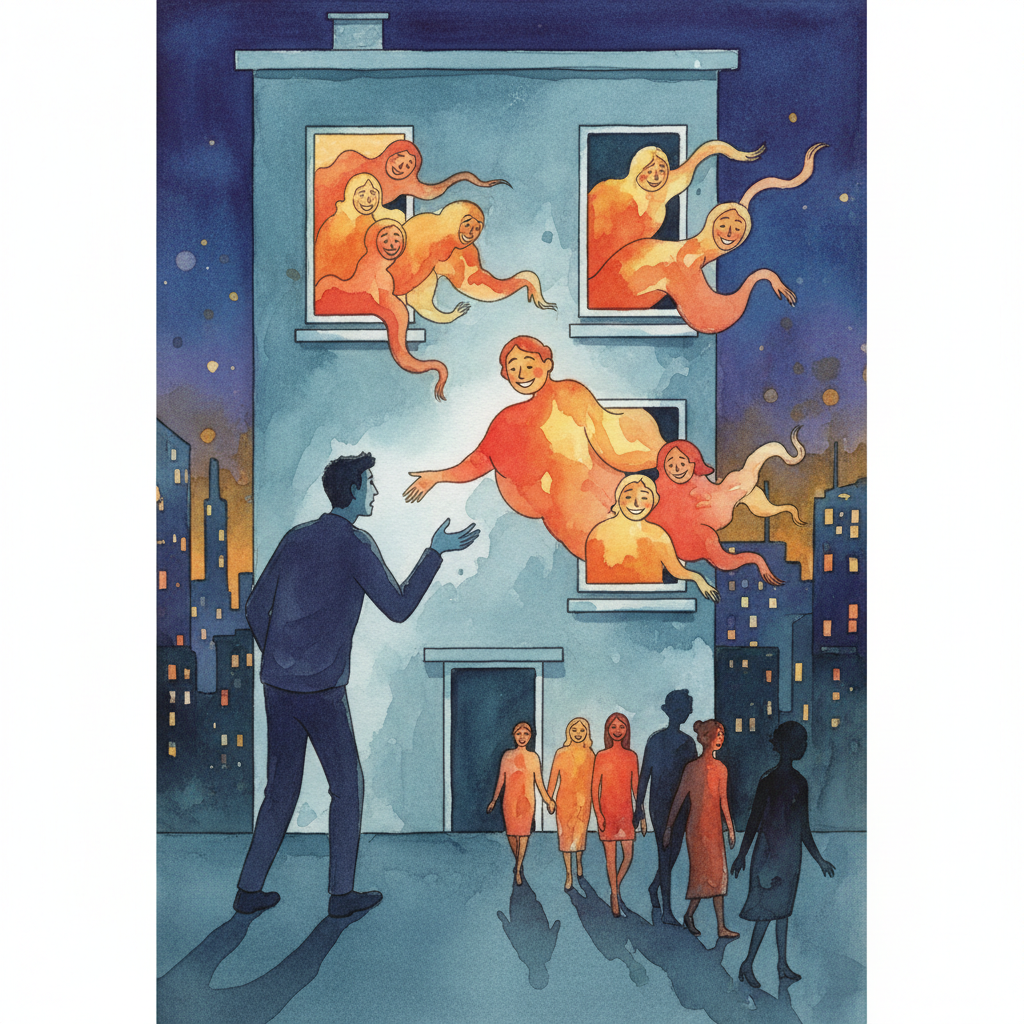
A solitary man lives in his apartment. One day, a large family appears at his door. They are strangers. They insist they are friendly. They insist they are there to rescue him from loneliness.
He refuses entry. They enter anyway.
He protests. They reinterpret his resistance as emotional confusion.
He seeks external authority—police, landlord, social order—but no one meaningfully intervenes. The family continues to settle in, reorganizing his space and redefining his reality. Their speech is frequently cheerful, even affectionate, but their collective behavior is invasive and relentless.
As the pressure escalates, the man’s autonomy erodes. The family’s “friendship” increasingly resembles a social machine designed to absorb and erase the individual. By the conclusion, the play leaves us with one of its bleakest insights: communities that claim to cure isolation can become engines of annihilation.
A useful way to approach this synopsis is to treat the family both literally and allegorically:
- Literal reading: a grotesque home invasion by socially manipulative intruders.
- Political reading: coercive collectivism normalizing itself as care.
- Psychological reading: invasive social anxiety staged as external figures.
- Urban-modern reading: fragile individuality crushed by procedural indifference.
A strong production does not need to choose only one reading; it can keep all four active.
Themes and Analysis
1) The terror of compulsory intimacy
Most theatre audiences are familiar with plays about loneliness. Tomodachi is stranger: it is about loneliness being “solved” by force. The family repeatedly claims benevolence, and this is exactly why they are frightening. They do not approach as villains announcing violence; they approach as ordinary people announcing concern.
This is Abe’s key inversion. The usual moral script says community saves the isolated individual. In Tomodachi, community colonizes the isolated individual.
The family’s language can be performed as warm, bureaucratic, sentimental, or pseudo-therapeutic. Each choice changes the flavor but not the mechanism: the target’s “no” is translated into evidence that he needs more intervention.
2) Politeness as a weapon
Japanese theatre often stages conflict through subtle shifts in social register. In Tomodachi, civility itself is destabilized. The family can appear courteous while violating boundaries. Their politeness is not hypocrisy in the simple sense; it is a social technology that makes resistance look unreasonable.
For international audiences, this often resonates beyond Japan. Similar dynamics appear in Western social life:
- institutional language that avoids accountability,
- “for your own good” paternalism,
- pressure to perform emotional transparency,
- group consensus used to invalidate dissent.
This is one reason the play reads as globally legible rather than culture-locked.
3) The apartment as a moral battlefield
The setting is small, but dramaturgically it is huge. The apartment is not just scenery; it is the man’s last legal and psychological boundary. Once it is occupied, the play becomes a choreography of displacement:
- who stands where,
- who sits without asking,
- who touches what,
- who controls movement,
- who defines “normal use” of the room.
Directors can make this spatial politics painfully clear. In early scenes, the man can still create lines of defense. Later, those lines collapse. By the final third, he often appears as a guest in his own home.
4) Absurdism with social teeth
Abe Kōbō (安部公房) is often linked to absurdist theatre, and Tomodachi does invite comparisons with Beckett, Ionesco, or Pinter. But its energy is distinct.
- It is less metaphysical stasis than social invasion.
- It is less language-collapse for its own sake than language capture.
- It is less “nothing happens” than “too much happens under false normality.”
The absurdity is not abstract. It is procedural. Scene by scene, the impossible is made administratively plausible.
5) Victim/perpetrator instability
One of the play’s most discomforting achievements is how it complicates moral clarity without excusing harm. The family members are oppressive, but they can be staged as human rather than demonic. They may believe their own rhetoric. They may feel sincere. That sincerity does not reduce the violence; it reveals how violence can function inside social virtue.
The protagonist, meanwhile, can be played as sympathetic but not purely idealized. He may be passive, rigid, evasive, or emotionally unprepared. None of this justifies the invasion, but it gives the play texture beyond allegorical simplification.
6) Death, loneliness, and the city
The ending image—where the family moves on to look for another isolated person—extends the play beyond one apartment. The city becomes a hunting ground. “Friendship” becomes a repeatable protocol. The social structure that failed to protect one person will fail again.
This cyclical ending makes Tomodachi feel chillingly modern. The play does not resolve into justice. It resolves into process.
For Western Audiences
A practical comparison map
If you are introducing this play to English-speaking collaborators, here is a useful orientation map:
- Beckett parallel: existential estrangement and unstable human relation.
- Pinter parallel: menace entering domestic space through ordinary speech.
- Ionesco parallel: absurd social logic escalating beyond realism.
- Albee parallel: middle-class civility exposing cruelty beneath etiquette.
But Tomodachi is not derivative of these traditions. Its social pressure feels specifically rooted in postwar urban modernity in Japan while still communicating transnationally.
Why the play travels well
Even without deep prior knowledge of Japanese social codes, non-Japanese audiences quickly recognize the core mechanism: language of care that denies consent.
Three staging factors make the play exportable:
- Clear situational engine: intrusion, normalization, takeover.
- Flexible style: can be naturalistic, stylized, or expressionist.
- Scalable interpretation: psychological chamber drama or political allegory.
Translation and English access
There is an established English translation lineage for Tomodachi (友達) under the title Friends, including publication records tied to translator Donald Keene and English-language editions from the late 1960s. Bibliographic records and listings (e.g., Google Books, WorldCat, and library catalogs) continue to circulate the play in English.
For theatre makers, this matters: unlike many important Japanese scripts that remain inaccessible, Tomodachi has a documented path into English-reading contexts.
Overseas performance footprint
The global footprint is modest but real, especially in educational and international theatre contexts. Public documentation includes examples of bilingual/English-oriented school productions outside Japan (for example, Singapore-based reporting around a staging of Tomodachi/Friends). This is useful evidence that the play can function beyond specialist Japan studies environments.
In other words, the question is not “Can this play work outside Japan?” It already has.
Production Notes (for directors, dramaturgs, and actors)
Below is the practical profile from available metadata and production logic.
Core metadata (from Gikyoku Toshokan entry)
- Play title: Tomodachi (友達 / Friends)
- Playwright: Abe Kōbō (安部公房)
- Recommended cast size: 15 total (approx. 9 men, 6 women in listed profile; adaptable by company)
- Approximate runtime: 130 minutes
- Genre profile: absurdist social thriller / dark comedy / anti-utopian domestic drama
Casting considerations
A large cast is part of the dramaturgy. The family must feel collectively overwhelming, not merely numerous. Their power comes from coordinated pressure and constant presence.
Casting priorities:
- strong ensemble timing,
- ability to sustain tonal ambiguity (comic surface + violent subtext),
- precision in vocal texture (repetition, interruption, collective speech),
- physical literacy in spatial crowding without visual chaos.
Gender can be adjusted in some productions if relational hierarchies remain legible.
Runtime and pacing
At around 130 minutes, pacing discipline is essential. Directors should avoid flattening the rhythm into one continuous tone of dread. The script breathes better with calibrated waves:
- awkward comedy,
- creeping disturbance,
- bureaucratic absurdity,
- moral panic,
- drained fatalism.
Without those shifts, audiences may intellectually understand the play but not emotionally feel its trap.
Set and design scale
You do not need expensive scenography. You do need intelligent spatial dramaturgy.
Minimum effective design strategy:
- one apartment interior with clear zones (entry, private core, contested common area),
- furniture/props that can be “reassigned” by the family over time,
- visible reduction of protagonist territory,
- sound cues that enlarge social pressure (doorbells, footsteps, urban hum, group song motifs).
The set should tell a story of ownership transfer.
Performance style options
Directors have at least four viable style routes:
- Psychological realism: family as plausible social predators.
- Grotesque absurdism: heightened bodies and vocal score.
- Political fable: symbolic costuming, demonstrative staging.
- Hybrid mode: realistic beginning, stylized collapse.
For many companies, the hybrid model works best because it lets the audience enter through recognition before moving into estrangement.
Difficulty level
I would classify Tomodachi as moderately high difficulty for production teams:
- ensemble-heavy,
- long-form tension control,
- tonal complexity,
- delicate ethical framing (how to stage violence without trivializing real social vulnerability).
For advanced university theatre, repertory companies, and devised ensembles with strong actor discipline, it is highly rewarding.
Where to Find This Play
Primary internal reference
- Gikyoku Toshokan play page: https://gikyokutosyokan.com/posts/209
English availability (overview)
The play is known in English as Friends, with bibliographic evidence of translation by Donald Keene and long-circulating English editions (including 1960s-era publication records). Availability may vary by region and print status, so production teams should confirm current rights and text access through appropriate licensing channels.
Research orientation for non-Japanese readers
When preparing a production dossier, prioritize the following:
- Japanese critical context on Abe Kōbō’s theatrical period,
- English bibliographic records for Friends translation history,
- postwar Japanese urban-social context,
- comparative absurdist frameworks (without reducing Abe to a Western derivative).
Related Plays You Might Enjoy
If Tomodachi interests you, these Japanese works can extend your map of modern theatre:
-
Hanshin (半神 / Half-God) by Noda Hideki (野田秀樹) & Hagio Moto (萩尾望都)
A different but equally powerful exploration of identity, dependency, and embodied conflict.
Related guide: https://gikyokutosyokan.com/blog/en/guide-play-spotlight-hanshin-half-god -
Godot-influenced Japanese absurdist reception (contextual guide)
For readers interested in how Japanese playwrights engage Western absurdism as influence, adaptation, or resistance.
Related guide: https://gikyokutosyokan.com/blog/en/guide-if-you-like-waiting-for-godot -
Kishida Prize-era modern drama corpus
Many Kishida-focused English guides on this site can help build historical breadth around postwar and contemporary Japanese dramatic language.
Start here: https://gikyokutosyokan.com/blog/en/kishida-work-tokyo-notes
Deep-Dive Dramaturgy: How to Read the Family
One of the most productive rehearsal questions is deceptively simple: What is the family’s ontology?
Are they realistic people? A cultic social unit? A projection of anxiety? A bureaucratic collective wearing domestic masks? The script supports multiple answers, and this interpretive flexibility is one reason the play survives new historical moments.
Reading A: Social realism pushed to nightmare
In this approach, every family member is materially real, and the event is a plausible (if extreme) social crime. The terror comes from institutional inertia: no one stops what is happening. This reading works well when you want audiences to connect the play with present-day failures of legal and social systems.
Reading B: Allegory of compulsory belonging
Here, the family represents a larger apparatus: nation, company, neighborhood, ideology, or even the abstract demand to “fit in.” Their individual personalities matter less than their collective function. Costume and movement can support this by reducing personal differentiation.
Reading C: Psychological externalization
In this version, the family can be staged as fragments of internal conflict—fear of intimacy, fear of abandonment, fear of social judgment, fear of death. This does not require surreal stage technology; it requires rigorous actor score and sound design. The family’s speech can feel like invasive thought loops as much as dialogue.
Reading D: Hybrid civic-psychological lens
Many contemporary productions choose this. The family is both socially real and psychologically amplified. This allows the audience to read the play politically without losing emotional depth.
The key directorial warning: do not over-explain. Tomodachi gains power from unresolved ambiguity. If the production tells the audience “what it means” too early, the script’s pressure drops.
Language, Translation, and Tone in English Production
Because Tomodachi exists in English under Friends, translation strategy becomes an artistic decision, not just a technical one.
Title problem: “Friends” is too ordinary—and that is useful
In English, Friends sounds benign, even sitcom-like. That mismatch can be productive. The everyday title sharpens the shock when the play reveals itself as invasive social horror. Some companies choose to retain Tomodachi (友達) in promotional framing while using Friends in script reference, preserving both familiarity and cultural specificity.
Register shifts matter
Abe’s social menace depends heavily on register:
- polite phrasing used coercively,
- affectionate forms used strategically,
- “we” language used to erase individuality,
- euphemism replacing direct force.
In rehearsal, actors should map these shifts line by line. If all speech is played at one emotional temperature, the manipulative logic becomes blunt. The text works best when the audience can hear the family’s linguistic self-justification in real time.
Repetition as pressure, not redundancy
Some English-language productions trim repeated phrases too aggressively. That is often a mistake. Repetition is part of the coercive structure. It should feel like administrative insistence: not dramatic flourish, but procedural persistence.
Humor calibration
The script contains dark comedy, and international audiences may laugh more than expected. This is not a problem unless laughter becomes release rather than entrapment. The best productions let laughter curdle. The audience should gradually notice they are laughing at boundary collapse.
Rehearsal Blueprint for International Companies
Below is a practical process model that has worked for absurdist ensemble texts and is highly applicable to Tomodachi.
Week 1: Social mechanics before character psychology
Start by blocking social actions, not inner monologues:
- Who interrupts whom?
- Who grants “permission” to speak?
- Who reframes dissent?
- Who physically opens/occupies space?
This establishes the family as a coordinated system.
Week 2: Character differentiation inside the collective
Once the group mechanism is clear, add individual strategy:
- the seducer,
- the disciplinarian,
- the innocent mask,
- the practical manager,
- the “reasonable mediator.”
These roles may overlap. What matters is tactical variety. The family should not look like one-note antagonism.
Week 3: Sound and rhythm architecture
Build a sonic score for escalation:
- synchronized responses,
- staggered interruptions,
- sudden silence after overwhelming chatter,
- recurring sonic motifs (domestic sounds turned threatening).
In Tomodachi, rhythm is narrative. If the rhythm is flat, meaning flattens.
Week 4: Ethical framing and audience contract
Before previews, clarify the production’s ethical stance:
- What forms of coercion are being represented?
- How is vulnerability staged responsibly?
- What support is offered if audience members find themes personally activating?
This is especially important in educational contexts where students may connect the script to experiences of bullying, family control, or institutional pressure.
Why This Play Is Timely in 2026
In many countries, public language increasingly frames social conformity as emotional health, civic duty, or safety culture. These values can be meaningful and necessary. But Tomodachi asks what happens when those values become compulsory scripts that erase consent.
The play does not argue for atomized individualism. It does something more demanding: it asks us to distinguish care from capture.
That distinction is central in contemporary debates:
- platform moderation versus crowd harassment,
- workplace culture versus surveillance culture,
- community accountability versus coercive moral branding,
- “belonging” policies versus control of difference.
Abe Kōbō (安部公房) does not provide policy answers. He provides a theatrical laboratory where these contradictions become visible at human scale: one room, one body, one group, one language of concern that turns predatory.
This is why the script is not only historically important but pedagogically valuable. It trains audiences to listen for violence hidden in consensus speech.
Final Thoughts: Why Tomodachi deserves more international productions
A lot of theatre marketed as “urgent” turns out to be topical rather than durable. Tomodachi is durable. It remains urgent because it dramatizes a structure, not a headline.
That structure is this: a person says no, a group says “we know better,” institutions look away, and domination presents itself as compassion.
Abe Kōbō (安部公房) understood that modern violence often arrives without villain costumes. It arrives with smiles, procedures, and moral confidence. That is what makes Tomodachi so hard to shake off.
For international theatre communities—especially those working across languages, cultures, and institutional pressures—the play offers both artistic challenge and civic relevance. It asks artists to build a performance where laughter and dread are not opposites but accomplices.
If you are curating a season of global modern drama, teaching postwar performance, or searching for ensemble work that can provoke serious discussion without becoming didactic, Tomodachi (友達) is a compelling candidate.
And if you have only encountered Abe through novels, this play is one of the clearest ways to meet his theatrical mind: precise, unsettling, darkly funny, and relentlessly contemporary.
この記事で紹介した戯曲
Written by
戯曲図書館 編集部
演劇経験者が運営する戯曲検索サービス「戯曲図書館」の編集チームです。 脚本選びのノウハウ、演劇業界の最新情報、公演レポートなどを発信しています。
関連記事
Play Spotlight 2026: Tomodachi (Friends, 友達) by Kobo Abe (安部公房)
A 2026 English spotlight on Tomodachi, Kobo Abe's invasive dark comedy about loneliness, conformity, and kindness as violence.
2026-08-24
Play Spotlight 2026: Why Hogiuta (寿歌) Still Feels Urgent on Global Stages
A 2026 English spotlight on Hogiuta, So Kitamura's small-cast post-apocalyptic Japanese play of humor, music, and survival.
2026-08-31
Tomodachi vs No Exit: A 2026 Guide to Friendly Invasion, Hellish Rooms, and the Violence of Other People
Compare Tomodachi and No Exit through confinement, coercion, group pressure, and the politics of being trapped with others.
2026-08-30
Playwright Profile: Kobo Abe (安部公房) in 2026 — Why Friends and The Suitcase Still Feel Unsettling
A 2026 English guide to Kobo Abe's theatrical career, major plays, style, and why his stage work still matters for global theater artists.
2026-08-20