
If you like The Glass Menagerie, the best Japanese follow-up plays are dramas that understand how memory distorts truth, how families trap one another through love, and how small daily gestures can carry enormous emotional weight.
Tennessee Williams’s The Glass Menagerie remains one of the clearest models of intimate theatrical pain. It is a “memory play,” but that label only tells part of the story. What gives the play its staying power is the way memory becomes form: the apartment feels both exact and dreamlike, affection and resentment coexist, and every character is trying to protect something fragile that may already be broken.
If that is what you love, Japanese drama has rich companion texts. They do not imitate Williams, and that is exactly why they matter. Many Japanese plays approach similar emotional territory through quieter surfaces, ensemble rhythms, ghostly theatricality, or social pressure that sits just outside the room. The result is a set of works that can speak beautifully to English-language readers, directors, actors, and dramaturgs in 2026.
Quick Facts: Why The Glass Menagerie Fans Often Connect with Japanese Drama
| Item | Why It Matters |
|---|---|
| Core Williams appeal | Memory, tenderness, shame, and family obligation in one enclosed emotional system |
| Strong Japanese parallel | Characters often speak indirectly, so pain appears through pauses, routines, and social manners |
| Best fit for theater-makers | Excellent for actor training, translation workshops, chamber productions, and comparative literature courses |
| Useful production scales | Many strong options for 4–12 performers |
| Ideal audience | Readers who like poetic realism, family pressure, fragile identity, and plays where “nothing happens” but everything changes |
What Makes This a Good Crossover?
Standard reference accounts of The Glass Menagerie describe it as a 1944 memory play centered on Tom Wingfield’s recollection of his mother Amanda, his sister Laura, and the emotional burden of a family that cannot move together into the future. That structure matters because it gives the play a double life: it is realistic in detail, but subjective in atmosphere.
Japanese drama often excels in exactly that zone. Rather than driving everything through overt confrontation, many Japanese playwrights let pressure accumulate through incomplete conversations, recurring spaces, and characters who keep functioning even while their emotional reality is dissolving. For Glass Menagerie readers, this can feel deeply familiar.
The five plays below are not “Japanese versions” of Williams. They are better understood as parallel invitations: plays that ask what happens when memory becomes shelter, when family becomes obligation, and when delicacy itself becomes dangerous.
1) Tokyo Notes (東京ノート, Tōkyō Nōto) — Oriza Hirata (平田オリザ)
- Play page: https://gikyokutosyokan.com/posts/64
- Why Glass Menagerie fans connect: family duty, emotional avoidance, ordinary talk charged with sorrow
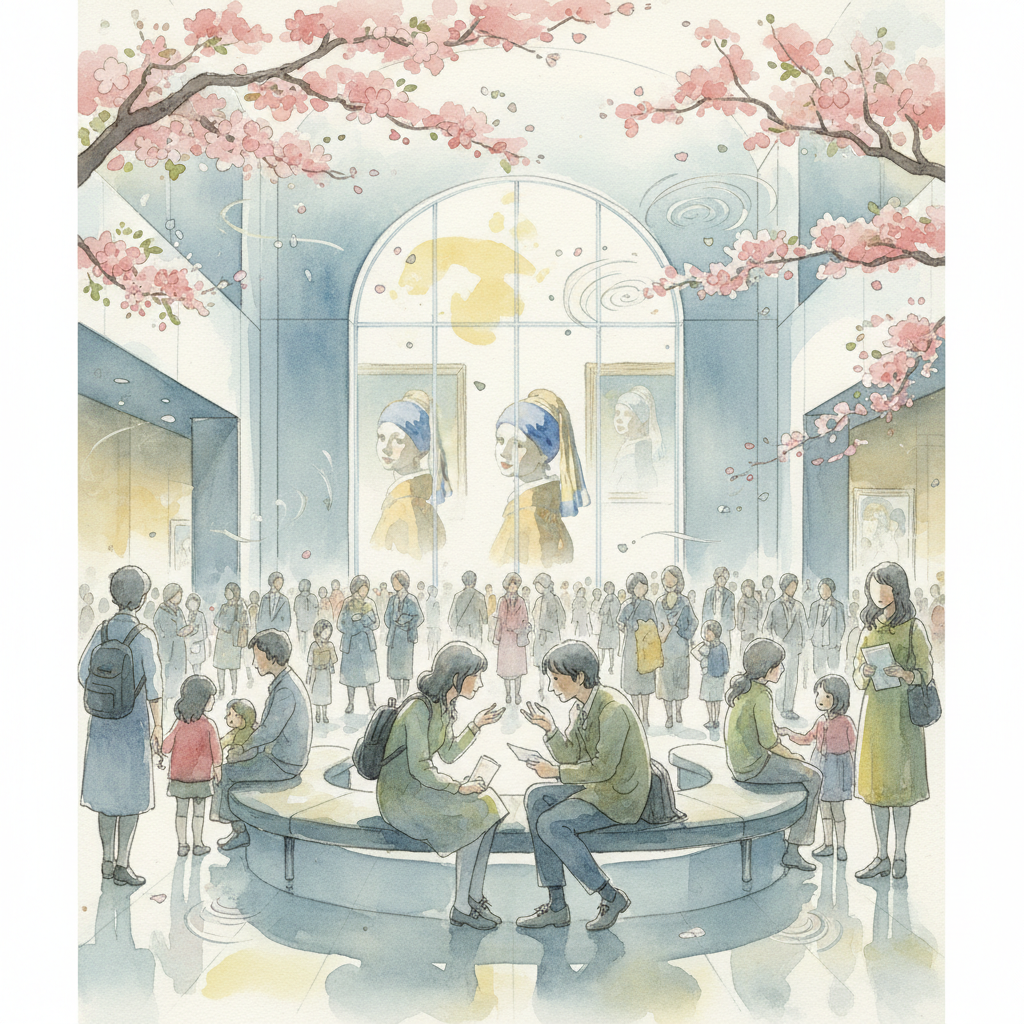
At first glance, Tokyo Notes may seem too cool, too public, or too diffuse to belong beside The Glass Menagerie. The action unfolds in an art museum lobby, not an apartment. Nobody delivers an Amanda Wingfield-style monologue. Nobody keeps a glass collection. And yet this is one of the strongest Japanese companion plays you can choose.
On Seinendan’s official English page, Oriza Hirata explains that the play depicts siblings and relatives gathering while a major war continues elsewhere in Europe, with their immediate concern becoming who will care for their aging parents. That combination is quietly devastating. Public catastrophe hums in the distance; private responsibility sits uncomfortably in the foreground. It is a structure Williams readers will recognize immediately.
What makes the pairing work is not plot resemblance but emotional method. Like Tom and Amanda, Hirata’s characters often speak around what matters. Care, inheritance, career, love, and obligation emerge through fragments rather than declarations. The play trusts the audience to hear the ache inside seemingly casual talk.
For actors, this is a brilliant study in low-temperature intensity. For directors, it offers a chamber-like emotional architecture without requiring melodrama. For readers who love The Glass Menagerie because it understands how families fail one another without ever fully stopping loving one another, Tokyo Notes is essential.
Related reading: Play Spotlight: Tokyo Notes
2) The Dressing Room (楽屋~流れ去るものはやがてなつかしき~, Gakuya) — Kunio Shimizu (清水邦夫)
- Play page: https://gikyokutosyokan.com/posts/208
- Why Glass Menagerie fans connect: memory as stage space, female fragility, illusion, theatrical self-invention
If The Glass Menagerie is a memory play, The Dressing Room asks a stranger question: what if memory never leaves the theater at all?
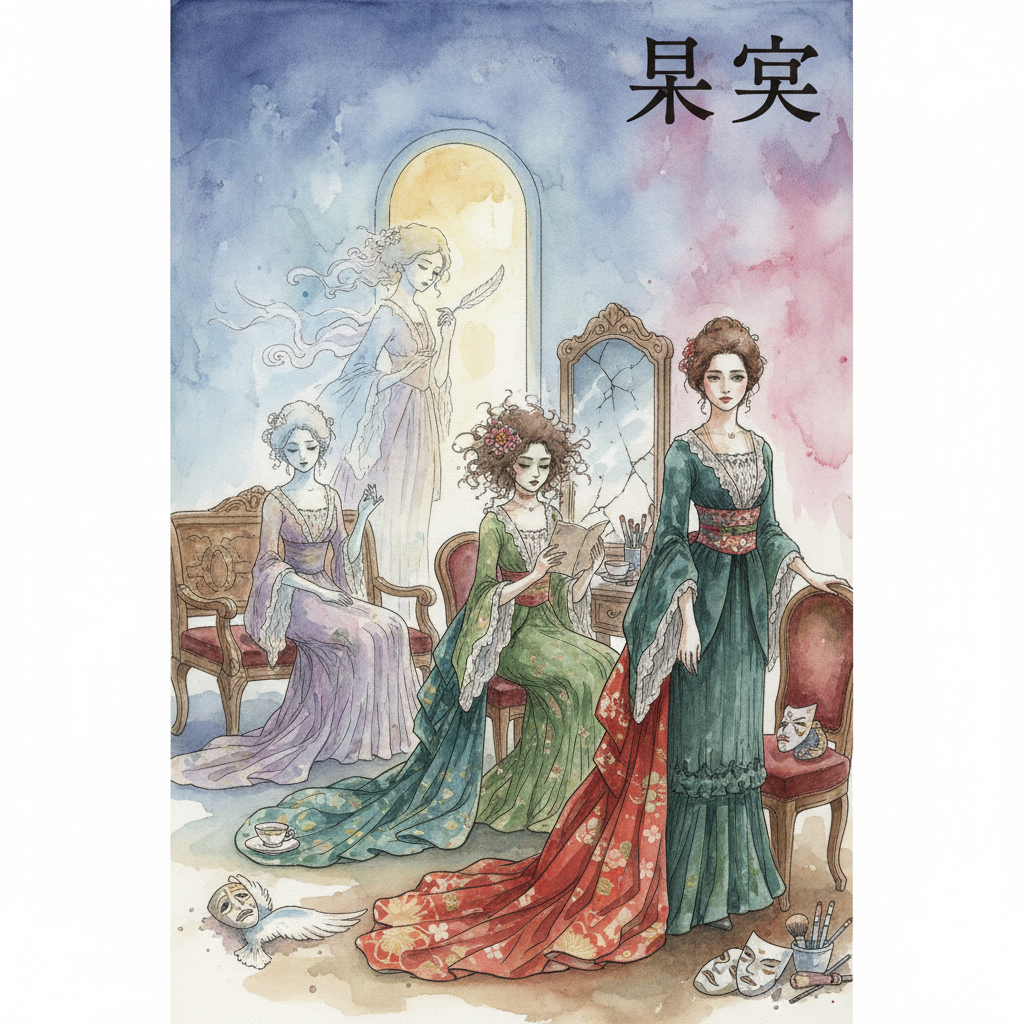
The catalog summary on Japanese Play Library describes a dressing room where four actresses—each tied in different ways to the role of Nina from Chekhov’s The Seagull—exist in unstable relation to performance, desire, and death. Two are already ghosts, still waiting for an entrance that will never come. That premise alone places the play in a world of emotional afterlife, which makes it a remarkable next step for Williams readers.
Laura’s glass animals in The Glass Menagerie are not merely props. They are a system of feeling: delicacy, inwardness, preservation, and the fear of contact. Shimizu reaches a related emotional zone by different means. In The Dressing Room, performance itself becomes the fragile object. Identity is unstable, desire is theatrical, and the women onstage seem to hover between role and self.
This makes the play especially rich for readers drawn to the dream logic of Williams rather than only his family story. If what stays with you from The Glass Menagerie is the sense that memory beautifies and damages at the same time, The Dressing Room extends that paradox into full meta-theater.
For English-speaking companies, it is also a useful bridge text between poetic realism and overt theatrical stylization.
Related reading: The Dressing Room vs Six Characters in Search of an Author
3) Ayumi (あゆみ) — Yukio Shibai (柴幸男)
- Play page: https://gikyokutosyokan.com/posts/85
- Why Glass Menagerie fans connect: life seen as remembered motion, tenderness without sentimentality, ordinary milestones turned theatrical
Japanese Play Library summarizes Ayumi with striking simplicity: it follows an ordinary woman’s life from her first step to her last. That description sounds almost too plain until you realize how closely it echoes one of Williams’s deepest talents—making a modest life feel cosmically exposed.
Where The Glass Menagerie filters the family through Tom’s backward glance, Ayumi turns a lifetime into a theatrical path. The appeal for Williams readers lies in scale. Neither play depends on spectacular plot. Both depend on the audience’s growing awareness that a life can be shaped, limited, and made luminous by the smallest habits, disappointments, and acts of endurance.
There is also an important tonal connection here. The Glass Menagerie is often mislabeled as only tragic, when it is actually full of warmth, embarrassment, humor, repetition, and domestic rhythm. Ayumi can offer a similar breadth. It is not interested in grand declarations alone; it is interested in how a person keeps moving through time.
For classrooms and rehearsal rooms, this makes Ayumi a particularly smart recommendation. It helps English-speaking theater-makers think about biography not as exposition, but as accumulated gesture. If Williams teaches memory as emotional lighting, Ayumi teaches memory as movement.
4) Sea and Parasol (海と日傘, Umi to Higasa) — Masataka Matsuda (松田正隆)
- Play page: https://gikyokutosyokan.com/posts/49
- Why Glass Menagerie fans connect: family weather, unspoken strain, emotional life shaped by place
Masataka Matsuda is one of the great writers of quiet pressure. The Yamaguchi Center for Arts and Media profile emphasizes his gift for using everyday settings and unsparing language to reveal invisible restraints in human life, and notes that Sea and Parasol won the Kishida Kunio Drama Award in 1996. That alone signals the play’s importance.
For Glass Menagerie readers, Matsuda offers something especially valuable: atmosphere without vagueness. His worlds are specific, inhabited, and socially grounded, but they also seem filled with weather—emotional and literal. A title like Sea and Parasol already suggests exposure and attempted shelter, which is part of why it sits so well beside Williams.
Amanda Wingfield lives in a condition of defensive fantasy. Tom lives in a condition of restless escape. Laura lives in a condition of protective retreat. Matsuda’s drama often understands those states without needing to duplicate those characters. Instead, he examines the hidden restraints of everyday life: what people cannot say, what their surroundings keep reminding them of, and how intimacy becomes shaped by class, place, and fatigue.
This is the recommendation for readers who love The Glass Menagerie not because it is “fragile,” but because it is exact about the emotional climate of a household. Sea and Parasol belongs to that same tradition of precision.
5) Girl Mask (少女仮面, Shōjo Kamen) — Jūrō Kara (唐十郎)
- Why Glass Menagerie fans connect: dreamlike subjectivity, femininity as performance, reality sliding into theatrical desire
This is the boldest pick on the list, and maybe the most exciting one.
The Japanese Play Library catalog describes Girl Mask as one of Jūrō Kara’s representative plays, using the idea of the “mask” to expose both a young woman’s interior life and the fictive structure of society. A production page for KUNIO’s staging notes that the play was originally premiered in 1969 and continues to feel urgent now because of its unstable sense of body, identity, and social existence.
Why place it beside The Glass Menagerie? Because both plays understand fragility as performance. Laura’s delicacy is not merely psychological; it is also theatrical, shaped by how others see her and how she retreats from visibility. Girl Mask radicalizes that insight. It moves away from Williams’s domestic realism and into a more fevered, surreal register, but it remains intensely interested in female image, projection, and the unstable border between selfhood and fantasy.
This is the right recommendation for readers who respond most strongly to the lyrical, nonrealistic side of The Glass Menagerie. If Tom’s opening claim—that memory gives truth in the pleasant disguise of illusion—feels like the key to Williams for you, then Kara’s theater may hit with unusual force.
Comparison Table: If You Love This in The Glass Menagerie, Start Here
| If this is what you love in Williams | Start with this Japanese play | Why it fits |
|---|---|---|
| Family pressure expressed indirectly | Tokyo Notes | Quiet dialogue reveals duty, distance, and emotional fatigue |
| Memory and illusion as theatrical form | The Dressing Room | Ghostly backstage space turns recollection into performance |
| A full life made moving through small moments | Ayumi | Everyday milestones become the dramatic engine |
| The emotional climate of a household | Sea and Parasol | Ordinary setting, hidden restraints, and precise atmosphere |
| Dreamlike fragility and identity under pressure | Girl Mask | Poetic subjectivity and performed selfhood drive the play |
Best Use Cases for English-Speaking Theater-Makers
1. Comparative literature or drama classes
Pair The Glass Menagerie with Tokyo Notes to discuss indirect speech, family responsibility, and how modern drama treats everyday conversation as structure.
2. Actor training
Pair Williams with The Dressing Room or Girl Mask to explore how realism shifts into stylization without losing emotional truth.
3. Small-company programming
Use Ayumi or Sea and Parasol when you want intimate Japanese drama that can resonate with audiences already fluent in Williams, Chekhov, or chamber-sized American realism.
4. Translation workshops
These plays are especially useful for discussing what gets lost or gained when tenderness, shame, and avoidance move across languages.
A Short Programming Path for Beginners
If you are new to Japanese drama and coming from The Glass Menagerie, I would recommend this order:
- Start with Tokyo Notes for its accessible realism and family pressure.
- Move to The Dressing Room if you want memory and theatricality.
- Read Ayumi if you care most about lifespan, tenderness, and ordinary time.
- Try Sea and Parasol for atmosphere and adult emotional precision.
- End with Girl Mask when you are ready for a more surreal leap.
That sequence moves from the most quietly recognizable to the most stylistically adventurous.
What Japanese Drama Adds to the Williams Conversation
One reason this crossover is worth doing is that Japanese plays often redistribute emotional emphasis in ways that can refresh how we read Williams. In The Glass Menagerie, the family apartment is the main pressure chamber. In Japanese drama, the pressure may come from family, but it often arrives braided with social ritual, workplace expectation, aging-parent responsibility, or the obligation to maintain surface harmony.
That shift matters in rehearsal. Actors cannot always rely on confrontation to carry the scene. Directors cannot always underline the emotional climax. Instead, the work often depends on listening, pacing, spacing, and the exact moment when avoidance becomes legible as pain. For theater-makers who already know Williams well, that can be liberating. It reveals that fragility onstage does not need to become decorative or passive. It can be structural.
This is why the pairing is more than a reading list. It is a practical way to widen a company’s expressive range while staying inside the emotional territory that makes The Glass Menagerie endure.
FAQ
Q1. What is the closest Japanese equivalent to The Glass Menagerie?
There is no exact equivalent, but Tokyo Notes is probably the best first recommendation if you want family pressure, emotional restraint, and the sadness of ordinary conversation.
Q2. Which recommendation is best if I love Laura’s fragility and inwardness?
Start with The Dressing Room or Girl Mask. Both explore identity, vulnerability, and theatrical selfhood in ways that can speak strongly to Laura-centered readers.
Q3. Which play is best for a realistic production style?
** Tokyo Notes is the clearest choice. Its museum-lobby conversations reward subtle ensemble listening and naturalistic acting.**
Q4. Which play is best for directors who want something poetic but still stageable?
** Ayumi is a strong option because its concept is simple, human, and theatrically flexible, while Sea and Parasol offers an equally strong atmosphere-driven path.**
Q5. Do I need deep knowledge of Japanese theater history before reading these plays?
No. Some cultural context helps, but all five can be approached first through performance, character, rhythm, and emotional structure.
Final Take
If The Glass Menagerie matters to you because it makes fragility feel theatrical rather than decorative, Japanese drama has a great deal to offer. The strongest companion plays are not clones of Tennessee Williams. They are works that understand a similar truth from different angles: memory protects and distorts, families sustain and wound, and delicacy is never just softness—it is a condition of risk.
For English-speaking readers in 2026, these five Japanese plays open a valuable path into a broader repertoire. They deepen, rather than dilute, what The Glass Menagerie already teaches so well.
Sources
- Wikipedia, “The Glass Menagerie” (premiere date, memory-play framing, character overview) — https://en.wikipedia.org/wiki/The_Glass_Menagerie
- Encyclopaedia Britannica, “The Glass Menagerie” (1944 production context and significance) — https://www.britannica.com/topic/The-Glass-Menagerie-play-by-Williams
- Seinendan official English page, “Tokyo Notes” (author statement, synopsis, production history, translation history) — https://www.seinendan.org/eng/play/1994/tokyonotes/
- Yamaguchi Center for Arts and Media, “Masataka MATSUDA” (biographical context and award history for Sea and Parasol) — https://www.ycam.jp/en/archive/profile/masataka-matsuda/
- KUNIO official site, “少女仮面” (1969 premiere note and contemporary production framing) — https://kunio.me/stage/shojokamen/
この記事で紹介した戯曲


Written by
戯曲図書館 編集部
演劇経験者が運営する戯曲検索サービス「戯曲図書館」の編集チームです。 脚本選びのノウハウ、演劇業界の最新情報、公演レポートなどを発信しています。
関連記事
If You Like Long Day's Journey Into Night (2026 Guide): 5 Japanese Plays About Family Secrets, Blame, and the Past That Won't Stay Buried
Love Long Day's Journey Into Night? Read 5 Japanese plays about family secrets, inherited grief, and the quiet violence of a past that refuses to stay buried.
2026-10-02
If You Like True West (2026 Guide): 5 Japanese Plays About Brothers, Masculinity, and the Myth You Can't Outrun
Love Sam Shepard's True West? Read 5 Japanese plays about brothers, inherited violence, failed masculinity, and the self you cannot shake off — from Matsuo Suzuki to Yu Miri.
2026-10-09
If You Like The Crucible (2026 Guide): 4 Japanese Plays About Scapegoats, Panic, and Public Obedience
Love The Crucible? Read 4 Japanese plays about fear, scapegoats, conformity, and the cost of refusing the crowd.
2026-08-21
Play Spotlight 2026: Henro (偏路) by Yukiko Motoya
A 2026 English spotlight on Henro, Yukiko Motoya's darkly comic family play about failed ambition, unwanted kindness, and going home.
2026-08-17