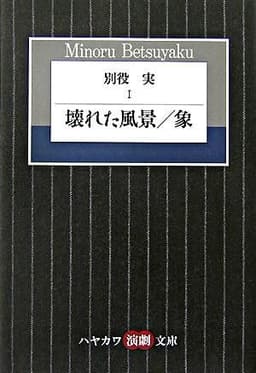
Betsuyaku Minoru’s Zō (象, The Elephant) and Eugène Ionesco’s Rhinoceros are absurdist plays about what a society chooses to normalize when moral shock starts wearing off.
That shared question makes them an unusually strong pairing in 2026. Both plays begin with something that should be impossible to absorb into ordinary life. In Ionesco, townspeople literally turn into rhinoceroses. In Betsuyaku, a hibakusha survivor’s scar becomes a public object that others learn to tolerate, manage, or ignore. In both cases, the real subject is not the bizarre image itself. It is the social behavior that forms around it.
For English-speaking readers, directors, dramaturgs, and teachers, this comparison is especially useful because it puts a famous European absurdist classic beside one of the sharpest postwar Japanese dramas. If you already know Rhinoceros, Zō becomes easier to place. If you start from Zō, Rhinoceros can look less like a general anti-conformity allegory and more like a play about the terrifying speed with which the abnormal becomes communal common sense.
Quick Facts
| Item | Zō (象, The Elephant) | Rhinoceros |
|---|---|---|
| Playwright | Betsuyaku Minoru (別役実) | Eugène Ionesco |
| First production / publication context | First staged in 1962 | First produced and published in 1959 |
| Core dramatic image | A hibakusha survivor publicly displaying an atomic-bomb keloid scar | Townspeople gradually transforming into rhinoceroses |
| Main social pressure | Witness fatigue, polite exclusion, pressure to suffer quietly | Herd conformity, ideological contagion, collapse of individuality |
| Typical cast profile | About 10 actors in source data | Medium ensemble, often 10–14 actors depending on cuts |
| Best production fit | Black box, actor-centered, rhythmically precise ensemble work | Flexible ensemble staging, anti-naturalist or expressionist design |
| Best for | Memory studies, postwar drama, ethics of spectatorship | Absurdism, conformity, political allegory, group psychology |
| Why they matter together | Both expose how societies adapt to the morally intolerable | Both turn absurdity into a diagnostic tool for modern collective behavior |
Why This Pairing Works
At first glance, the two plays do not seem to belong together neatly.
- Rhinoceros is a globally canonical absurdist drama, often taught as a warning about fascism, mass ideology, and conformity.
- Zō is a Japanese postwar play grounded in the afterlife of Hiroshima and the social marginalization of hibakusha.
But the pairing becomes powerful once you see their common engine:
- an image that should interrupt normal life,
- a community that quickly develops coping language around it,
- a protagonist or witness figure pressured to adjust,
- and a final ethical question about whether resistance is still possible.
The biggest difference is where each play places its crisis.
- In Rhinoceros, the crisis is conversion: people become part of the herd.
- In Zō, the crisis is accommodation: people learn how to live beside visible suffering without really facing it.
That distinction matters. Ionesco shows the violence of joining the crowd. Betsuyaku shows the violence of learning to call avoidance maturity.
1) Absurdism as Social Diagnosis, Not Decorative Weirdness
One reason this comparison is so productive is that it rescues both plays from a shallow understanding of “absurd theater.”
In Rhinoceros, absurdity is obvious. A rhinoceros charges through a provincial town. Then more appear. Then it becomes clear that the rhinoceroses are the townspeople themselves. The theatrical image is large, comic, grotesque, and immediately legible.
In Zō, absurdity is quieter. The impossible thing is not that an animal appears. It is that a society can look directly at catastrophic human pain and still reorganize daily life around emotional convenience. The absurdity is social before it is visual.
This gives the plays different theatrical temperatures:
| Absurdist pressure | Zō | Rhinoceros |
|---|---|---|
| Surface tone | Muted, dry, ethically uneasy | Escalating, comic-grotesque, panic-driven |
| Core fear | Being tolerated into silence | Being absorbed into the herd |
| Absurd image function | Reveals normalized historical avoidance | Reveals contagious collective transformation |
| Audience effect | Complicity through recognition | Complicity through alarm and laughter |
This is why the pairing works well in classrooms and rehearsal rooms. It shows that absurdism is not one style. It is a family of strategies for showing people adapting to impossible realities.
2) The Body on Stage: Scar vs Horn
The strongest contrast between the plays may be bodily.
In Rhinoceros, the body transforms outward. Jean’s change becomes one of the play’s most famous sequences: voice, skin, aggression, and species identity all shift in front of us. The body becomes the visible record of ideological surrender.
In Zō, the body does not transform into something new. It remains marked by history. The keloid scar is not a magical metamorphosis but a wound that society keeps trying to relocate—first into pity, then into etiquette, then into inconvenience.
That difference changes the politics of spectatorship.
In Rhinoceros
The question is: Will you become like them?
In Zō
The question is: What do you do when someone else’s wound remains visible longer than your sympathy does?
That is why Betsuyaku’s play feels so bracing even now. It does not allow the audience to imagine that the problem is only extremist conversion. It asks about a more ordinary moral failure: the failure to keep witnessing once witnessing becomes tiring.
For directors, this is a major practical distinction.
- Rhinoceros often needs a clear physical vocabulary of transformation.
- Zō needs a clear social vocabulary of looking, turning away, softening speech, and translating discomfort into “reasonableness.”
In other words:
- Ionesco externalizes danger through changing bodies.
- Betsuyaku externalizes danger through changing responses to the same body.
3) Conformity Works Differently in Each Play
It is tempting to describe both plays simply as critiques of conformity. That is true, but incomplete.
Rhinoceros: conformity as stampede
Ionesco’s play is one of the clearest dramatic accounts of herd logic in modern theater. At first people debate details—one horn or two? Asian or African rhinoceros?—as if precision might help them avoid the larger truth. Soon the debate becomes less important than the growing fact of conversion. More and more characters decide, rationalize, or drift into becoming rhinoceroses.
The play is often read in relation to fascism, totalitarianism, and ideological contagion, and that reading remains valid because the logic is so brutally clear: the group acquires momentum, and moral hesitation starts to look embarrassing or weak.
Zō: conformity as emotional management
Betsuyaku’s play is more intimate and, in some ways, colder. No herd rushes visibly across the stage. Instead, social pressure appears as advice, patience, exhaustion, and pragmatic language. The nephew’s argument in New National Theatre Tokyo’s synopsis is especially revealing: people no longer hate hibakusha, but they do not love them either; therefore survivors should bear pain quietly.
That is a terrifying sentence because it disguises exclusion as civility.
Side-by-side comparison
| Conformity question | Zō | Rhinoceros |
|---|---|---|
| What must the individual do? | Stop making suffering publicly demanding | Join or at least accept the herd logic |
| Social tone | Polite, weary, plausibly humane | Volatile, comic, increasingly militant |
| Mechanism | Normalization and witness fatigue | Mass contagion and ideological seduction |
| Moral danger | Quietly abandoning responsibility | Openly celebrating dehumanizing sameness |
This is one reason the pairing feels so alive in 2026. Ionesco helps us think about overt group radicalization. Betsuyaku helps us think about softer systems: the social demand not to make history too visible, too painful, or too inconvenient.
4) Language: Debate, Deflection, and the Manufacture of Normality
Both playwrights care deeply about language, but they deploy it in different ways.
Ionesco’s language world
In Rhinoceros, language often becomes absurd through over-explanation, pseudo-logic, and rationalization. The townspeople debate irrelevant taxonomy while the obvious crisis grows. This is one of the play’s central jokes and one of its deepest warnings: people use logic not only to clarify reality, but to delay recognition of reality.
Betsuyaku’s language world
In Zō, the speech is plainer and more deceptive. Betsuyaku’s dialogue often sounds almost modest. But its real function is evasive. People reframe ethical discomfort as practicality. They soften what they mean. They redirect. They normalize. The violence lives inside understatement.
This makes Zō especially difficult to translate and stage well. If the dialogue becomes too literary, it loses social plausibility. If it becomes too flat, it loses menace.
Comparative takeaway
| Language pattern | Zō | Rhinoceros |
|---|---|---|
| Main verbal strategy | Indirectness, deflection, socially acceptable avoidance | Argument, circular logic, comic rationalization |
| Threat emerges through | The calm tone of exclusion | The escalating absurdity of public reasoning |
| Biggest rehearsal risk | Underplaying the ethical violence | Playing the comedy without the political stakes |
For audiences, both plays ask a sharp question:
At what point does speech stop describing reality and start protecting us from it?
That question travels extremely well across cultures.
5) History Matters: Post-Hiroshima Japan vs Postwar European Ideological Crisis
A strong comparison should not flatten historical difference.
Zō and postwar Japan
According to Performing Arts Network Japan, Betsuyaku was one of the foundational figures of Japanese absurd drama, and Zō (1962) was among his breakthrough works. What makes Zō especially important is that it does not stage the bomb as spectacle. It stages the social afterlife of the bomb: who is seen, who is tolerated, who is asked to disappear into decorum.
That is historically specific. The hibakusha are not a generic symbol of trauma. They belong to a Japanese political and social history in which visible survival could bring pity, discomfort, discrimination, and instrumentalized memory all at once.
Rhinoceros and twentieth-century Europe
EBSCO’s overview of Rhinoceros captures the basic structure well: a provincial town where people gradually transform into rhinoceroses, leaving Bérenger to resist alone. Historically, the play has long been associated with anti-fascist and anti-totalitarian concerns, though it also works more broadly as a study of conformity and the absurd pressure of collective belief.
Why the difference matters
If you erase history, both plays shrink into the same abstract anti-conformity lesson. That would be a mistake.
- Rhinoceros asks what happens when ideology becomes species-like collective force.
- Zō asks what happens when catastrophic history remains in the room but everyday society wants emotional closure on its own schedule.
One is about joining the beast. The other is about learning how to live beside the wound without letting it interrupt normality too much.
6) Staging the Crowd vs Staging the Gaze
For theater-makers, this pairing is not just interpretive. It is practical.
Staging Rhinoceros
The central challenge is scale and accumulation. Even in minimalist productions, the audience must feel the growing pressure of rhinocerization. The world should seem to tip, step by step, until Bérenger’s isolation becomes both ridiculous and heroic.
Useful staging tools include:
- escalating sound design,
- vocal score shifts,
- costume or body-language mutation,
- and increasingly unstable group rhythm.
Staging Zō
The central challenge is not transformation but attention. Who looks? For how long? With what emotional register? When does concern become fatigue? When does listening become performance? When does silence become policy?
Useful staging tools include:
- highly controlled pause work,
- spatial distance around the marked body,
- repetition that becomes socially unbearable,
- and careful management of audience discomfort.
Side-by-side production guide
| Production need | Better first choice |
|---|---|
| Teaching absurdist transformation and group contagion | Rhinoceros |
| Teaching witness politics and the social life of trauma | Zō |
| Strong anti-naturalist visual design | Rhinoceros |
| Quiet, actor-centered ethical pressure | Zō |
| Intro course on absurdism | Rhinoceros |
| Advanced comparative postwar drama seminar | Zō + Rhinoceros together |
A repertory pairing would be especially rich. Rhinoceros can show the loud violence of collective conversion. Zō can show the quieter violence that follows once a society learns to call its avoidance balance.
7) Endings and the Ethics of Resistance
Both plays move toward resistance, but they define that resistance differently.
Bérenger in Rhinoceros
By the end, Bérenger becomes the last human standing. His refusal is dramatic, isolated, and openly declarative. He resists because surrender would mean loss of self. The ending is lonely but theatrically forceful.
The pressure of endurance in Zō
Zō is harsher in a different way. The problem is not only whether one person resists. It is whether society allows certain pain to remain publicly meaningful at all. The play offers less triumphant resistance because its enemy is not just ideology. It is normalization.
That is a harder enemy to fight onstage and off. A stampede can be named. Polite historical exhaustion is slipperier.
This gives us a useful final contrast:
| Ending question | Zō | Rhinoceros |
|---|---|---|
| What must be resisted? | Social pressure to privatize pain | Social pressure to join the herd |
| Tone of resistance | Fraught, unstable, ethically unresolved | Defiant, lonely, existentially clear |
| Audience aftereffect | Uneasy self-recognition | Alarmed admiration for refusal |
If Rhinoceros ends with “do not become them,” Zō ends closer to “do not call your withdrawal maturity.”
8) How to Use This Pairing in Teaching, Programming, and Rehearsal
In a world drama course
Read Rhinoceros first as the more globally familiar absurdist gateway, then move to Zō to complicate what absurdism can do historically and ethically.
In a rehearsal lab
Use Rhinoceros to explore group rhythm, escalation, and anti-naturalist transformation. Use Zō to explore pause, indirect speech, and the politics of looking.
In a festival or reading series
Program them around a shared frame such as:
- absurdism after war,
- theater and conformity,
- or how societies normalize the intolerable.
In dramaturgy packets
Ask audiences to track three things:
- when the impossible first appears,
- how the group begins explaining it,
- and what kind of person gets pressured to adjust.
That simple structure makes both plays more legible without reducing them.
Related Reading on Japanese Play Library
Play pages
Related English articles
- Play Spotlight: Zō (象) / The Elephant by Betsuyaku Minoru
- If You Like Waiting for Godot, Try These 5 Japanese Plays
FAQ
Is Zō basically Japan’s Rhinoceros?
No. The comparison is useful because both are absurdist plays about social normalization, but their historical stakes are different. Rhinoceros focuses on herd conformity and ideological conversion. Zō focuses on postwar witness fatigue, hibakusha marginalization, and the pressure to make visible suffering socially quiet.
Which play is easier for first-time readers?
Rhinoceros is usually easier at first because its central metaphor is immediate and theatrical. Zō often becomes more powerful after some historical framing.
Which play is better for acting training?
Both are excellent, but for different reasons. Rhinoceros is great for ensemble escalation, physical transformation, and tonal control. Zō is better for subtext, pause, indirect speech, and ethically charged listening.
Are they both “Theatre of the Absurd”?
Yes, but in different ways. Rhinoceros is one of the classic European absurdist texts. Zō belongs to the development of Japanese absurd drama and adapts absurdist pressure to a specifically postwar Japanese social reality.
Why pair them in 2026?
Because contemporary audiences need both warnings. We need plays about overt mass conformity, and we need plays about quieter forms of moral withdrawal that present themselves as maturity, balance, or emotional practicality.
Final Takeaway
Both Zō and Rhinoceros ask what a community becomes when the unacceptable starts to feel ordinary, but Ionesco stages the terror of joining the herd while Betsuyaku stages the terror of learning not to look too long at another person’s wound.
That is why the pairing still feels urgent. Rhinoceros remains one of the great anti-conformity plays. Zō remains one of the great plays about the politics of witness fatigue. Read together, they make each other sharper.
One warns that the crowd can become monstrous very quickly.
The other warns that monstrosity can also sound patient, civilized, and tired.
Sources
- New National Theatre, Tokyo, The Elephant (Zou) — synopsis, hibakusha framing, 1962 premiere context, and revival notes.
https://www.nntt.jac.go.jp/english/play/e20000633_play.html - Performing Arts Network Japan, “Minoru Betsuyaku” — career overview, Zo (The Elephant, 1962), and Betsuyaku’s place in Japanese absurd drama.
https://performingarts.jpf.go.jp/en/article/6909/ - EBSCO Research Starters, “Rhinoceros by Eugène Ionesco” — plot overview, principal characters, production context, and conformity themes.
https://www.ebsco.com/research-starters/literature-and-writing/rhinoceros-eugene-ionesco - StageAgent, Rhinoceros (Play) Plot & Characters — synopsis and production-oriented summary.
https://stageagent.com/shows/play/1944/rhinoceros - Japanese Play Library, Play Spotlight: Zō (象) / The Elephant by Betsuyaku Minoru — internal comparative and staging context.
https://gikyokutosyokan.com/blog/en/guide-play-spotlight-zou-the-elephant
この記事で紹介した戯曲

Written by
戯曲図書館 編集部
演劇経験者が運営する戯曲検索サービス「戯曲図書館」の編集チームです。 脚本選びのノウハウ、演劇業界の最新情報、公演レポートなどを発信しています。
関連記事
Shintoku-maru vs Oedipus Rex: A 2026 Guide to Fate, Family, and the Body on Stage
Compare Shuji Terayama's Shintoku-maru (身毒丸) and Sophocles' Oedipus Rex as plays about prophecy, incest, mother-figures, and the suffering body — with staging notes for English-speaking theater-makers.
2026-10-04
Five Days in March vs Angels in America: A 2026 Guide to Political Theater, Sex, and the End of the World
Compare Toshiki Okada's Five Days in March and Tony Kushner's Angels in America as generational political plays about apocalypse, apathy, and intimacy under history.
2026-09-27
Tomodachi vs No Exit: A 2026 Guide to Friendly Invasion, Hellish Rooms, and the Violence of Other People
Compare Tomodachi and No Exit through confinement, coercion, group pressure, and the politics of being trapped with others.
2026-08-30
History of the Rise and Fall of Japanese Literature vs Arcadia: A 2026 Guide to Literature, Time, and National Imagination
Compare Oriza Hirata's History of the Rise and Fall of Japanese Literature with Arcadia through time, authorship, and modernity.
2026-08-16